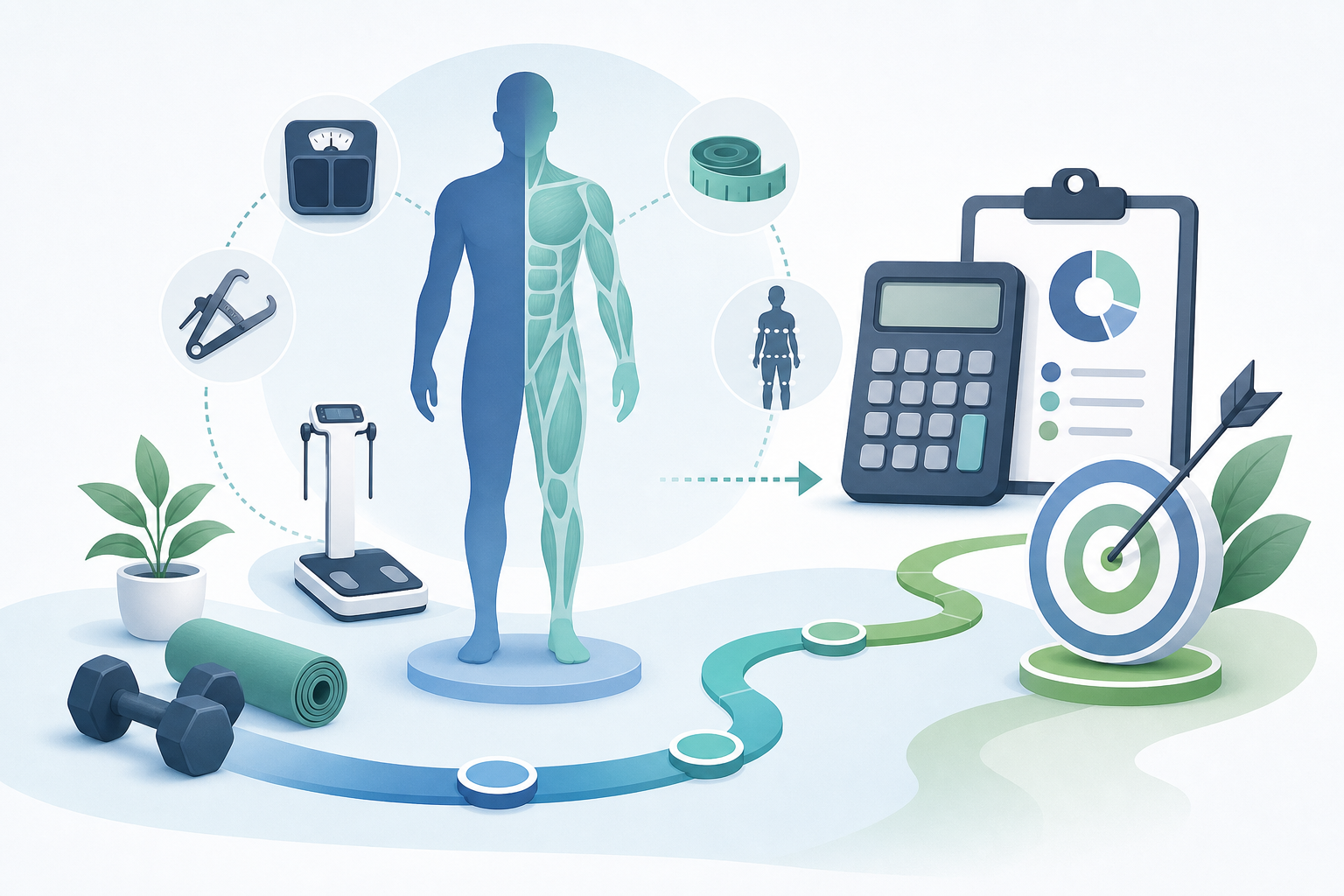
How is lean body mass estimated? Most calculators use an equation based on body weight, height and sex, or subtract estimated fat mass from total body weight. The result is an approximation of the weight of muscle, bone, organs, water and other non-fat tissues. It is not a direct measurement of muscle or a complete assessment of body composition.
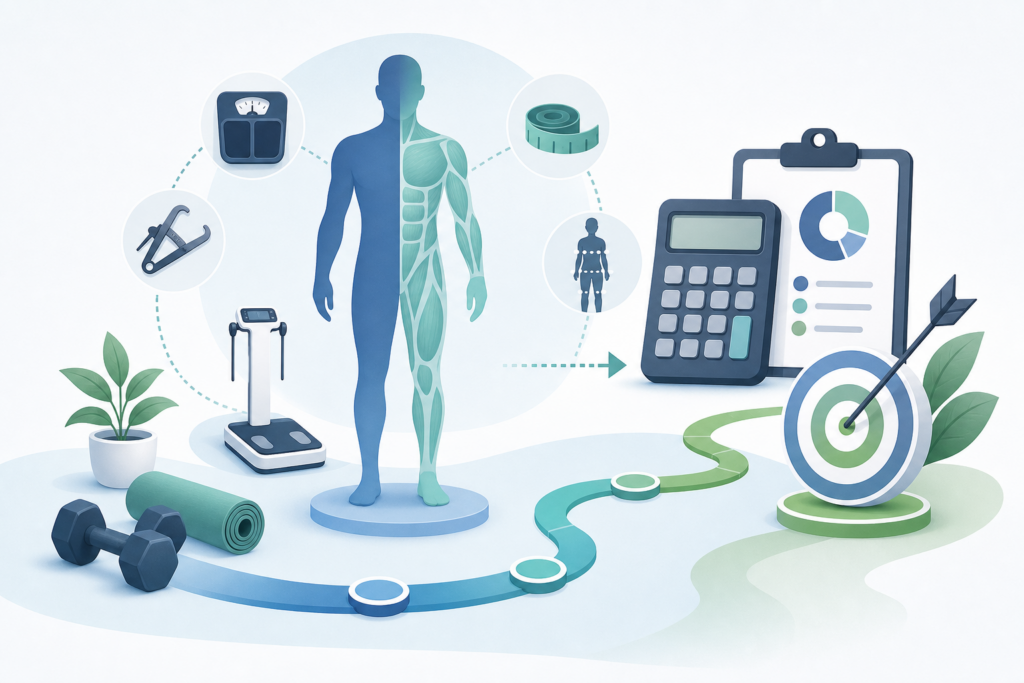
How is lean body mass estimated using different methods?
Lean body mass can be estimated in two main ways. The first uses a population-based equation developed from measurements collected in a group of people. The second starts with a body-fat percentage and calculates the remaining fat-free portion of body weight.
- Equation-based estimate: Height, weight and sex are entered into a formula such as the Boer equation.
- Body-fat-derived estimate: Estimated fat mass is subtracted from total body weight.
- Instrument-based assessment: Methods such as dual-energy X-ray absorptiometry or bioelectrical impedance estimate different body components using scans or electrical properties.
None of these approaches involves physically separating and weighing body tissues. Even instrument-based assessments rely on models and assumptions, although they may provide more individual information than a basic height-and-weight equation.
What does lean body mass include?
Lean body mass is body weight minus fat mass. It includes skeletal muscle, body water, bones, organs, connective tissue and other non-fat components.
This means lean mass should not be interpreted as muscle mass alone. For example, a change in estimated lean body mass could reflect a change in body water rather than a change in muscle tissue.
The terms lean body mass and fat free mass are often used interchangeably in consumer calculators. In some technical contexts, they may be defined slightly differently because certain essential lipids can be counted within lean tissue. For general equation-based estimates, both terms usually refer to the non-fat portion of body weight.
How the lean body mass calculator produces an estimate
The lean body mass calculator uses the Boer equations. These equations require body weight in kilograms and height in centimetres, along with the applicable male or female equation.
For males:
Estimated lean body mass in kg = 0.407 × weight in kg + 0.267 × height in cm − 19.2
For females:
Estimated lean body mass in kg = 0.252 × weight in kg + 0.473 × height in cm − 48.3
If measurements are entered in another unit system, they must be converted before the formula is applied. The calculator handles the required unit conversion where relevant.
Worked example
Consider a male who weighs 80 kg and is 175 cm tall. The Boer equation gives:
0.407 × 80 + 0.267 × 175 − 19.2 = 60.085 kg
The estimated lean body mass is therefore about 60.1 kg. Estimated fat mass would be approximately 19.9 kg because total weight minus estimated lean mass is 80 − 60.1 kg.
This does not establish that the person has exactly 60.1 kg of non-fat tissue. It shows the value predicted by the equation for those inputs.
Estimating lean mass from body-fat percentage
If a body-fat percentage is available, lean body mass can be calculated with a different formula:
Estimated lean body mass = body weight × (1 − body-fat percentage as a decimal)
For example, a person weighing 80 kg with an estimated body-fat percentage of 25% would have:
80 × (1 − 0.25) = 60 kg of estimated lean body mass
This method appears straightforward, but its accuracy depends heavily on the body-fat estimate. If the percentage comes from skinfold measurements, a smart scale or another indirect method, any error in that percentage carries into the lean mass result.
Body-fat-derived and equation-based estimates can therefore produce different answers for the same person. Agreement between them does not prove that either result is exact; it only shows that their assumptions produced similar values.
Why indirect lean mass estimates have limits
The Boer equations describe average relationships observed in a population. An individual may differ from those average relationships because height and weight do not show how body mass is distributed.
Equation-based results may be less representative for people at body-size extremes or those with unusually high muscularity. Two people with the same height, weight and equation category can have different amounts of fat, muscle, bone and body water while receiving the same calculated result.
Other important limitations include:
- Hydration is not assessed: Water is part of lean body mass, but the equation cannot identify short-term fluid changes.
- Muscle is not isolated: The result combines muscle with all other non-fat tissues.
- Body-fat distribution is unknown: Height and weight do not show where fat or lean tissue is located.
- Individual physiology is simplified: The male and female equations are fixed statistical models and do not capture every variation in body composition.
- Small changes may be misleading: Changes in scale weight, measurement technique or hydration can affect calculated or instrument-derived results.
Instrument-based assessments also have limitations. Results can vary with the device, testing conditions, calibration and the model used to interpret the measurement. When precision matters, an equation result may be compared with an appropriate body-composition assessment rather than treated as a measured value.
What the lean body mass calculator can and cannot tell you
What it can tell you
- An estimated lean body mass based on the Boer equation.
- The approximate non-fat portion of body weight predicted from height, weight and sex.
- A consistent value that may help with broad comparisons when the same method and input conditions are used over time.
- A starting estimate for calculations that use lean mass, provided their own limitations are also considered.
What it cannot tell you
- Your directly measured fat free mass.
- How much of the result is skeletal muscle, bone, water or organ tissue.
- Your exact body-fat percentage or fat distribution.
- Whether a change in the estimate represents muscle gain or loss.
- Whether a particular body weight or body composition is appropriate for your health.
For trend comparisons, use the same calculation method each time. Switching between the Boer equation, a smart scale and a scan may create apparent changes that reflect different methods rather than actual tissue change.
Frequently asked questions
Is lean body mass the same as muscle mass?
No. Muscle is one part of lean body mass, but lean mass also includes water, bones, organs and other non-fat tissues. A lean body mass calculator cannot separate these components.
Is lean body mass measured or calculated?
In this calculator, it is calculated from height, weight and sex. Weight and height may be measured inputs, but the lean body mass result is an equation-based estimate rather than a direct measurement.
Why does my smart scale give a different result?
A smart scale generally uses bioelectrical impedance and its own prediction model, while the calculator uses the Boer equation. Hydration, recent food or drink, device design and different model assumptions can contribute to differing results.
Can lean body mass change without muscle changing?
Yes. Lean body mass includes water and other non-fat tissues, so changes in hydration can alter body-composition estimates without representing an equivalent change in muscle. This is one reason short-term differences should be interpreted cautiously.
Which estimate should I use for tracking?
A consistent method is generally easier to interpret than repeatedly changing methods. Record which method you used and avoid treating small differences as confirmed tissue changes. If an accurate body-composition assessment is important for a clinical or specialist purpose, an appropriate professionally administered method may provide more useful information.
In summary, the answer to how is lean body mass estimated depends on the available inputs. The Boer equation predicts it from height, weight and sex, while a body-fat-derived calculation subtracts estimated fat mass from total weight. Both provide approximations, and neither should be interpreted as an exact measurement of muscle or other individual tissues.