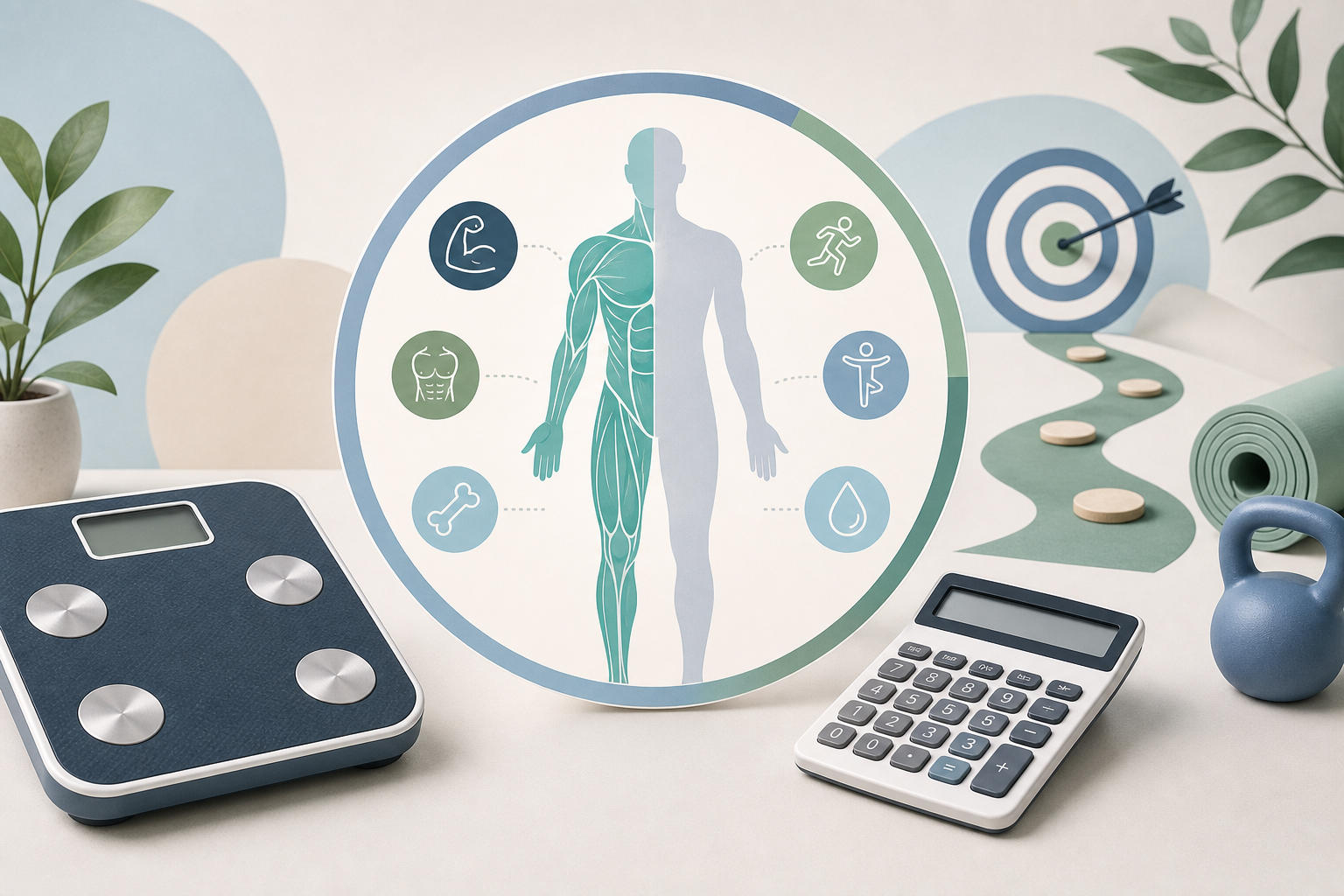
What is lean body mass? Lean body mass is your total body weight minus fat mass. It includes skeletal muscle, bones, organs, body water and other non-fat tissues. A lean body mass calculator estimates this amount from basic measurements, but it does not directly measure body composition.
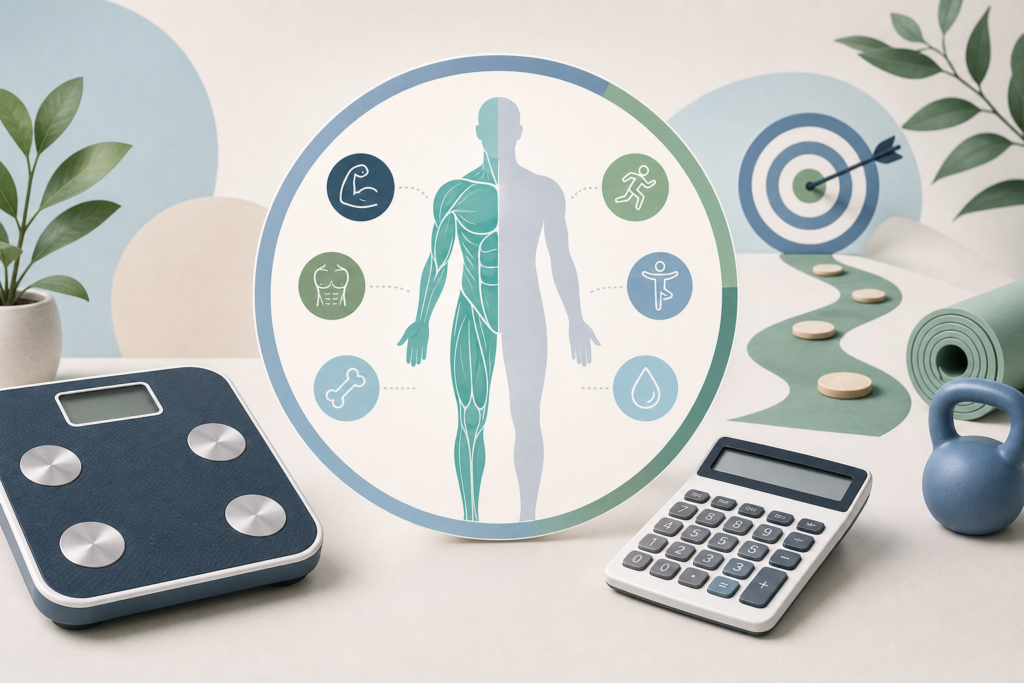
What is lean body mass and what does it include?
Lean body mass describes the combined weight of the body’s non-fat components. For example, if a person weighs 80 kg and has an estimated 20 kg of fat mass, their estimated lean body mass is 60 kg.
Lean body mass includes:
- Skeletal muscle
- Bones and connective tissues
- Internal organs
- Blood and other body fluids
- Water stored inside and outside cells
- Skin and other non-fat tissues
This broad definition is important because lean mass is not simply another term for muscle. Muscle is one component, but organs, water and bone also contribute substantially to the result.
Lean body mass is usually expressed in kilograms or pounds. It may also be considered as a percentage of total body weight, although an equation-based calculator generally reports an estimated mass rather than a measured percentage.
Lean body mass, fat-free mass and muscle mass
The terms lean body mass and fat free mass are often used interchangeably in general body-composition tools. In this context, both mean body weight after estimated fat mass has been removed.
Definitions can vary slightly between research methods and body-composition devices. For practical use, it is best to check how a particular calculator, scan or report defines its result rather than assuming every method measures exactly the same tissues.
| Term | What it generally describes | What it does not mean |
|---|---|---|
| Lean body mass | Muscle, bone, organs, water and other non-fat tissues | Muscle alone |
| Fat-free mass | Total body mass excluding fat mass | Total body weight |
| Muscle mass | The body’s muscle tissue | All lean tissues combined |
| Fat mass | The estimated weight of body fat | Body-fat percentage itself |
Because lean body mass contains a large amount of water, a change in lean mass does not automatically represent a change in muscle. Hydration, stored carbohydrate and the contents of the digestive system can affect measured or inferred body-composition values.
How the lean body mass calculator estimates your result
The calculator uses the Boer equations. These are population-based formulas that estimate lean body mass from weight, height and the sex option selected in the tool.
| Equation | Formula |
|---|---|
| Male | Lean body mass = 0.407 × weight + 0.267 × height − 19.2 |
| Female | Lean body mass = 0.252 × weight + 0.473 × height − 48.3 |
For these formulas, weight is entered in kilograms and height in centimetres. If the calculator offers another unit system, it can convert the measurements before applying the equation.
How to enter your information
- Choose the unit system requested by the tool.
- Enter your current height and weight.
- Select the relevant sex option used by the equation.
- Select Calculate to view the estimated lean body mass.
- Check the units and read the limitations before using the result.
The answer is an equation-based estimate. It is not a measurement of your individual muscle, bone, organ or water mass.
Practical example and interpretation
Consider a male who weighs 80 kg and is 175 cm tall. Using the male Boer equation:
Estimated lean body mass = (0.407 × 80) + (0.267 × 175) − 19.2
The result is approximately 60.1 kg. This means the equation estimates that about 60.1 kg of the person’s total weight consists of muscle, bone, organs, water and other non-fat tissues.
Subtracting that estimate from total weight gives an implied fat mass of approximately 19.9 kg:
80 kg − 60.1 kg = 19.9 kg
These figures should not be interpreted as measured tissue amounts. Another person with the same height and weight could have a different body composition because the equation cannot account for individual differences in muscularity, bone structure, fat distribution or hydration.
Comparing results over time
A lean mass estimate can provide context when tracking body weight, but comparisons need consistent inputs. Use measurements taken under similar conditions and avoid treating a small difference as definite tissue gain or loss.
The Boer equation uses weight, height and sex rather than directly assessing body tissues. If body weight changes, the estimate will also change even though the formula cannot identify whether that change came from muscle, fat, water or another source.
What the calculator can and cannot tell you
What it can tell you
- An approximate lean body mass based on the Boer equation
- The amount of total weight estimated to come from non-fat tissues
- A consistent equation-based figure that may help provide context for weight or body-composition records
- An implied fat mass when the lean estimate is subtracted from total body weight
What it cannot tell you
- Your directly measured muscle mass
- How much of the result is water, bone, organs or muscle
- Where fat or muscle is located in the body
- Whether a recent weight change came from fat, muscle, fluid or digestive contents
- Your fitness, strength, health status or nutritional needs
- Whether a particular body-composition value is appropriate for you
The estimate may be less accurate for people at body-size extremes or those whose muscularity differs substantially from the populations represented by the equation. When precision is important, an equation should be compared with an appropriate direct body-composition assessment rather than treated as a measured value.
Common questions about lean mass
Is lean body mass the same as muscle mass?
No. Muscle is part of lean body mass, but lean body mass also includes water, bones, organs, blood and other non-fat tissues. A lean mass result therefore cannot be read as the number of kilograms or pounds of muscle you have.
Does body water count as lean body mass?
Yes. Water is included in lean body mass. This is one reason hydration and fluid shifts can influence some body-composition readings, particularly methods that use the body’s electrical properties.
Can lean body mass change while body weight stays the same?
It can. Different body components may change in opposite directions while total weight remains similar. However, an equation that uses only height, weight and sex will not detect such changes if the entered height and weight remain the same.
Can I calculate fat mass from estimated lean body mass?
You can derive an approximate value by subtracting estimated lean body mass from total weight. For example, a body weight of 70 kg and an estimated lean body mass of 52 kg implies about 18 kg of fat mass. The accuracy of the derived value depends on the accuracy of the original lean mass estimate.
Why might the calculator differ from a body-composition device?
Different methods use different assumptions and inputs. The Boer equation relies on height, weight and sex, while body-composition devices may also use electrical impedance, X-rays or other measurement techniques. Hydration and testing conditions can affect some device readings, so results from different methods are not always directly comparable.
Is a higher lean body mass always better?
Not necessarily. Lean body mass varies with height, body size, age, sex, muscularity and other individual characteristics. A single number does not determine health, physical ability or the suitability of a weight-management plan.
Putting what is lean body mass into context
Understanding what is lean body mass helps prevent a common mistake: interpreting lean mass as muscle alone. It is the combined mass of muscle, bone, organs, water and other non-fat tissues.
A lean body mass calculator provides a convenient estimate rather than a direct measurement. It is most useful when its formula, units and limitations are understood, and when results from different methods are not treated as interchangeable.