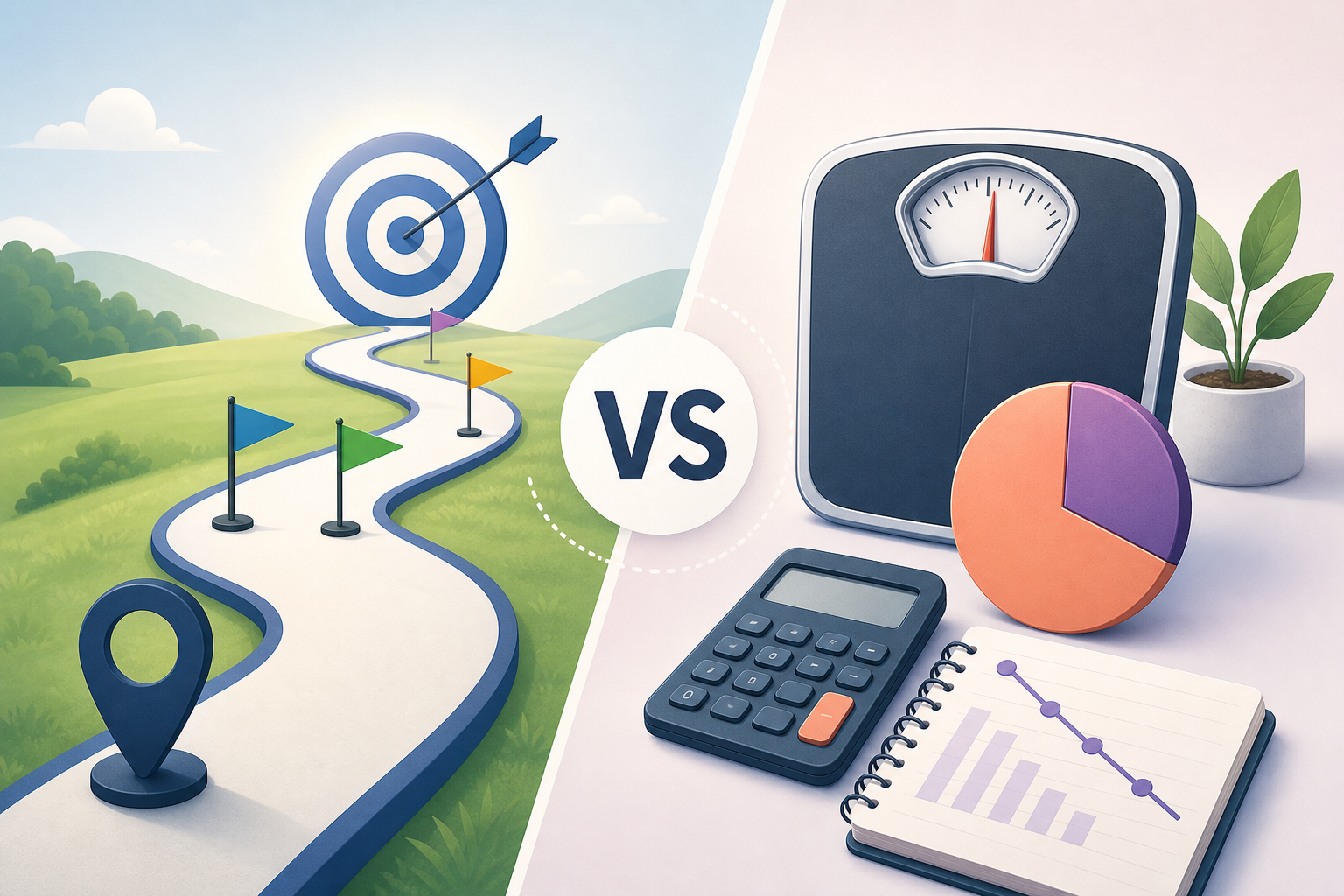
The question “goal progress vs weight loss percentage whats the difference” comes down to the denominator used. Goal progress measures how much of a specific target has been completed, while weight loss percentage measures the change relative to starting weight. The same weight change can therefore produce two different percentages, and each answers a different planning question.
Goal progress vs weight loss percentage whats the difference in practical terms?
Goal progress is tied to a chosen target weight. It compares the change achieved so far with the total change needed to move from the starting weight to that target.
Weight loss percentage does not require a target. It shows how much weight has changed as a proportion of the starting weight.
| Measure | Question answered | Compared with |
|---|---|---|
| Goal progress | How much of my planned weight-change goal is complete? | The total distance from starting weight to target weight |
| Weight loss percentage | What percentage of my starting weight have I lost? | Starting weight |
For example, someone may be halfway to a target without having lost 50% of their starting weight. “Halfway” refers to the selected goal, not to half of the person’s body weight.
How the two percentages are calculated
Goal progress formula
For a weight-loss goal, goal completion percentage is calculated as:
Goal progress % = (starting weight − current weight) ÷ (starting weight − target weight) × 100
The numerator represents the weight change already achieved. The denominator represents the full change required to reach the target.
A result of 0% means there has been no movement from the starting value toward the target. A result of 100% means the target has been reached. A result above 100% means the current weight has moved beyond the selected target.
Weight loss percentage formula
Weight loss percentage is usually calculated as:
Weight loss % = (starting weight − current weight) ÷ starting weight × 100
Here, the denominator is always the starting weight. The target weight does not affect the result.
Both formulas require the starting and current weights to use the same unit. Kilograms or pounds can be used, provided they are not mixed within the calculation.
A practical example of the difference
Consider a person who starts at 90 kg, chooses a target of 80 kg and currently weighs 85 kg.
The total planned change is 10 kg:
90 kg − 80 kg = 10 kg
The change achieved so far is 5 kg:
90 kg − 85 kg = 5 kg
Goal progress is therefore:
5 ÷ 10 × 100 = 50%
Weight loss percentage is:
5 ÷ 90 × 100 = approximately 5.6%
The person has completed 50% of the chosen goal but has lost approximately 5.6% of the starting weight. Both results are correct because they use different reference points.
| Current weight | Goal progress | Weight loss percentage |
|---|---|---|
| 90 kg | 0% | 0% |
| 85 kg | 50% | Approximately 5.6% |
| 80 kg | 100% | Approximately 11.1% |
| 78 kg | 120% | Approximately 13.3% |
This example also shows why reaching 100% goal progress does not mean losing 100% of starting weight. It means completing the planned change between the starting and target values.
When each measure is more useful
Use goal progress for target-based planning
Weight goal progress is useful when there is a clearly defined starting weight and target weight. It can show how far someone has moved along that specific path, making it suitable for personal milestones or structured planning.
However, the result depends heavily on the selected target. If the target changes, the progress percentage changes even when the current weight stays the same.
For example, moving from 90 kg to 85 kg is 50% progress toward an 80 kg target. If the target is changed to 75 kg, the same current weight represents about 33.3% progress.
Use weight loss percentage for change from baseline
Weight loss percentage is useful when the main question is how large the change has been relative to the starting value. Because it does not depend on a target, it can be used even when no final weight has been selected.
It may also make changes easier to compare across different starting weights. A 5 kg change represents a different proportion for someone starting at 70 kg than for someone starting at 120 kg.
Neither measure, by itself, establishes whether a target is appropriate or describes changes in body composition, fitness, nutrition, symptoms or overall health.
What the goal progress calculator can and cannot tell you
The goal progress calculator estimates how much of a weight-change goal has been completed. It uses the starting, current and target weights and handles the direction of the planned change automatically.
What it can show
- The total planned weight change between the starting and target values.
- The amount of change recorded so far.
- The percentage of the selected goal completed.
- Whether the current value is before, at or beyond the target.
- Progress for a loss or gain goal when the values are entered correctly.
What it cannot show
- Whether a particular target is suitable for an individual.
- How much of a weight change comes from fat, muscle, water or other components.
- Whether the recorded change represents an improvement in health.
- How quickly future change will occur.
- The effects of eating patterns, physical activity, medicines, health conditions or other personal factors.
The output is a mathematical estimate based on the entered values, not a measured assessment of body composition or health. Day-to-day scale readings may also vary, so a single current weight can produce a different progress result from a longer-term trend.
Broader planning tools may consider additional information. For example, the US National Institute of Diabetes and Digestive and Kidney Diseases provides a Body Weight Planner and weight-management resources for exploring weight-planning scenarios.
Common interpretation issues
Progress can be negative
For a loss goal, a current weight above the starting weight indicates movement away from the target and may produce a negative progress percentage. This is a mathematical description of direction, not a judgement about the person or the reason for the change.
Progress can exceed 100%
If the current weight passes the target in the planned direction, goal progress can be greater than 100%. In the 90 kg to 80 kg example, a current weight of 78 kg represents 120% completion of the original 10 kg goal.
Changing the target changes the result
Goal progress is not fixed unless the starting and target values remain fixed. Updating the target creates a new planning range and therefore a new percentage.
A smaller percentage is not automatically poor progress
Goal size affects the calculation. Completing 3 kg of a 5 kg goal equals 60%, while completing 3 kg of a 15 kg goal equals 20%. The achieved change is identical, but the planned total differs.
Frequently asked questions
Is goal progress the same as percentage of weight lost?
No. Goal progress divides the achieved change by the total change required to reach a target. Percentage of weight lost divides the achieved change by starting weight.
Why is my goal progress much higher than my weight loss percentage?
This is often expected because the selected goal is usually much smaller than the starting weight. Losing 5 kg toward a 10 kg goal is 50% goal progress, but from a 90 kg starting weight it is approximately 5.6% weight loss.
Can goal completion percentage be more than 100%?
Yes. A result above 100% means the entered current weight has passed the chosen target in the intended direction. It does not, by itself, indicate whether further change is appropriate.
What happens if the target equals the starting weight?
There is no measurable change goal because the starting-to-target difference is zero. The standard progress formula would require division by zero, so a meaningful goal progress percentage cannot be calculated.
Should I use kilograms or pounds?
Either unit works because both calculations are based on ratios. Use the same unit for the starting, current and target weights.
Does 100% goal progress mean the result is permanent?
No. It means the entered current weight equals the selected target at that time. The percentage does not predict future weight or describe how values may change later.
Putting the two measures in context
For anyone asking “goal progress vs weight loss percentage whats the difference,” the simplest distinction is that goal progress is target-based, while weight loss percentage is baseline-based. Goal progress shows completion of a chosen plan; weight loss percentage shows the size of the change relative to starting weight.
Using the correct measure depends on the question being asked. A goal progress calculator is appropriate for tracking movement toward a defined target, while the weight loss percentage formula is appropriate for expressing change from the starting value.