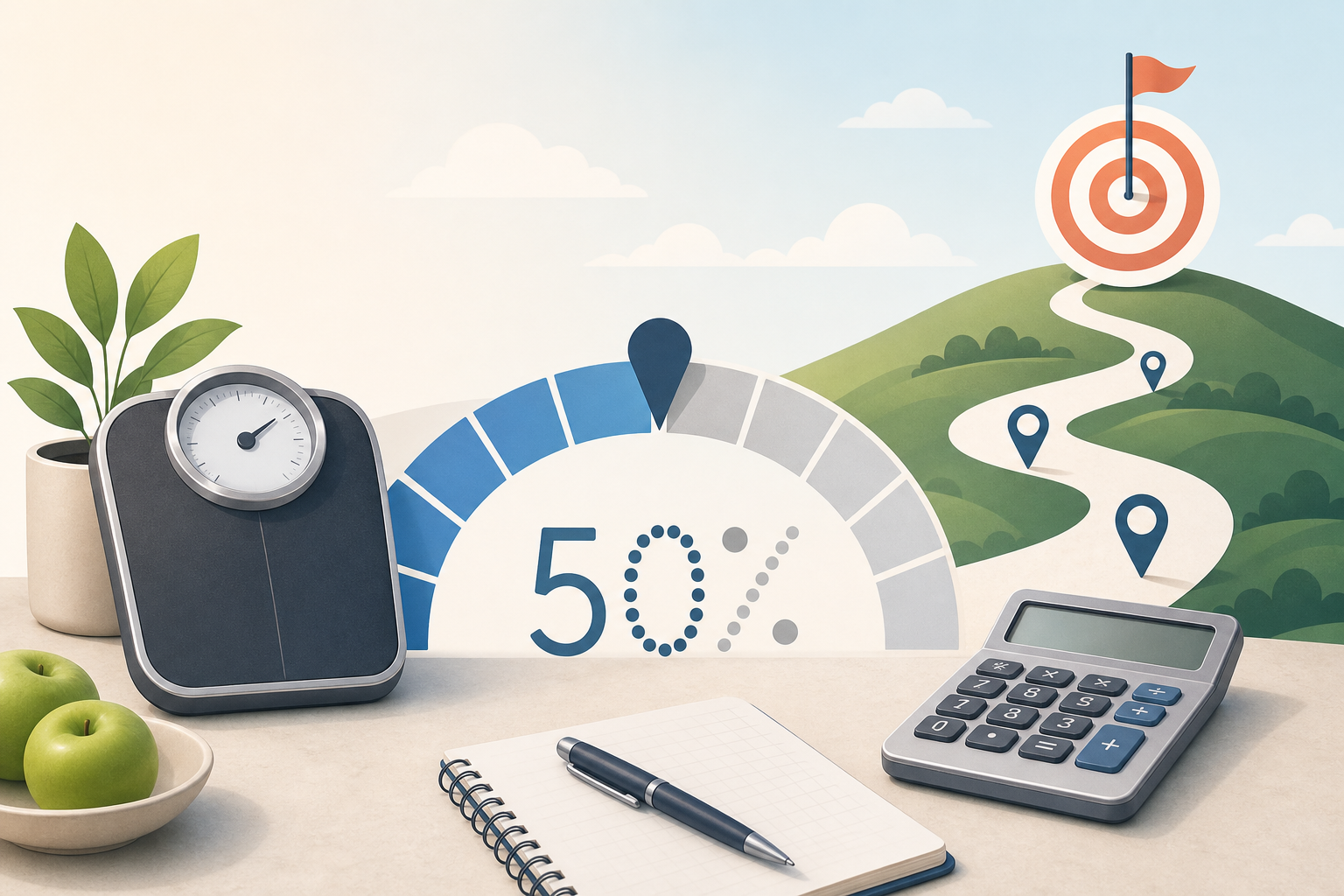
If your question is “what does 50 progress toward a weight goal actually mean,” the intended percentage is usually 50%. It means you have completed half of the numerical weight change between your starting weight and target weight. It does not mean that half of the expected time has passed, that half of your body fat has been lost, or that a particular health outcome has been achieved.
what does 50 progress toward a weight goal actually mean in numbers?
At 50% progress, your current weight is halfway between your starting weight and target weight. The calculation compares the weight change completed so far with the total planned change.
For example, suppose you start at 90 kg and set a target of 80 kg. The total planned change is 10 kg. At a current weight of 85 kg, you have completed 5 kg of that change:
5 kg completed ÷ 10 kg planned × 100 = 50%
This is a mathematical description of goal completion. It does not evaluate whether the target is appropriate, how the change occurred, or what the change means for your health.
How goal completion percentage is calculated
For a weight-loss goal, the usual formula is:
Progress % = (starting weight − current weight) ÷ (starting weight − target weight) × 100
A goal progress calculator can also handle the direction of the goal automatically. For a gain goal, progress is based on how much weight has been gained relative to the total planned gain.
The unit does not affect the percentage as long as all entries use the same unit. A calculation using kilograms will produce the same progress percentage as the equivalent calculation using pounds.
The halfway weight
Another way to find the 50% point is to calculate the midpoint between the starting and target weights:
Halfway weight = (starting weight + target weight) ÷ 2
For a starting weight of 90 kg and a target of 80 kg, the midpoint is 85 kg. For a gain goal starting at 60 kg with a target of 70 kg, the midpoint is 65 kg.
A practical weight goal progress example
Consider someone whose starting weight is 100 kg and whose target is 84 kg. The total planned change is 16 kg.
| Current weight | Change completed | Goal completion percentage |
|---|---|---|
| 96 kg | 4 kg | 25% |
| 92 kg | 8 kg | 50% |
| 88 kg | 12 kg | 75% |
| 84 kg | 16 kg | 100% |
At 92 kg, the person is at 50% weight goal progress because 8 kg is half of the planned 16 kg change. This remains true whether the change took two months, six months or another length of time.
If the current weight later rises to 93 kg, the percentage will decrease because the calculation uses the latest entered weight. That change in percentage simply reflects the new measurement; it does not explain why the scale changed.
Why halfway in weight is not halfway in time
A goal completion percentage measures distance between three weight values. It does not predict the date on which the target will be reached.
Body weight does not necessarily change at a constant rate. Day-to-day measurements can also vary with factors such as food and fluid in the body, clothing, measurement timing and differences between scales. A single result may therefore look different from the broader trend.
The NIDDK Body Weight Planner treats weight planning as a time-based process involving food intake and physical activity. This is different from a simple goal completion percentage, which does not model future changes or estimate a completion date.
For example, reaching 50% progress after 10 weeks does not establish that the remaining 50% will take another 10 weeks. The percentage alone contains no information about future pace.
What a goal progress calculator can and cannot tell you
What it can tell you
A goal progress calculator can provide a consistent numerical summary of a defined goal. Depending on the values entered, it can show:
- the total weight change planned between the starting and target weights;
- the amount of change completed based on the current weight;
- the remaining numerical distance to the target;
- the goal completion percentage; and
- whether progress has reached or passed 100%.
Progress can exceed 100% when the current weight moves beyond the original target in the intended direction. For example, moving from 90 kg to 79 kg with a target of 80 kg represents more than 100% completion of that original numerical goal.
What it cannot tell you
The calculator cannot determine:
- how much of the weight change came from body fat, muscle, water or other components;
- whether the target weight is suitable for an individual;
- whether health markers have improved;
- how much energy intake or activity contributed to the change;
- how long the remaining change will take; or
- whether a short-term scale change represents a lasting trend.
In particular, 50% goal completion is not the same as losing 50% of excess body fat or receiving 50% of a possible health benefit. Those are separate questions that cannot be answered from starting, current and target weights alone.
How to interpret the halfway point usefully
Treat 50% as a progress marker rather than a health rating. It answers the narrow question, “How much of the planned scale-weight change has been completed?”
For more consistent comparisons, use measurements taken under reasonably similar conditions. It may also be more informative to consider a series of measurements than to interpret one isolated reading, especially when the result is close to a milestone such as 50% or 100%.
The meaning of the percentage also depends on the original entries. If the starting weight was recorded incorrectly or the target has changed, the result may no longer represent the current plan. Updating the goal creates a new comparison and can substantially change the percentage even when current weight stays the same.
A target should not be treated as validated merely because it was entered into a calculator. The calculation accepts the target as a planning value; it does not assess the personal context behind it.
Frequently asked questions
Is 50% progress always the average of starting and target weights?
Yes, when progress is calculated only from starting, current and target weights, the 50% point is the numerical midpoint. Add the starting and target weights and divide by two.
Can 50% progress mean I have lost half of my body fat?
No. A scale-based goal completion percentage does not measure body-fat change. It cannot separate changes in fat, muscle, water or other body components.
Why did my progress percentage fall even though I had previously reached 50%?
The result is recalculated from the current weight entered. If the latest weight moves away from the target, the percentage can fall. Differences in measurement conditions or short-term scale variation may also affect the displayed result.
What happens if I change my target weight?
Changing the target changes the total planned distance and therefore changes the percentage. For example, a current weight that represented 50% of the original goal may represent less or more than 50% of a revised goal.
Can progress be higher than 100%?
Yes. A result above 100% means the current weight has passed the stated target in the planned direction. It does not indicate that further change is necessarily appropriate; it only describes the arithmetic relative to the original target.
What if my starting weight and target weight are the same?
There is no weight-change distance to use as the basis of a percentage. Because the formula would require division by zero, a meaningful goal completion percentage cannot be calculated for identical starting and target weights.
In summary, the answer to “what does 50 progress toward a weight goal actually mean” is that half of the planned numerical weight change has been completed. It is a useful milestone for tracking a defined goal, but it does not by itself describe body composition, health status, future pace or the suitability of the target.