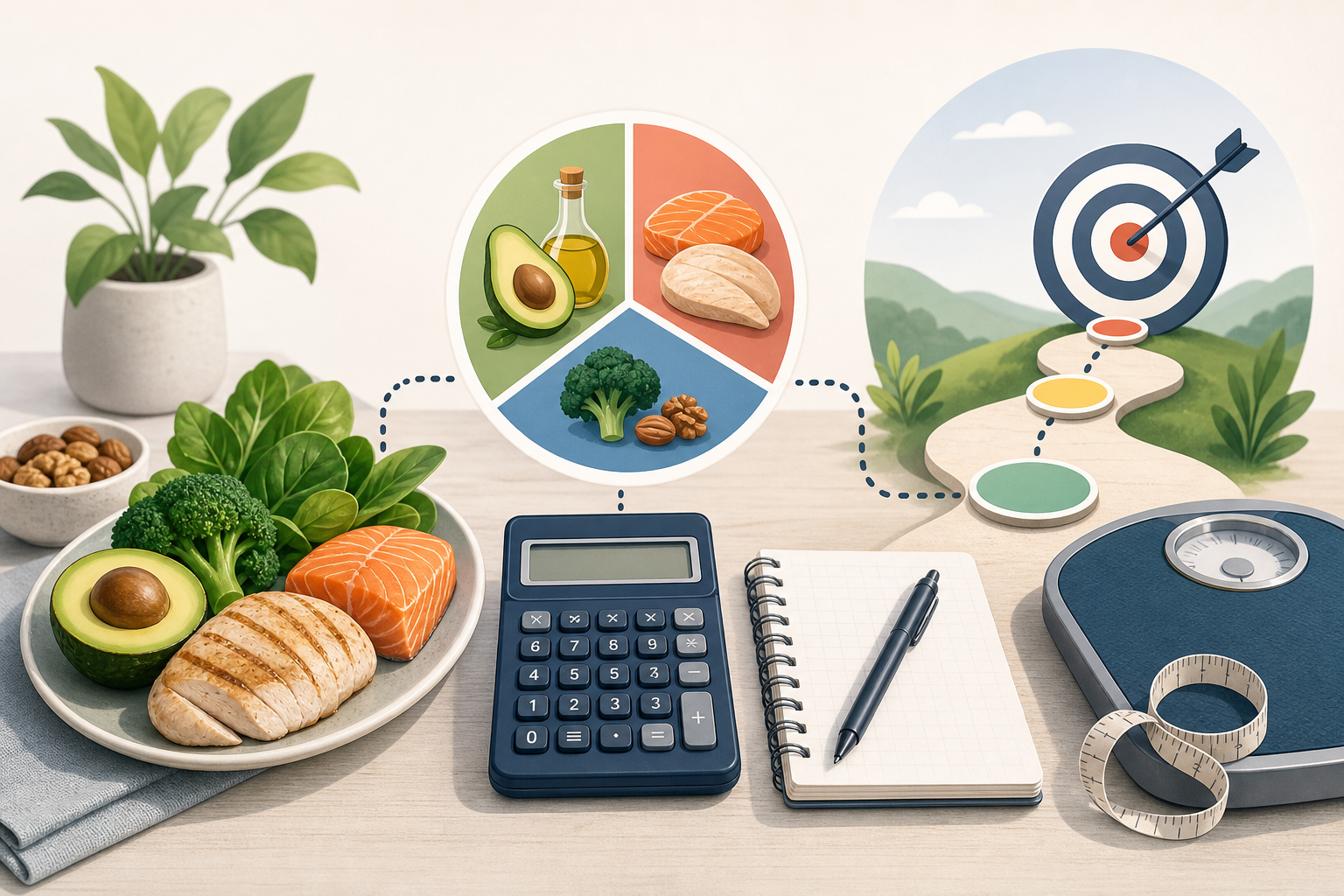
Learning how to calculate lowcarb macros means converting a daily calorie target into grams of protein, carbohydrate and fat. In this planning model, protein receives 30% of calories, carbohydrate receives the percentage you select, and fat receives all remaining calories. Each calorie allocation is then divided by the energy provided per gram of that macronutrient.
How to calculate lowcarb macros with the percentage method
The calculation begins with two planning inputs: total daily calories and the chosen carbohydrate percentage. Protein is fixed at 30% of calories, while the fat percentage is calculated as the balance.
The percentage formula is:
- Protein percentage = 30%
- Carbohydrate percentage = selected carb percentage
- Fat percentage = 100% − protein percentage − carbohydrate percentage
For example, selecting 25% carbohydrate produces a fat allocation of 45% because 100% − 30% − 25% = 45%.
The calorie allocations are converted to grams using standard energy values:
- Protein: 4 kcal per gram
- Carbohydrate: 4 kcal per gram
- Fat: 9 kcal per gram
These conversion factors are used for nutrition planning, but real foods are more complex than a three-macronutrient calculation. Published food labels may also involve rounding. The broader scientific basis for macronutrient energy and intake planning is covered in the National Academies’ Dietary Reference Intakes.
Step-by-step macro calculation
1. Start with daily calories
Choose the daily calorie amount that the macro pattern will divide. This figure is an input to the calculation, not a measured energy requirement. If the calorie target changes, all three gram amounts will change even when the percentages stay the same.
2. Calculate protein calories and grams
Multiply daily calories by 30%, expressed as 0.30. Then divide the result by 4 kcal per gram.
Protein grams = daily calories × 0.30 ÷ 4
At 2,000 kcal, protein accounts for 600 kcal. Dividing 600 by 4 gives 150 g of protein.
3. Calculate carbohydrate calories and grams
Convert the selected carb percentage to a decimal and multiply it by daily calories. Divide the resulting carbohydrate calories by 4.
Carbohydrate grams = daily calories × carb percentage ÷ 4
For a 25% carb percentage, use 0.25 in the formula. At 2,000 kcal, that equals 500 kcal from carbohydrate, or 125 g.
4. Assign the remaining calories to fat
Subtract the protein and carbohydrate percentages from 100%. Multiply daily calories by that remaining percentage, then divide by 9.
Fat grams = daily calories × remaining fat percentage ÷ 9
With 30% protein and 25% carbohydrate, fat receives 45% of total calories. At 2,000 kcal, that is 900 kcal, or 100 g of fat.
Worked example at 2,000 calories
Consider a person planning a 2,000 kcal pattern with 25% of calories from carbohydrate. The calculation keeps protein at 30% and assigns the remaining 45% to fat.
| Macronutrient | Percentage | Calories | Conversion | Estimated grams |
|---|---|---|---|---|
| Protein | 30% | 600 kcal | 600 ÷ 4 | 150 g |
| Carbohydrate | 25% | 500 kcal | 500 ÷ 4 | 125 g |
| Fat | 45% | 900 kcal | 900 ÷ 9 | 100 g |
The calorie allocations add to 2,000 kcal, and the percentages add to 100%. Small differences can appear when gram results are rounded.
The selected carb percentage affects fat because protein remains fixed in this model. If carbohydrate is reduced while calories and protein stay unchanged, the calculated fat percentage rises by the same number of percentage points. If carbohydrate is increased, the fat allocation falls.
How to interpret low carb macros
Macro percentages describe how total planned energy is distributed. They do not show the proportion of food by weight or volume. A gram of fat provides more energy than a gram of protein or carbohydrate, so the fat gram amount may be lower than expected even when fat represents a large calorie share.
The same carb percentage also produces different gram amounts at different calorie levels. For example, 25% carbohydrate equals 125 g at 2,000 kcal but 100 g at 1,600 kcal. A percentage therefore needs to be considered alongside total calories.
Likewise, the protein result in this model is driven by calories rather than body weight. At 1,600 kcal, the fixed 30% allocation gives 120 g of protein; at 2,400 kcal, it gives 180 g. This is a feature of the percentage-based method, not an individual assessment of protein needs.
Food choices cannot be evaluated from percentages alone. Two menus can have similar macro totals while differing substantially in fibre, micronutrients, food variety and degree of processing. Macro numbers are best understood as one layer of meal planning rather than a complete description of dietary quality.
What the low carb macro calculator can and cannot tell you
The low carb macro calculator automates the same arithmetic. It converts a daily calorie value into estimated grams using 30% protein, the selected carbohydrate percentage and fat as the remaining percentage.
The calculator can show:
- the calorie allocation for protein, carbohydrate and fat;
- the estimated grams of each macronutrient;
- how a different carb percentage changes the fat balance;
- how changing total calories changes all gram amounts.
The calculator cannot determine:
- whether the entered calorie level reflects an individual’s energy needs;
- whether a particular carb percentage is appropriate for a person’s circumstances;
- the quality, variety or processing level of foods used to meet the totals;
- fibre, vitamin, mineral or other micronutrient adequacy;
- medical suitability or likely changes in body weight.
The outputs are planning estimates rather than measured intake. Actual intake depends on serving sizes, recipe ingredients, label accuracy and how consistently foods are recorded. Nutrition labels and tracking databases may also round values or use different entries for similar foods.
When reviewing a result, check that the calorie input and selected carbohydrate percentage match the intended scenario. Also note whether a food-tracking system displays total carbohydrate or another carbohydrate measure, because definitions should be kept consistent when comparing totals.
Frequently asked questions
What does carb percentage mean?
Carb percentage is the share of total daily calories assigned to carbohydrate. It is not the percentage of the food’s physical weight. To convert it into grams, multiply daily calories by the percentage in decimal form and divide by 4.
Why is protein fixed at 30%?
Thirty per cent is a rule built into this particular planning model. It allows the calculator to vary carbohydrate and use fat as the balance. It should not be interpreted as a personalised protein assessment or a universal target.
What happens if I lower the carbohydrate percentage?
With calories and protein held constant, lowering the carbohydrate percentage increases the fat percentage. A reduction from 25% to 20% carbohydrate, for example, changes fat from 45% to 50% in this model.
Why do my calculated calories not match exactly after rounding?
Macro results are commonly displayed as whole grams or limited decimal places. Rounding each macronutrient separately can create a small difference when the displayed grams are converted back into calories. The unrounded calculation is more precise than the displayed total.
Are these carbohydrate grams total carbs or net carbs?
The percentage formula converts carbohydrate calories into grams but does not independently subtract fibre or sugar alcohols. Use the carbohydrate definition stated by the calculator or tracking system, and avoid comparing totals based on different definitions.
Can I use the same percentages at a different calorie level?
Yes, the same percentages can be applied mathematically to another calorie amount, but the gram targets will change. Whether that calorie amount or macro pattern suits an individual is outside what the percentage calculation can establish.
Putting the calculation together
In summary, how to calculate lowcarb macros comes down to three operations: assign 30% of calories to protein, assign the selected percentage to carbohydrate, and give the remaining percentage to fat. Divide protein and carbohydrate calories by 4 and fat calories by 9 to estimate grams.
This method is transparent and easy to recalculate when calories or the carb percentage changes. Its results describe a proposed energy split, not food quality, nutrient adequacy or an individually measured requirement.