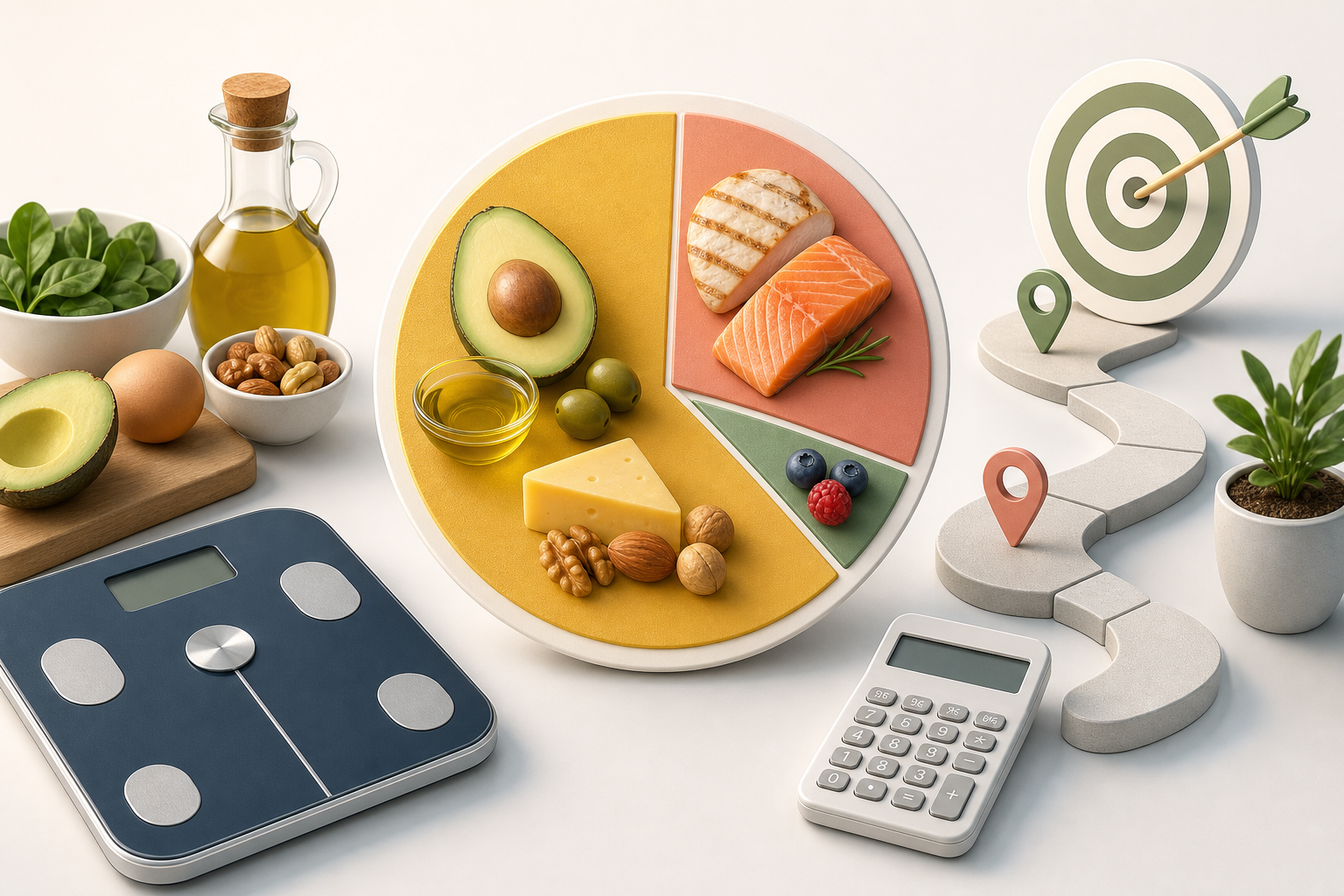
If you are asking what does a 75 fat 20 protein 5 carb keto split mean, the numbers describe the percentage of daily calories assigned to each macronutrient: 75% from fat, 20% from protein and 5% from carbohydrate. They are calorie percentages, not percentages of the weight or volume of food on your plate.
This ketogenic macro ratio is a fixed planning preset. It can translate a daily calorie target into estimated gram targets, but it is not a universal or individually optimal ratio.
What does a 75 fat 20 protein 5 carb keto split mean in practice?
For every 100 calories in the plan, approximately 75 calories come from fat, 20 from protein and 5 from carbohydrate. Across a full day, the same proportions are applied to the selected calorie target.
- Fat: 75% of daily calories
- Protein: 20% of daily calories
- Carbohydrate: 5% of daily calories
The percentages always add up to 100%. However, the gram amounts do not follow the same 75:20:5 pattern because fat provides more energy per gram than protein or carbohydrate.
For planning calculations, fat is assigned 9 kilocalories per gram, while protein and carbohydrate are each assigned 4 kilocalories per gram. These standard energy values are used to convert calorie allocations into estimated grams.
How calorie percentages become gram targets
The calculation has two stages. First, multiply total daily calories by each macro percentage. Then divide the resulting calories by the energy provided per gram.
Fat calculation
Daily calories × 0.75 ÷ 9 = estimated grams of fat
Protein calculation
Daily calories × 0.20 ÷ 4 = estimated grams of protein
Carbohydrate calculation
Daily calories × 0.05 ÷ 4 = estimated grams of carbohydrate
Because the result for fat often includes a decimal, it may be rounded to the nearest whole gram. Rounding can create a small difference between the selected calorie total and the calories calculated from the final gram targets.
Example of the keto macro ratio at 2,000 calories
For a practical example, consider a daily planning value of 2,000 kilocalories. Applying the preset produces the following calculation:
| Macronutrient | Calorie share | Calories | Conversion | Estimated grams |
|---|---|---|---|---|
| Fat | 75% | 1,500 kcal | 1,500 ÷ 9 | About 167 g |
| Protein | 20% | 400 kcal | 400 ÷ 4 | 100 g |
| Carbohydrate | 5% | 100 kcal | 100 ÷ 4 | 25 g |
The estimated daily targets are therefore 167 grams of fat, 100 grams of protein and 25 grams of carbohydrate. These numbers represent a mathematical allocation, not a measured record of what someone has eaten.
The gram targets change when the calorie value changes, even though the percentages remain fixed. For example:
| Daily calories | Fat at 75% | Protein at 20% | Carbohydrate at 5% |
|---|---|---|---|
| 1,600 kcal | About 133 g | 80 g | 20 g |
| 2,000 kcal | About 167 g | 100 g | 25 g |
| 2,400 kcal | 200 g | 120 g | 30 g |
This is why two people using the same ketogenic macro ratio can receive different gram targets. The ratio is identical, but the calorie inputs are different.
How to interpret these keto macros
The split describes where dietary energy is intended to come from. It does not mean that 75% of each meal, plate or food container should be fat by weight. Foods contain different amounts of water, fibre and other components, so their physical size does not correspond directly to their calorie contribution.
A food portion containing fat may look smaller than a carbohydrate-rich portion while providing more calories. This reflects fat’s higher energy value per gram, not an error in the calculation.
Total carbohydrate versus net carbohydrate
A gram target should be interpreted according to the carbohydrate definition used by the calculator or food-tracking method. “Total carbohydrate” and “net carbohydrate” are not interchangeable. Net carbohydrate is commonly calculated by subtracting some fibre or other specified components from total carbohydrate, but definitions and food-labelling practices can vary.
The fixed calculation itself simply allocates 5% of calories to carbohydrate using 4 kilocalories per gram. It does not determine how a particular tracking app, food label or meal plan categorises fibre.
The ratio does not assess food quality
Matching the percentages does not show whether meals provide adequate fibre, vitamins, minerals or an appropriate range of foods. A macro result describes quantities of energy-providing nutrients; it does not provide a complete nutritional assessment.
Protein needs can also depend on factors that a fixed percentage does not capture, including body size, life stage and activity context. As calorie intake changes, a percentage-based protein target changes automatically, even if other personal factors remain the same.
What the keto macro calculator can and cannot tell you
The keto macro calculator applies the 75% fat, 20% protein and 5% carbohydrate preset to a daily calorie value. Its purpose is to make the arithmetic consistent and provide convenient gram estimates for planning.
What it can calculate
- The calories assigned to fat, protein and carbohydrate.
- Estimated daily grams based on 9 kcal per gram of fat and 4 kcal per gram of protein or carbohydrate.
- A consistent set of targets using the calculator’s fixed ketogenic-style preset.
- How macro gram targets change when the daily calorie input changes.
What it cannot determine
- Whether the entered calorie value reflects an individual’s measured energy needs.
- Whether this macro ratio is appropriate for a particular person or health circumstance.
- Whether following the calculated targets will produce ketosis.
- Whether a meal pattern is nutritionally complete or suitable over time.
- How an individual will respond in terms of appetite, digestion, training or body weight.
The calculator output is an estimate derived from the entered calorie value. It is not a laboratory measurement of energy use, food intake or metabolic state. Ketosis, for example, is a physiological state and cannot be confirmed by a percentage calculation alone.
Ketogenic diets may not be appropriate for everyone, and some circumstances can require individual clinical guidance. The calculator does not screen for those circumstances or replace an assessment of personal nutritional needs.
Frequently asked questions
Is 75% fat the same as eating 75 grams of fat?
No. The 75 refers to the percentage of total calories supplied by fat. The number of grams depends on the daily calorie target because each gram of fat provides approximately 9 kilocalories.
Why are the fat grams not three times the protein grams?
The calorie percentages and gram proportions are different. Fat provides approximately 9 kilocalories per gram, compared with 4 kilocalories per gram for protein. At 2,000 calories, the preset gives about 167 grams of fat and 100 grams of protein.
Does a 5% carbohydrate allocation always equal 25 grams?
No. It equals 25 grams only when the daily target is 2,000 kilocalories. At 1,600 kilocalories, 5% corresponds to about 20 grams; at 2,400 kilocalories, it corresponds to about 30 grams.
Are the calculator results exact?
The percentage arithmetic is fixed, but the gram outputs are planning estimates. Rounded grams, food-label rounding and differences between recorded and actual portions can all produce small variations.
Does following these keto macros guarantee ketosis or weight loss?
No. A macro calculation cannot predict an individual metabolic response or body-weight change. It only converts a calorie value into the calculator’s selected fat, protein and carbohydrate allocation.
Is 75/20/5 the only ketogenic macro ratio?
No. It is one ketogenic-style planning pattern rather than a universal definition or optimal ratio. Different approaches may use different allocations depending on their purpose and the needs of the individual.
Putting the 75/20/5 split into context
In summary, what does a 75 fat 20 protein 5 carb keto split mean? It means that 75% of planned calories come from fat, 20% from protein and 5% from carbohydrate. At 2,000 kilocalories, that converts to approximately 167 grams of fat, 100 grams of protein and 25 grams of carbohydrate.
The value of the split is its simplicity: it provides a consistent way to calculate keto macros from daily calories. Its limitation is equally important—the result is a preset mathematical allocation, not proof that the calorie target, macro ratio or resulting meal pattern is individually suitable.