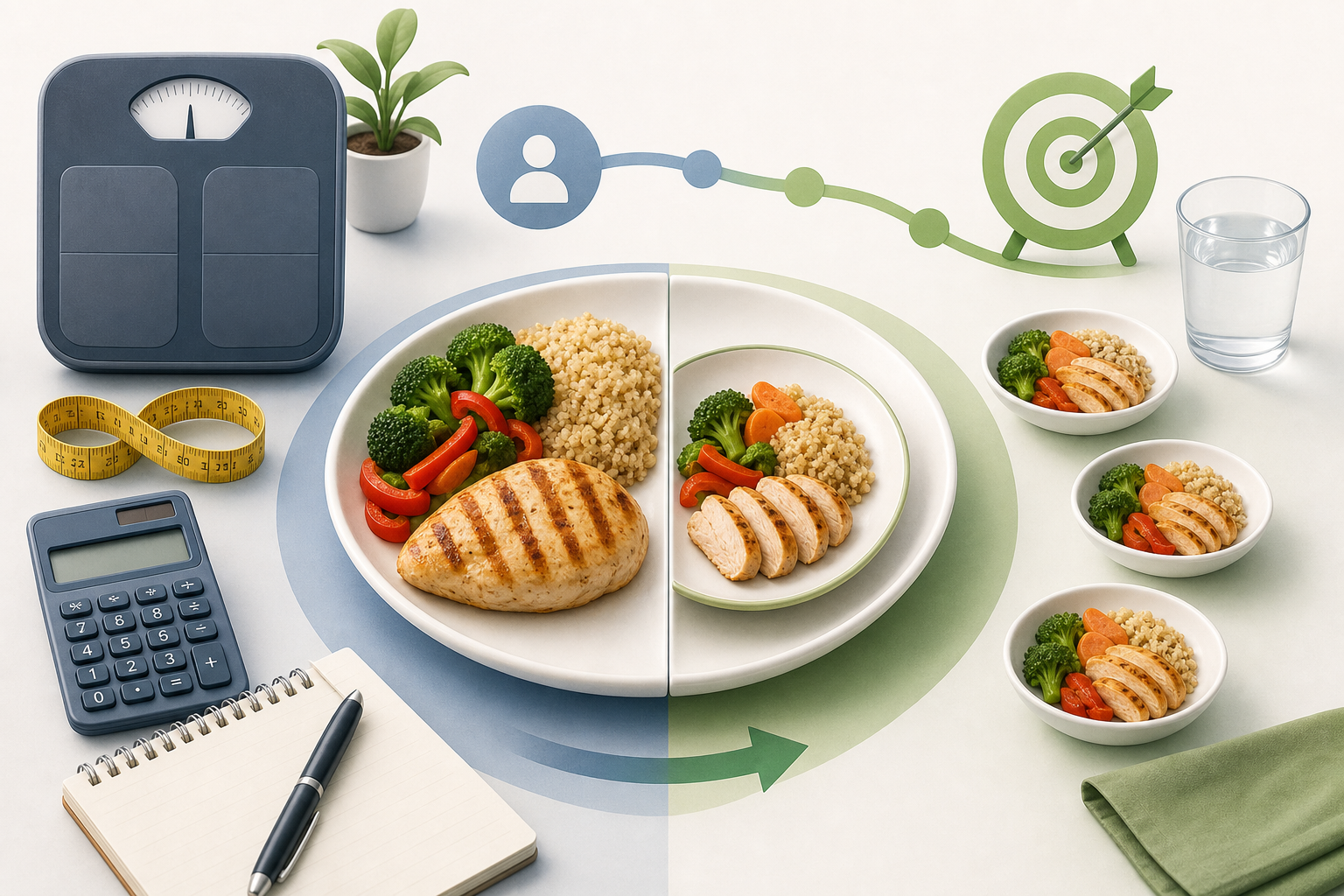
A lower daily calorie target lowers the amount available for each meal, but it does not automatically change the way those calories are distributed. In simple terms, how a calorie deficit changes your calories per meal depends on the size of the daily reduction, the number of meals and whether you use an equal or customised meal pattern.
For example, dividing 2,100 kcal evenly across three meals gives 700 kcal per meal. If the daily target changes to 1,800 kcal and the same three-meal structure is retained, the equal allocation becomes 600 kcal per meal. The distribution method is unchanged; only the daily total has decreased.
How a calorie deficit changes your calories per meal
A calorie deficit means that the daily calorie target is below estimated daily energy expenditure. Because energy expenditure and maintenance calories are estimates unless assessed under controlled conditions, the size of the planned deficit is also an estimate.
When the daily target falls, each meal allocation must fall, snacks must be reduced, or both. If the number of eating occasions and their proportions remain the same, every allocation decreases in direct proportion to the daily target.
Suppose breakfast, lunch and dinner each receive one-third of daily calories. Reducing the daily target by 10% would reduce each of those equal meal allocations by 10%. It would not require changing the number of meals or making one particular meal smaller than the others.
A deficit does not determine when you should eat or how large breakfast should be compared with dinner. Those are separate meal-planning decisions.
The formula for calculating daily calories per meal
The basic formula is:
Calories per meal = daily calorie target ÷ number of meals
This calculation assumes that all meals receive an equal share and that no calories are reserved separately for snacks or drinks. If snacks are part of the plan, subtract their allocation before dividing the remaining calories among meals.
For example, a daily target of 1,800 kcal divided across three equal meals gives:
1,800 ÷ 3 = 600 kcal per meal
If 300 kcal is reserved for snacks, the meal calculation becomes:
(1,800 − 300) ÷ 3 = 500 kcal per meal, plus 300 kcal for snacks
Comparing two daily targets
| Planning example | Daily target | Meals | Equal calories per meal |
|---|---|---|---|
| Higher starting target | 2,100 kcal | 3 | 700 kcal |
| Lower target | 1,800 kcal | 3 | 600 kcal |
| Higher starting target | 2,100 kcal | 4 | 525 kcal |
| Lower target | 1,800 kcal | 4 | 450 kcal |
In both comparisons, the daily target falls by 300 kcal. With three meals, that reduction is spread as 100 kcal per meal. With four meals, it is spread as 75 kcal per meal. These are arithmetic examples rather than recommended calorie targets.
Equal and customised meal calorie allocation
An equal split is a convenient baseline, not a requirement. Meal sizes can vary while still adding up to the same daily target.
One person might prefer a substantial breakfast, while another may reserve more calories for an evening meal. Work hours, training schedules, appetite, food traditions and household routines can all influence meal calorie allocation.
Using percentages instead of equal meals
A customised pattern assigns a percentage of the daily target to each eating occasion. For a three-meal pattern, an illustrative distribution could be 25% at breakfast, 35% at lunch and 40% at dinner.
| Meal | Share of daily target | At 2,100 kcal | At 1,800 kcal |
|---|---|---|---|
| Breakfast | 25% | 525 kcal | 450 kcal |
| Lunch | 35% | 735 kcal | 630 kcal |
| Dinner | 40% | 840 kcal | 720 kcal |
Here, each meal becomes smaller when the daily target decreases, but the 25%–35%–40% pattern stays the same. This illustrates the central distinction: the calorie deficit changes the quantities, while the chosen distribution rule controls their proportions.
Keeping one meal unchanged
Meal reductions do not have to be proportional. If someone wants to keep breakfast unchanged, the reduction can come from lunch, dinner or snacks instead.
For example, a change from 2,100 to 1,800 kcal requires reallocating 300 kcal somewhere in the day. Keeping a 500-kcal breakfast means the entire 300-kcal difference must be taken from other planned eating occasions. The totals still need to add up, even when the reduction is uneven.
What a calories per meal calculator can and cannot tell you
A calories per meal calculator divides a daily calorie target across the selected number of meals. It can quickly show how changing the daily target or meal count changes the equal allocation.
The calculator can help you:
- divide a daily target evenly across a chosen number of meals;
- compare allocations at two different daily targets;
- see the effect of adding or removing a meal;
- create a simple baseline before adjusting meals for preference; and
- check whether planned meal values add up to the intended daily total.
The calculator cannot determine whether the entered daily calorie target is appropriate for an individual. It also cannot assess hunger, food quality, nutrient adequacy, health conditions, exercise demands or the practicality of a particular eating schedule.
Its output is a planning value, not a measured energy requirement. The underlying calculation is exact for the numbers entered, but the daily calorie target may itself be estimated.
Practical factors when reducing meal allocations
A smaller calorie allocation does not necessarily require eating less often. You can retain the same meal schedule, change the number of meals or modify the balance between meals and snacks. The useful approach is the one that fits the daily target and remains workable within the person’s normal routine.
Account for all planned eating occasions
If the daily target is divided among meals without accounting for snacks, the final total may exceed the intended amount. Decide first whether snacks, calorie-containing drinks or other planned items are included within meal values or given separate allocations.
Avoid treating every day as identical
A daily target can be used as a planning average, but actual meals may vary. A larger lunch on one day can be balanced by different allocations elsewhere if that approach fits the overall plan. A calories-per-meal result does not need to function as a rigid limit for every plate.
Consider more than calories alone
Calorie division does not describe the nutrient content of meals. Foods with the same calorie value can differ in protein, carbohydrate, fat, fibre and micronutrients. The National Academies’ Dietary Reference Intakes provide broader reference information on energy and nutrient requirements, but the simple meal-division formula does not evaluate those needs.
Recalculate rather than subtracting casually
When the daily target or number of meals changes, calculate the complete allocation again. This reduces arithmetic errors and makes it easier to confirm that all meals and snacks still add up to the intended total.
Frequently asked questions
Does a calorie deficit mean every meal must be smaller?
No. Every meal becomes smaller only if the daily reduction is distributed proportionally across all meals. You may instead keep one meal unchanged and reduce other meals or snacks, provided the complete day still matches the planned target.
Should I divide my calories equally between meals?
Equal division is simple, but it is not required. Unequal meals may suit appetite, work, exercise, cultural eating patterns or personal preference better. The allocations only need to add up to the chosen daily target.
What happens if I eat four meals instead of three?
With an equal split, the calorie amount per meal becomes smaller because the same daily total is divided into more parts. For example, 1,800 kcal gives 600 kcal across three equal meals or 450 kcal across four equal meals.
Should snacks count as meals in the calculator?
That depends on how you want to organise the plan. You can count each snack as an eating occasion, or reserve a snack allowance first and divide the remaining calories among main meals. Use one method consistently so calories are not counted twice or omitted.
Can the calculator find my calorie deficit?
No. The calculator’s purpose is to divide an entered daily target across meals. It does not calculate maintenance calories, estimate energy expenditure or decide the size of a calorie deficit.
Putting the change into context
The clearest way to understand how a calorie deficit changes your calories per meal is to separate two decisions. The daily calorie target determines how much energy is available for the day, while the allocation method determines how that amount is divided.
If the distribution method stays the same, a lower daily target produces proportionally lower meal values. If meal sizes, snack allowances or meal frequency change, the calories can be redistributed unevenly while still reaching the same daily total. A calculator provides the arithmetic baseline; the final pattern remains a personal planning choice.