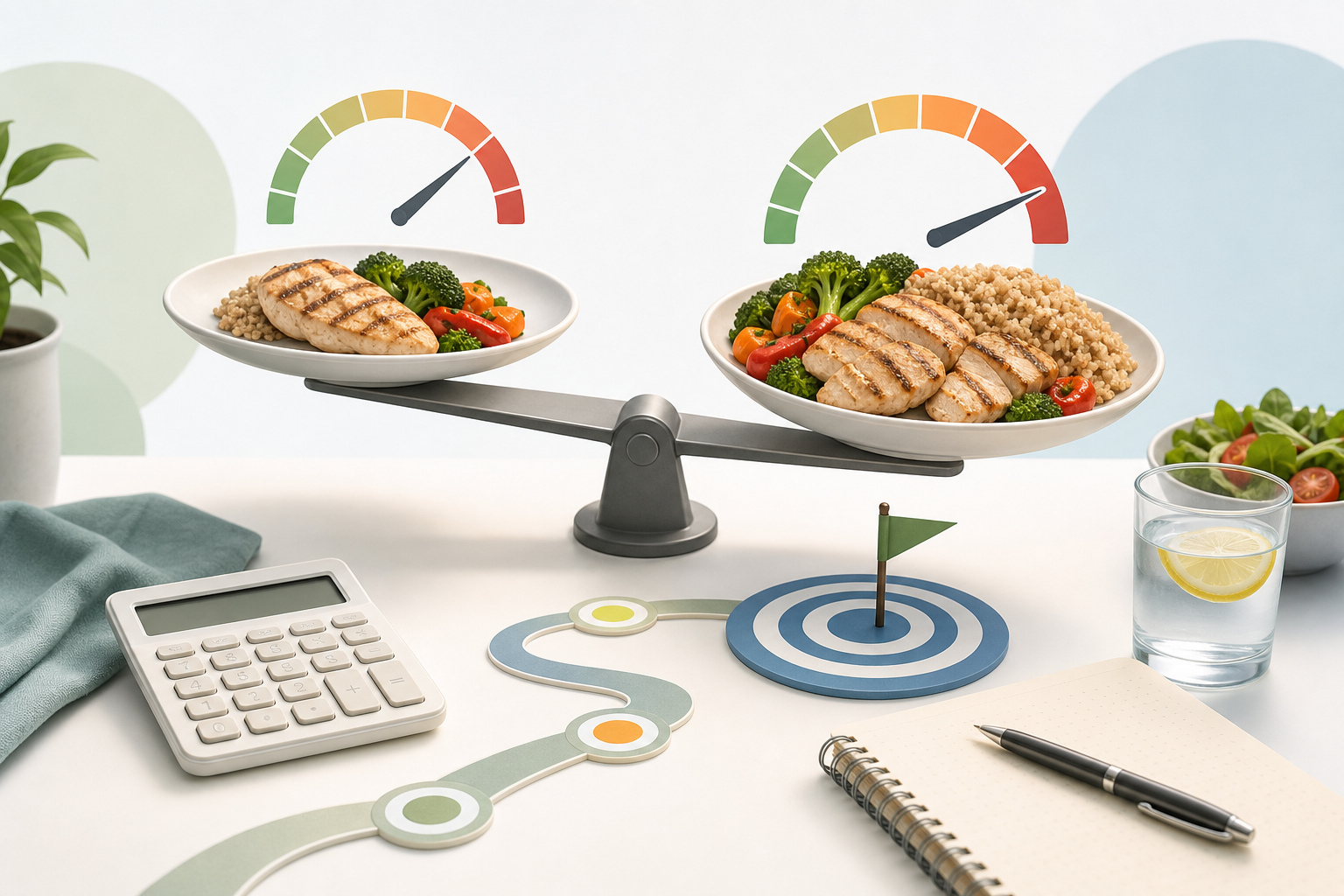
Understanding why portion size changes a meals calorie total starts with a simple principle: eating more or less of the same food changes the amount of energy consumed. If a portion doubles while the recipe stays the same, its estimated calories generally double. Confusion arises when a listed serving, a measured portion and the amount actually eaten are not the same.
Understanding why portion size changes a meals calorie total
Calorie values describe an amount of food, not just the name of the food. A bowl of rice, a plate of pasta or a handful of nuts has no single calorie total unless the quantity is defined.
For the same food or recipe, calories usually scale in proportion to portion weight or volume. A basic calculation is:
Calories eaten = calories in the stated serving × number of servings eaten
| Stated serving | Calories per serving | Amount eaten | Estimated calories eaten |
|---|---|---|---|
| 100 g | 180 kcal | 50 g | 90 kcal |
| 100 g | 180 kcal | 150 g | 270 kcal |
| 100 g | 180 kcal | 200 g | 360 kcal |
This proportional method works best when the food is evenly mixed and the calorie value is reliable. It may be less precise for foods with uneven ingredients, such as a salad with dressing concentrated at the bottom or a casserole with different amounts of cheese in each serving.
Why serving-size assumptions matter
A serving size is a reference amount. It is not necessarily the amount a person serves themselves or eats. A nutrition label might describe 30 g as one serving even if the portion poured into a bowl is 45 g or 60 g.
The same issue applies to recipes and restaurant information. A recipe may state that it makes six servings, but cutting it into four portions increases the calories in each portion. Dividing it into eight portions lowers the amount per portion without changing the calories in the full recipe.
Several terms are useful to distinguish:
- Serving size: the reference quantity used for a listed calorie value.
- Portion size: the quantity placed on a plate or in a container.
- Amount eaten: the quantity actually consumed, which may be less or more than the served portion.
- Recipe yield: the total amount made and the number of portions into which it is divided.
When estimating calories in a meal, the calorie figure and the quantity must use compatible units. For example, a value listed per 100 g should be matched with the number of grams eaten, not with an undefined description such as “one bowl.”
A practical portion calculation
Suppose a cooked pasta dish contains an estimated 1,200 kcal in the full batch. The calorie amount per portion depends on how the batch is divided.
| Number of equal portions | Estimated calories per portion |
|---|---|
| 4 | 300 kcal |
| 5 | 240 kcal |
| 6 | 200 kcal |
If the portions are not equal, dividing by the number of portions is only an approximation. A more specific approach is to weigh the finished dish and calculate calories per gram.
For example, if the cooked batch weighs 1,000 g and contains an estimated 1,200 kcal, it provides about 1.2 kcal per gram. A 250 g portion would therefore contain an estimated 300 kcal:
1,200 kcal ÷ 1,000 g = 1.2 kcal per gram
1.2 × 250 g = 300 kcal
Ingredients added after weighing also count. Oil, sauce, cheese, spreads, sugar and caloric drinks can change the meal total even when the main portion appears unchanged. Conversely, leaving part of the meal uneaten means the amount consumed may be lower than the amount served.
Portion size is not the only factor in meal calories
Two portions of the same weight can have different calorie totals because their ingredients differ. A food’s estimated energy depends partly on the amounts of carbohydrate, protein, fat and other energy-providing components it contains. The National Academies’ Dietary Reference Intakes provide detailed background on energy and macronutrients.
Preparation can also change the calculation. Frying food in oil may add energy, while boiling food in water may increase its cooked weight without adding calories. As a result, 100 g of a food in its raw form may not have the same calorie value as 100 g after cooking.
Common reasons that similar-looking portions have different meal calories include:
- Different amounts of cooking oil, butter or dressing
- Higher- or lower-fat versions of an ingredient
- Sweetened rather than unsweetened products
- Changes in water content during cooking
- Different ratios of ingredients within a mixed dish
- Extras such as sauces, toppings and caloric drinks
This is why portion scaling should use calorie information that matches the specific product, recipe and preparation state whenever possible.
What a meal calorie calculator can and cannot tell you
A meal calorie calculator adds the calorie estimates entered for breakfast, lunch, dinner, snacks and caloric drinks. The basic method is:
Daily meal calories = breakfast + lunch + dinner + snacks and drinks
For example, estimated entries of 400 kcal for breakfast, 550 kcal for lunch, 650 kcal for dinner and 250 kcal for snacks and drinks produce a daily total of 1,850 kcal.
The calculator can help with:
- Adding several meal estimates consistently
- Comparing different planned portion sizes
- Seeing how snacks and drinks affect the daily total
- Reviewing how calories are distributed across meals
However, the result is only as accurate as the values entered. If a lunch is entered as 500 kcal based on one serving but the amount eaten was one and a half servings, the calculator will not automatically detect the difference.
A meal calorie calculator also does not measure the food, verify a recipe or assess nutrient quality. It cannot show whether a meal provides enough protein, fibre, vitamins, minerals or variety simply from its calorie total. Meal calories describe estimated energy, not the complete nutritional value of a meal.
How to improve a portion-based calorie estimate
Exact measurement is not always practical, but consistent methods can reduce avoidable differences between the listed serving and the amount eaten.
- Check the reference quantity. Note whether the calorie value applies per serving, per item, per 100 g or per 100 ml.
- Match the food’s condition. Use raw values for raw weights and cooked values for cooked weights where the available information makes that distinction.
- Measure the amount actually used. A kitchen scale can be more specific than descriptions such as a spoonful, cup or medium bowl.
- Count the number of servings. Divide the amount eaten by the stated serving size before multiplying by calories per serving.
- Include additions. Account for cooking fats, sauces, toppings, sugar and caloric drinks where relevant.
- Record leftovers when useful. If part of a portion remains, the served amount and eaten amount are not identical.
Measurements should still be treated as estimates. Nutrition labels may use rounded values, recipes may not be divided evenly, and food composition can vary between products and batches. Greater precision in weighing does not remove uncertainty from the underlying calorie data.
Frequently asked questions
Do calories always double when portion size doubles?
For the same evenly mixed food, doubling the amount generally doubles the estimated calories. This may not hold exactly if the larger portion contains a different ratio of ingredients or if extra sauce, oil or toppings are added.
Should I use the portion served or the portion eaten?
Use the amount eaten when estimating energy consumed. Use the amount served when planning a plate or recipe portion. If some food is left, these quantities will differ.
Why does cooked food have a different calorie value per 100 g?
Cooking can change a food’s water content and weight. Food that absorbs water may have fewer calories per 100 g than its dry form, while food that loses water may have more calories per 100 g. Added oil or other ingredients can also change the total.
Can I estimate portions using cups or spoons?
Volume measures can be useful when a recipe or label uses the same measure. Their accuracy depends on how the food is filled, levelled or packed. Weight is often more consistent for foods whose density or shape varies.
Does a lower-calorie portion mean a more nutritious meal?
Not necessarily. Calorie totals estimate energy, while nutritional quality also involves the types and amounts of nutrients and foods present. Two meals with similar calories can have very different nutritional profiles.
Putting portion-based meal totals in context
The clearest explanation of why portion size changes a meals calorie total is that calorie information applies to a defined quantity. Change that quantity and the estimated energy changes with it. Reliable meal totals therefore depend on matching the calorie value to the portion actually eaten.
Daily totals are most useful when treated as estimates rather than measured facts. Consistent serving assumptions, suitable food data and attention to extras make comparisons between meals more meaningful.