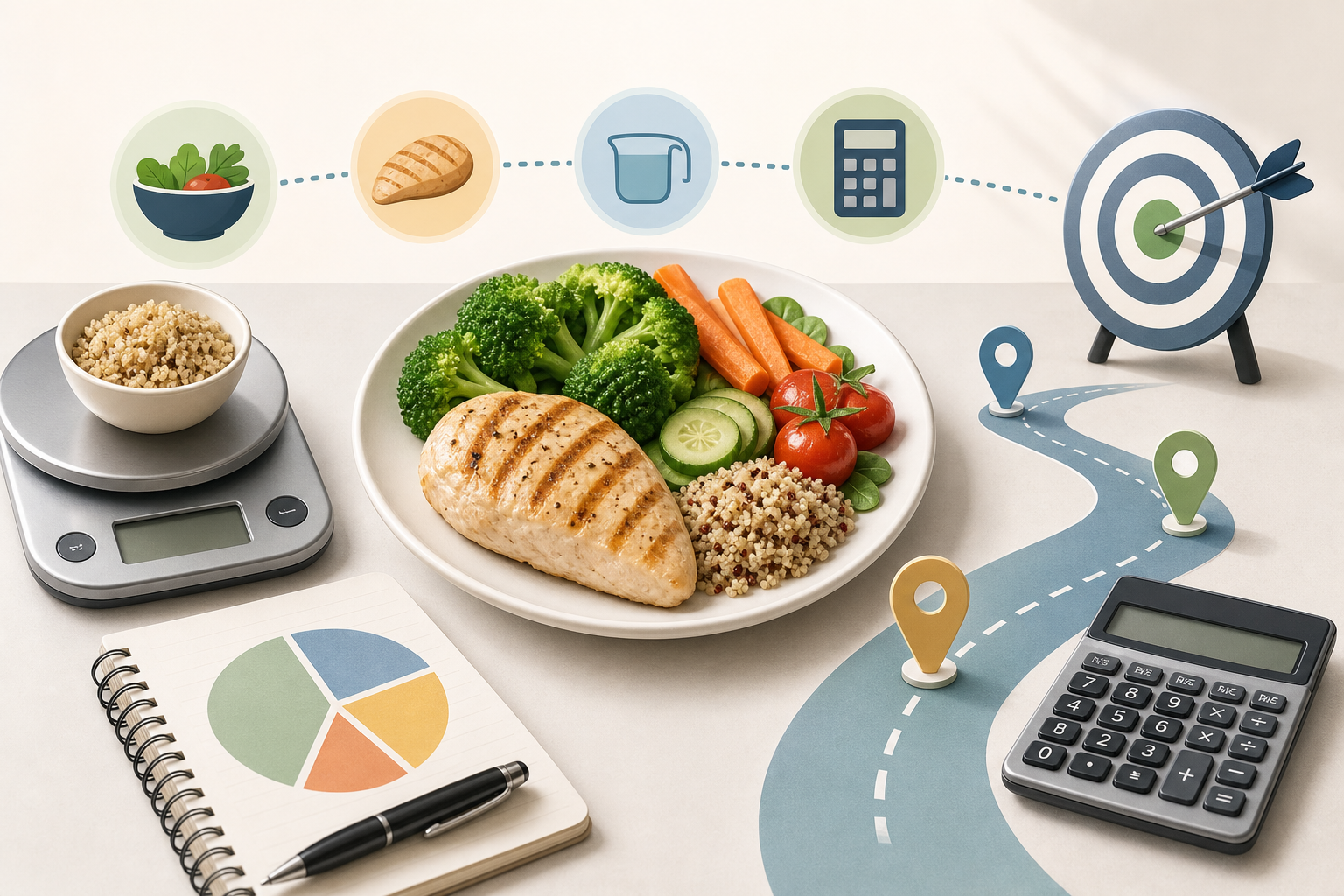
Learning how to estimate the calories in a meal starts with a simple process: identify each ingredient or meal component, determine the portion consumed, find the calorie value for that portion, and add the values together. The result is an estimate rather than a laboratory measurement, but careful portion information can make it more useful for meal planning.
- How to estimate the calories in a meal step by step
- Calculate calories from ingredients or meal components
- Do not overlook smaller additions
- Why portion size matters
- Check whether the value is for cooked or uncooked food
- Confirm the serving definition
- Estimating mixed dishes and meals away from home
- Restaurant and takeaway meals
- What a meal calorie calculator can and cannot tell you
- What the calculator can show
- What the calculator cannot show
- Ways to improve a meal calorie estimate
- Putting the estimate into practice
- Frequently asked questions
- Should drinks be included in meal calories?
- Can I estimate a meal without weighing every ingredient?
- Do I count the full amount of cooking oil?
- How do I estimate calories in a buffet or shared meal?
- Why does my estimate differ between calorie sources?
How to estimate the calories in a meal step by step
- List every component. Include main foods, side dishes, sauces, cooking fats, toppings and caloric drinks.
- Record the portion of each item. Use grams, millilitres, package servings or familiar household measures such as cups and tablespoons.
- Find an appropriate calorie value. Check the food label, recipe information, restaurant nutrition details or a reliable food database.
- Adjust the value to match your portion. A label value is only useful when the listed serving size matches the amount eaten.
- Add the adjusted values. The sum is the estimated calorie total for the meal.
For example, if a meal contains rice, beans, vegetables, cooking oil and a drink, calculate each part separately. Leaving out the oil or drink could make the total noticeably different from the complete meal estimate.
Calculate calories from ingredients or meal components
Packaged foods usually provide calories for a stated serving or quantity. If the amount you eat differs from that quantity, scale the label value up or down.
The basic calculation is:
Calories in your portion = calories in the listed serving × your portion size ÷ listed serving size
Suppose a food provides 240 kcal per 100 g and your portion weighs 150 g:
240 × 150 ÷ 100 = 360 kcal
Repeat this calculation for each component, then add the results. A meal with estimated components of 360 kcal, 140 kcal, 80 kcal and 60 kcal would have an estimated total of 640 kcal.
Do not overlook smaller additions
Meal calories may include more than the foods that occupy most of the plate. Depending on the meal, remember to account for:
- Oil, butter or other fats used during cooking
- Dressings, dips, spreads, gravy and sauces
- Sugar, syrup, cream or milk added to drinks
- Cheese, nuts, seeds and other toppings
- Bread, side dishes and desserts
- Juice, soft drinks, alcohol and other caloric drinks
If a shared ingredient is used for several servings, first estimate the calories in the full amount and then divide by the number of portions. For example, 480 kcal of cooking ingredients divided evenly among four servings contributes about 120 kcal to each serving.
Why portion size matters
A calorie value applies to a particular amount of food. If the portion estimate is inaccurate, the estimate for the calories in a meal will also be inaccurate, even when the label or database value is correct.
A kitchen scale generally provides more consistent portion information than visual estimates. Measuring cups and spoons can also be useful, especially for liquids, sauces and ingredients used in small quantities. Household measures are less precise for foods that can be packed, heaped or cut into different sizes.
Check whether the value is for cooked or uncooked food
Food may gain or lose water during cooking, changing its weight without producing the same change in total energy. For example, cooked grains absorb water, while meat may lose water during heating.
Match the condition of the food to the calorie entry whenever possible. Use a cooked-food value for a cooked portion and an uncooked-food value for an uncooked amount. Mixing the two can distort the estimate.
Confirm the serving definition
A “serving” is not a universal quantity. One brand may define a serving differently from another, and your portion may contain more than one labelled serving. Check the number of grams or millilitres rather than relying only on terms such as “one bowl” or “one portion.”
Estimating mixed dishes and meals away from home
Mixed dishes such as curries, soups, casseroles, pasta dishes and stir-fries are easiest to estimate from the full recipe. Add the calories from all ingredients, including cooking fats and sauces, and divide the total according to the amount served.
For example, consider a pot of soup made with ingredients estimated at 1,800 kcal in total. If it produces six similar portions, each portion would be approximately:
1,800 ÷ 6 = 300 kcal
If the portions are not equal, weighing the finished dish can improve the estimate. Divide the recipe’s total calories by its finished weight to obtain an estimated calorie value per gram, then multiply that figure by the weight of the portion served.
Restaurant and takeaway meals
Use published restaurant nutrition information when it is available. Check whether the stated figure covers the whole item, one serving or a meal combination that includes sides and drinks.
When no nutrition information is available, compare the meal with a similar documented dish and treat the result as a rough estimate. Recipe differences, portion sizes, cooking oil and sauces can create substantial uncertainty. It is usually more honest to record a reasonable range than to assume an exact figure.
What a meal calorie calculator can and cannot tell you
A meal calorie calculator adds the values entered for breakfast, lunch, dinner, snacks and caloric drinks. Its basic method is:
Daily meal calories = breakfast + lunch + dinner + snacks and drinks
For example:
400 + 550 + 650 + 250 = 1,850 kcal per day
This total can help compare a planned or recorded day of eating with an overall calorie target. It can also show how individual meals and snacks contribute to the daily estimate.
What the calculator can show
- The sum of the meal calorie estimates entered
- The contribution of breakfast, lunch, dinner and snacks to the daily total
- Differences between alternative daily meal plans
- Whether the arithmetic across meals has been added consistently
What the calculator cannot show
- Whether the original food and portion estimates are accurate
- The nutrient quality or variety of the meals
- Whether cooking oils, sauces or drinks have been omitted
- Your individual energy needs or how your body will respond
- A directly measured value for the energy in a meal
The output is only as reliable as the information entered. If breakfast is recorded as 400 kcal, the calculator adds 400 kcal; it does not independently verify the ingredients or portion sizes.
Ways to improve a meal calorie estimate
Perfect precision is rarely possible in everyday meal tracking. Consistent methods are generally more useful than changing between labels, database entries and visual estimates without checking how each source defines a portion.
- Use the product label for branded foods. Formulations can differ between brands and countries.
- Use weights where practical. Grams and millilitres make it easier to scale values to the actual portion.
- Choose a close food match. Preparation method, fat content and added ingredients may affect the value.
- Record cooking fats separately. Do not assume they are included in a basic entry for vegetables, meat or grains.
- Keep recipe portions consistent. Divide the full recipe total by the amount actually produced.
- Avoid false precision. A restaurant estimate does not become more accurate simply because it is recorded to the nearest single calorie.
Calories describe food energy, but they do not provide a complete picture of a meal. Foods also supply varying amounts of protein, carbohydrate, fat, fibre, vitamins and minerals. The National Academies’ Dietary Reference Intakes provide broader scientific context on energy and macronutrients, but a calorie sum alone does not assess overall diet quality.
Putting the estimate into practice
A practical way to learn how to estimate the calories in a meal is to begin with meals for which the portions and ingredients are known. Packaged foods and home-prepared recipes are usually easier to calculate than restaurant dishes with unknown quantities.
First estimate each meal independently, then use the meal totals to calculate the daily amount. Keep the distinction clear: ingredient and portion data produce estimated meal calories, while the daily calculator simply adds those estimates together.
When information is uncertain, note the uncertainty rather than treating the result as measured fact. A sensible estimate can support planning and comparison even when an exact value is unavailable.
Frequently asked questions
Should drinks be included in meal calories?
Include any drink that provides calories, whether it is consumed with a meal or between meals. Water and other drinks labelled as having no calories do not add to the total, but sweetened beverages, milk-based drinks and alcohol may need to be counted.
Can I estimate a meal without weighing every ingredient?
Yes, but the result will usually be less precise. Package servings, measuring cups, restaurant nutrition information and familiar household portions can provide workable estimates. Be consistent about the method and recognise when a value is based mainly on visual judgement.
Do I count the full amount of cooking oil?
Count the amount estimated to remain in the food you eat. This may be difficult to determine if oil is left in a pan or discarded, so the result may need to be treated as a range. For a shared recipe, divide the estimated retained amount among the portions.
How do I estimate calories in a buffet or shared meal?
Break the plate into separate components and estimate the portion of each one. Include sauces, dressings, desserts and drinks. Because recipes and serving sizes may be unknown, consider the result a rough estimate rather than an exact total.
Why does my estimate differ between calorie sources?
Sources may describe different brands, recipes, preparation methods or serving sizes. Water content and the distinction between cooked and uncooked weights can also affect values. Use the entry that most closely matches the food and portion in front of you.