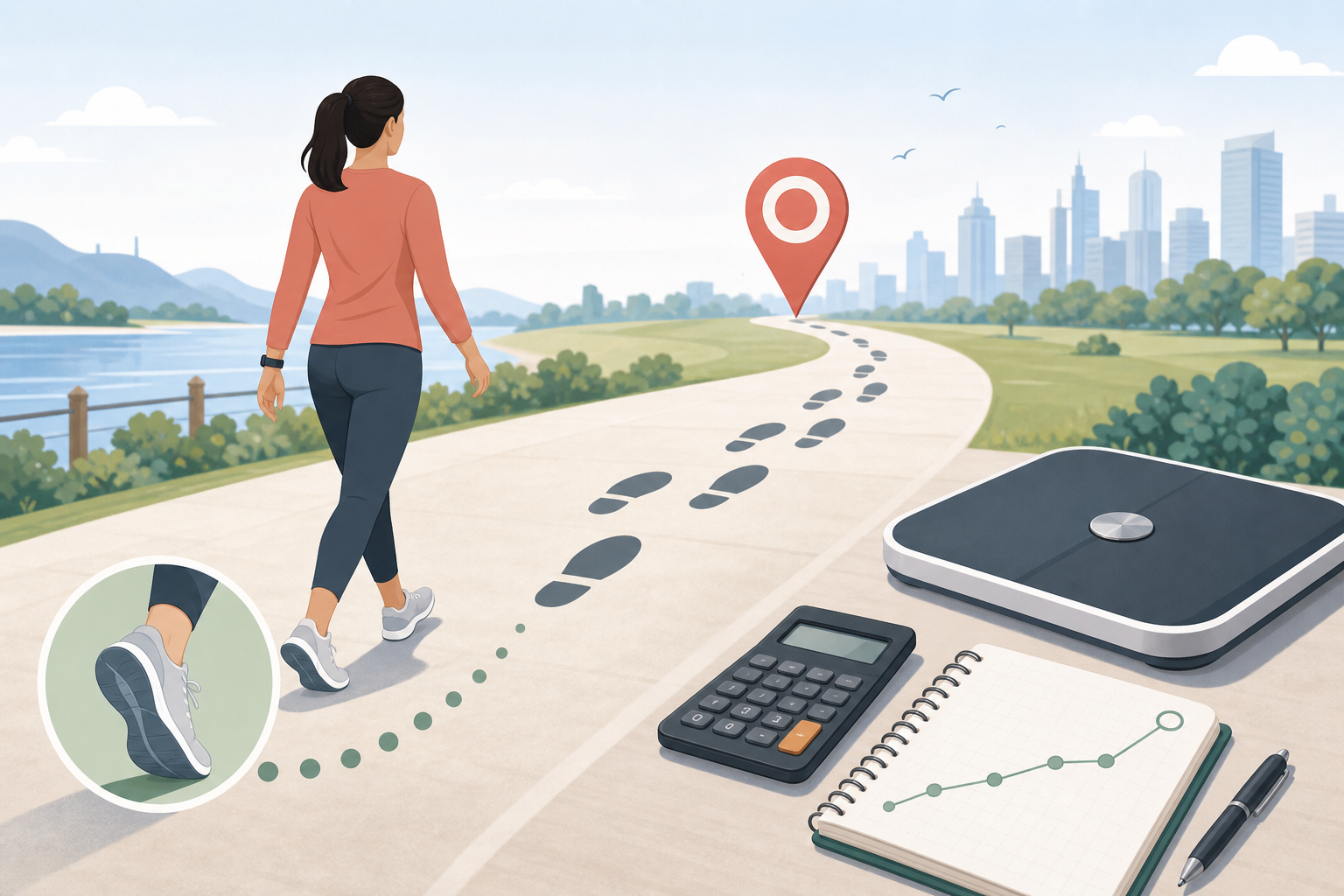
If you are asking how many steps are in one kilometre, there is no single number that applies to everyone. The answer depends mainly on step length. For example, a person taking 60-centimetre steps would need about 1,667 steps to cover one kilometre, while someone taking 80-centimetre steps would need about 1,250 steps.
- How many steps are in one kilometre at different step lengths?
- The formula for converting steps to kilometres
- Example using a 70-centimetre step
- Why step length changes the answer
- How the steps to kilometres calculator works
- What the calculator can tell you
- What the calculator cannot tell you
- What does 10000 steps in km equal?
- How to obtain a more personal estimate
- Using step and distance estimates consistently
- Frequently asked questions
- Is 1,000 steps equal to one kilometre?
- Why does my tracker show a different distance?
- Does height determine exact steps per kilometre?
- Are walking and running steps converted in the same way?
- Should I use step length or stride length?
- Can I calculate kilometres without knowing my step length?
- The practical answer
A height-based estimate can provide a practical planning value, but it is not the same as measuring distance with a calibrated device. Walking speed, terrain, footwear and natural movement patterns can all change the result.
How many steps are in one kilometre at different step lengths?
One kilometre contains 100,000 centimetres. Dividing that distance by your average step length gives your estimated steps per kilometre.
| Average step length | Estimated steps per kilometre |
|---|---|
| 50 cm | 2,000 steps |
| 55 cm | 1,818 steps |
| 60 cm | 1,667 steps |
| 65 cm | 1,538 steps |
| 70 cm | 1,429 steps |
| 75 cm | 1,333 steps |
| 80 cm | 1,250 steps |
| 85 cm | 1,176 steps |
| 90 cm | 1,111 steps |
These figures are mathematical examples rather than universal averages. A shorter step length produces more steps per kilometre, while a longer step length produces fewer.
The formula for converting steps to kilometres
The basic conversion uses the number of steps and an estimated or measured step length:
Distance in kilometres = steps × step length in centimetres ÷ 100,000
To calculate steps per kilometre instead, use:
Steps per kilometre = 100,000 ÷ step length in centimetres
Example using a 70-centimetre step
Suppose your estimated step length is 70 centimetres. The calculation for one kilometre is:
100,000 ÷ 70 = approximately 1,429 steps
If you record 6,000 steps at the same estimated step length, the distance calculation is:
6,000 × 70 ÷ 100,000 = 4.2 kilometres
The result remains an estimate because the calculation assumes that every step is 70 centimetres long. In daily life, step length is rarely identical from one step to the next.
Why step length changes the answer
Step length is the distance from the initial contact of one foot to the initial contact of the other foot. It is sometimes confused with stride length, which covers two steps: from one foot contacting the ground to the next contact of that same foot.
Height can help estimate step length because people with greater height often have the potential to take longer steps. However, two people of the same height may still record different distances from the same number of steps.
Factors that can affect step length include:
- Walking speed and whether the pace changes during the route
- Uphill, downhill or uneven ground
- Indoor walking, where frequent turns may shorten steps
- Crowded routes or stop-and-start movement
- Footwear and the surface underfoot
- Personal walking pattern and comfortable range of motion
- Whether the steps were recorded while walking or running
Running steps may be longer than walking steps, but this varies with speed and technique. A conversion based only on height may therefore be less representative when a step total combines household movement, outdoor walking and running.
How the steps to kilometres calculator works
The steps to kilometres calculator converts a recorded step total into estimated kilometres using a height-based step-length estimate. This avoids applying one fixed conversion rate to every person.
The general process is:
- Choose the unit system or other options requested by the tool.
- Enter your height and step total.
- Select Calculate to view the estimated distance and supporting details.
- Review the explanation and limitations before using the result for planning.
What the calculator can tell you
The calculator can provide a consistent estimate for comparing daily step totals, planning approximate walking distances or translating a step goal into kilometres. It may be more personally relevant than assuming that every person takes the same number of steps per kilometre.
It is also useful when only a step count is available. For example, if a basic pedometer reports steps but not distance, a height-based estimate can translate the total into a more familiar distance unit.
What the calculator cannot tell you
The calculator does not directly measure the route you travelled. It cannot account for every change in step length, terrain, pace or device sensitivity.
It also cannot confirm that every recorded movement was a genuine walking step. Wrist-worn trackers and phones may use different detection methods, and where the device is carried can affect the count. For that reason, its output may differ from GPS distance or a measured route.
What does 10000 steps in km equal?
The answer to 10000 steps in km depends on the assumed step length. Using the standard conversion formula, 10,000 steps could represent the following distances:
| Average step length | Distance for 10,000 steps |
|---|---|
| 55 cm | 5.5 km |
| 60 cm | 6.0 km |
| 65 cm | 6.5 km |
| 70 cm | 7.0 km |
| 75 cm | 7.5 km |
| 80 cm | 8.0 km |
| 85 cm | 8.5 km |
For example, two people may each record 10,000 steps. If one has an average step length of 60 centimetres, the estimated distance is 6 kilometres. If the other averages 80 centimetres per step, the same step count represents an estimated 8 kilometres.
This does not mean that either person has a better step total. Steps and distance are simply different measurements, and the conversion between them depends on step length.
How to obtain a more personal estimate
A height-based estimate is convenient when you do not know your step length. If you want a conversion based more closely on your own walking pattern, you can estimate step length over a measured route.
- Choose a flat, clearly measured distance, such as 100 metres.
- Walk at your usual pace rather than deliberately lengthening or shortening your steps.
- Count the steps needed to cover the measured distance.
- Repeat the walk and use the average step count.
- Divide the distance in centimetres by the average number of steps.
For example, 100 metres equals 10,000 centimetres. If you cover that distance in 145 steps, your estimated step length is:
10,000 ÷ 145 = approximately 69 centimetres per step
Your corresponding estimate would be about 1,449 steps per kilometre:
100,000 ÷ 69 = approximately 1,449 steps
A longer test route can reduce the influence of a few unusually short or long steps. Repeating the measurement can also show whether your result is reasonably consistent.
Even a measured step length remains specific to the conditions of the test. A flat-route measurement may not represent walking on hills, moving through a busy building or running.
Using step and distance estimates consistently
For day-to-day comparisons, consistency can be more useful than trying to find a supposedly universal conversion. Use the same device position and the same conversion method when comparing one day or week with another.
If you change phones, trackers or calculation methods, differences in the reported total may reflect the method rather than a major change in the distance covered. GPS and step-based estimates also measure distance differently, so exact agreement should not be expected.
Choose the measurement that suits the question. A step count is useful for describing accumulated movement, including short trips around the home or workplace. A measured route or GPS estimate may be more useful when the distance of a particular walk matters.
Frequently asked questions
Is 1,000 steps equal to one kilometre?
Not for most step lengths shown in the examples above. Covering one kilometre in exactly 1,000 steps would require an average step length of 100 centimetres. With a 70-centimetre step, 1,000 steps would equal an estimated 0.7 kilometres.
Why does my tracker show a different distance?
Your tracker may use its own step-length estimate, GPS data or a combination of sensor inputs. Differences can also arise from variable pace, hills, turns, device placement or steps that were missed or incorrectly detected.
Does height determine exact steps per kilometre?
No. Height can support a useful estimate, but it does not determine exact step length. Walking pattern, pace, terrain and individual body proportions can change the number of steps needed.
Are walking and running steps converted in the same way?
The mathematical formula is the same, but the step length entered should represent the activity. A height-based walking estimate may not accurately represent running steps, particularly when running speed varies.
Should I use step length or stride length?
Use step length when the formula multiplies a count of individual steps. If you have measured stride length, remember that one stride normally contains two steps, so confirm which measurement your calculator or device requires.
Can I calculate kilometres without knowing my step length?
You need either an assumed or estimated step length to convert steps into distance. A height-based method can provide a planning estimate when a personal measurement is unavailable, but it should not be treated as a directly measured distance.
The practical answer
The answer to how many steps are in one kilometre depends on the length of each step. A 60-centimetre step gives about 1,667 steps per kilometre, a 70-centimetre step gives about 1,429, and an 80-centimetre step gives about 1,250.
A height-based calculation is suitable for general planning, while a step length measured over a known route can provide a more individual estimate. In either case, the result may differ from GPS because real-world step length changes with pace, terrain and walking conditions.