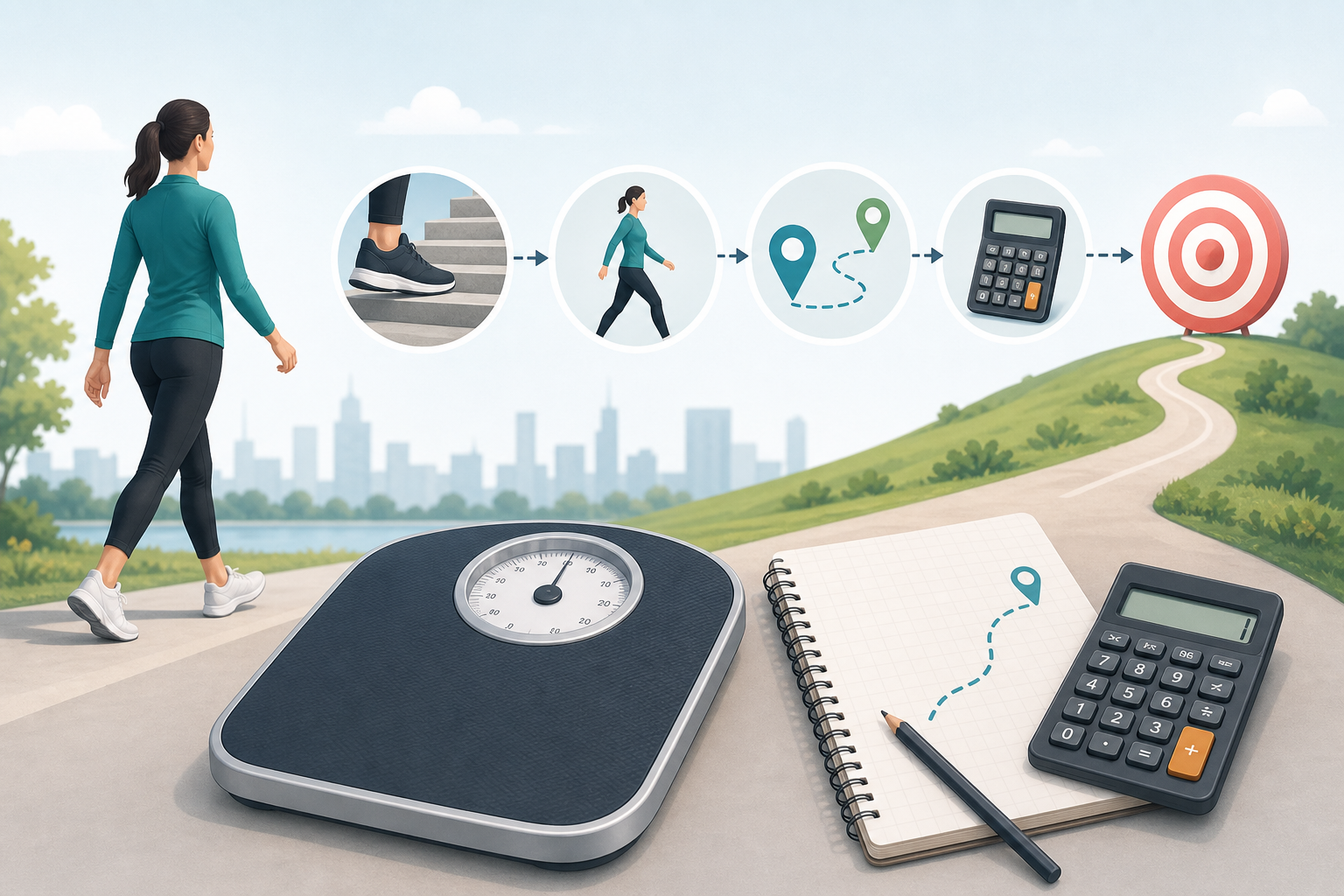
To understand how to calculate walking distance from steps, multiply your step count by your estimated step length. The result is an approximate distance because step length varies between people and can change with pace, terrain, footwear and gait. A height-based estimate is useful when you have not measured your step length directly.
In its simplest form, the calculation is: distance = number of steps × step length. Keep both values in compatible units, then convert the result into kilometres or miles if needed.
How to Calculate Walking Distance From Steps
The calculation has two parts: estimate or measure the length of one step, then multiply it by the total number of steps.
Distance = steps × step length
For example, if you take 6,000 steps and your estimated step length is 0.70 metres:
6,000 × 0.70 m = 4,200 m, or 4.2 km
If you work in inches, multiply the number of steps by step length in inches. Divide the result by 63,360 to convert inches to miles.
| Starting unit | Conversion |
|---|---|
| Metres | Divide by 1,000 to get kilometres |
| Centimetres | Divide by 100,000 to get kilometres |
| Feet | Divide by 5,280 to get miles |
| Inches | Divide by 63,360 to get miles |
A steps to distance conversion is only as accurate as the step-length value used. Step count may come from a phone, watch, pedometer or manual count, while step length may be measured directly or estimated from height.
Estimating Step Length From Height
When measured step length is unavailable, a calculator may estimate it by multiplying height by a sex-specific factor:
Estimated step length = height × sex-specific factor
The selected factor represents a broad population estimate. It does not determine the exact step length of a particular person, even when height and the requested sex category are entered correctly.
It is also important to distinguish step length from stride length. Step length is generally the distance from a contact by one foot to the next contact by the other foot. A full stride usually covers two steps, from one foot’s contact to its next contact.
If a measured stride length covers two steps, divide it by two before using the basic distance formula. Treating a two-step stride as a one-step length would approximately double the estimated distance.
How to measure step length yourself
A direct measurement can reflect your usual walking pattern more closely than a height-based estimate. One practical method is to walk a known distance at a normal pace and count the steps taken.
- Choose a flat, measured route long enough to include several natural steps.
- Begin walking before the measured section so that your pace is already settled.
- Count each step taken within the measured distance.
- Divide the known distance by the number of steps.
- Repeat the process and use the average if the results differ.
For example, covering 20 metres in 28 steps gives a measured average step length of about 0.714 metres: 20 ÷ 28 = 0.714. This value can then be multiplied by a separate step count.
Practical Steps-to-Distance Examples
Suppose a person records 10,000 steps and uses an estimated step length of 0.72 metres. The calculation is:
10,000 × 0.72 m = 7,200 m = 7.2 km
To express this in miles, convert 7.2 kilometres to approximately 4.47 miles. This example does not mean that every 10,000-step day equals 7.2 kilometres. Someone with a shorter or longer step length would receive a different estimate from the same step count.
Consider another person who records 4,500 steps with a measured step length of 0.64 metres:
4,500 × 0.64 m = 2,880 m = 2.88 km
These examples show why step count alone cannot determine distance. Two people can record the same number of steps while covering different distances.
What a Walking Distance Calculator Can and Cannot Tell You
A walking distance calculator applies the conversion consistently and avoids the need to manage unit calculations manually. Depending on the available options, it may use your height and a sex-specific factor to estimate step length before calculating distance.
What it can estimate
- Step length based on the information and calculation method used by the tool.
- Total walking distance from the entered step count.
- Distance in the supported metric or imperial units.
- How different step counts or planning values affect the estimated distance.
What it cannot determine
- Your exact step length throughout the day.
- Whether every recorded movement was a genuine walking step.
- The precise route distance without location or route measurements.
- Walking speed, exercise intensity or energy expenditure from step count alone.
- How much of the total came from level ground, slopes, stairs or uneven surfaces.
To use the tool, choose the requested unit system, enter the available measurements and step count, and select Calculate. Review the supporting details so you know whether the result is based on a measured step length or a height-based estimate.
Step-derived distance should not be treated as a measured route length. GPS mapping, a measured track or a calibrated walking test may produce a different result because those methods assess distance more directly.
Why Walking Distance From Steps Can Vary
Step length is not fixed. Even the same person may take shorter or longer steps in different settings, so one estimated value may not represent every part of the day equally well.
- Pace: Step length may change when walking slowly, comfortably or briskly.
- Terrain: Hills, stairs, soft ground and uneven surfaces can alter normal movement.
- Footwear: Different shoes may affect comfort and gait.
- Environment: Crowded spaces and frequent turns can produce shorter steps than an open route.
- Device placement: A phone in a bag may detect movement differently from a watch or waist-worn pedometer.
- Gait: Individual movement patterns affect the relationship between height and step length.
Step count also does not describe walking intensity by itself. The 2024 Adult Compendium of Physical Activities distinguishes walking activities by factors such as speed and context, illustrating why an identical distance or step total does not necessarily represent an identical activity demand.
For routine comparisons, consistency can be more useful than false precision. Using the same device and the same step-length method makes estimates easier to compare, although it does not remove measurement error.
Frequently Asked Questions
How many kilometres are 10,000 steps?
There is no single conversion that applies to everyone. Multiply 10,000 by your step length in metres, then divide by 1,000. With an assumed step length of 0.72 metres, the estimate would be 7.2 kilometres, but a different step length changes the result.
Can height alone provide an accurate walking distance?
Height can support a practical estimate of step length, but it does not measure it. People of the same height can have different gait patterns, and an individual’s step length can change with walking conditions.
Should I use step length or stride length?
Use step length when multiplying by a standard step count. If you have measured a full stride from one foot contact to the next contact by the same foot, divide that measurement by two to obtain an average step length.
Why does my watch show a different distance?
A watch may combine step detection with its own stride estimate, motion sensors or location data. Differences in algorithms, device settings, GPS reception and step detection can therefore produce a result that does not match a simple height-based calculation.
Is measured step length always better than a height-based estimate?
A carefully measured average may better represent the pace and conditions used during the measurement. It may still be less representative when you walk at a different speed, on another surface or with a substantially different gait.
Does walking distance show how many calories were used?
No. Distance and step count do not capture all the factors involved in estimating activity energy expenditure. Pace, terrain, body size and the specific activity context can affect the estimate, so distance should not be treated as a direct calorie measurement.
Using the Estimate in Context
The most direct answer to how to calculate walking distance from steps is to multiply step count by average step length and convert the resulting units. A measured step length can personalise the calculation, while a height-based value offers a convenient approximation when no measurement is available.
Report the result as an estimate rather than an exact route distance. Keeping the same input method can make day-to-day comparisons more consistent, but pace, terrain, footwear, gait and device behaviour may still affect the numbers.