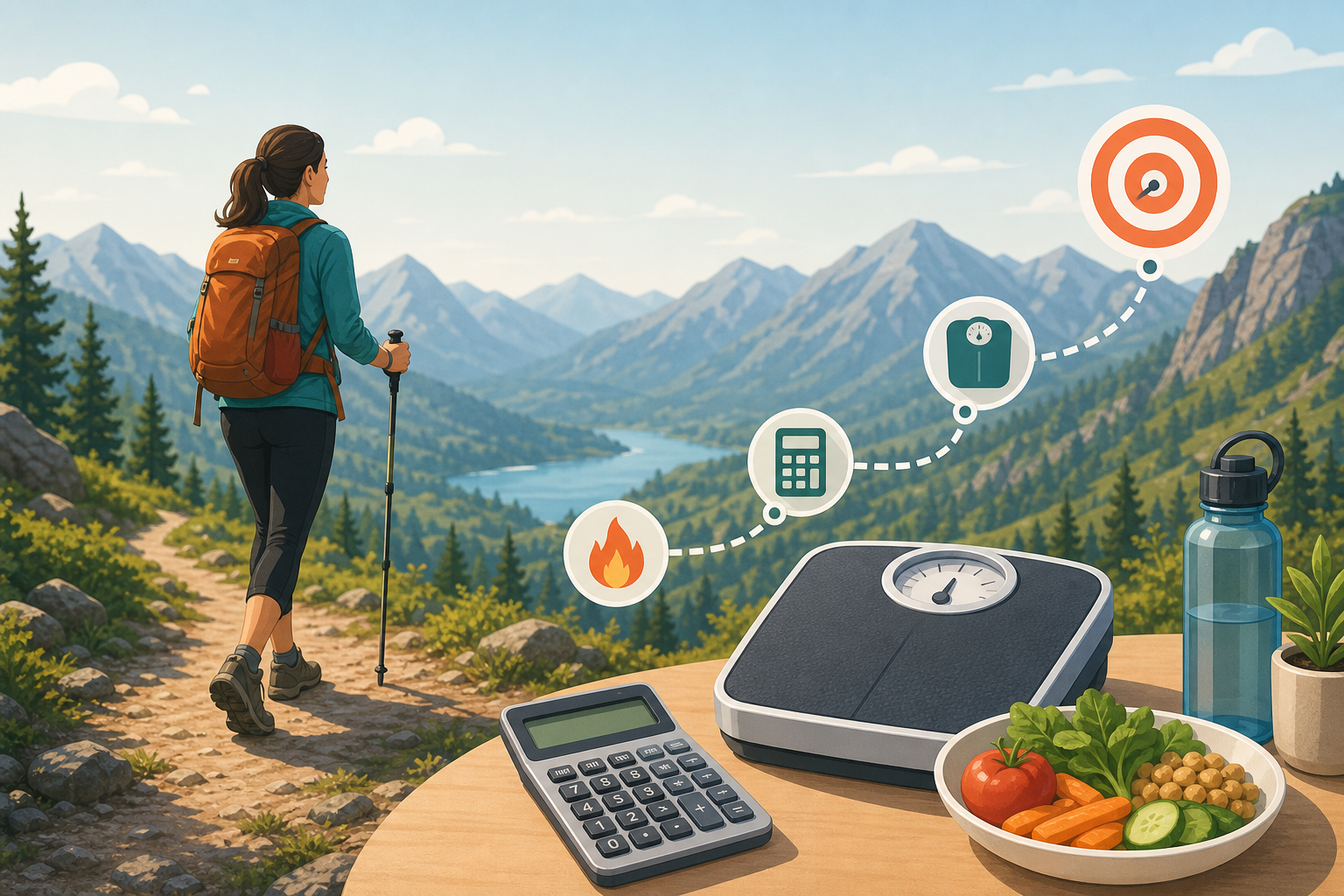
If you are wondering how many calories does hiking burn, the answer depends mainly on body weight, hiking duration and intensity. An 80 kg person hiking for 90 minutes at an estimated intensity of 6 MET uses about 756 kilocalories (kcal) according to a standard MET-based calculation. This is an estimate rather than a measured value because terrain, elevation, pack weight, pace, surface conditions and rest stops can all affect actual energy expenditure.
How many calories does hiking burn at different intensities?
Hiking ranges from easy walking on a maintained trail to sustained climbing over steep or uneven ground. As the physical demands increase, estimated energy expenditure generally rises.
The table below shows illustrative estimates for 60 minutes using three example intensity values. These figures are calculated estimates, not universal burn rates for every trail or hiker.
| Body weight | 4 MET | 6 MET | 8 MET |
|---|---|---|---|
| 60 kg | 252 kcal | 378 kcal | 504 kcal |
| 80 kg | 336 kcal | 504 kcal | 672 kcal |
| 100 kg | 420 kcal | 630 kcal | 840 kcal |
A MET, or metabolic equivalent, is a way to classify the energy cost of an activity relative to rest. Published activity references, including the 2024 Adult Compendium of Physical Activities, provide MET values for many types of physical activity. A selected value represents a category of activity; it does not measure one person’s effort directly.
What affects calories burned hiking?
Body weight, active hiking time and intensity form the basis of a simple hiking calorie burn estimate. Several trail and personal factors influence how well the selected intensity represents the actual outing.
Body weight
Within the MET formula, estimated calorie use increases in direct proportion to body weight. If two people hike for the same time at the same assigned MET value, the calculation gives the heavier person a higher estimate.
This is a feature of the equation, not a judgement about fitness or hiking ability. Two people of the same weight can still have different measured energy expenditure because movement efficiency and actual effort vary.
Duration
Longer active hiking time produces a higher estimate. For useful results, duration should represent the period spent hiking rather than the full time between arriving at and leaving the trail.
Long meal breaks, sightseeing stops and other inactive periods can inflate the estimate if they are included as active minutes. Short pauses naturally occur on most hikes, so perfect timing is not necessary, but distinguishing moving time from substantial rest periods improves consistency.
Terrain and elevation change
A level, firm trail usually requires less effort than steep, loose or uneven ground at a similar pace. Repeated climbs, scrambling and difficult footing can raise the intensity, while downhill travel may still be demanding even when it feels different from climbing.
Distance alone does not capture these differences. Two hikes of the same length can have substantially different time and effort requirements.
Pace and pack weight
A faster pace generally increases effort, particularly on an incline. Carrying water, camping equipment or other gear can also make a hike more demanding, but a basic calculator may not adjust separately for the exact load.
Weather, altitude and trail conditions may change perceived difficulty as well. Unless the calculator specifically requests these details, their effects are represented only indirectly through the chosen intensity.
How the hiking calorie calculation works
A common estimation method combines a MET value with body weight and time:
Estimated kcal = MET × 3.5 × body weight in kilograms ÷ 200 × minutes
The MET value represents the selected activity intensity. Body weight must be entered in kilograms for this version of the equation, while time is entered in minutes. A calculator that accepts pounds can convert the weight before applying the formula.
Practical example
Consider an 80 kg adult who spends 90 active minutes hiking at an estimated intensity of 6 MET:
6 × 3.5 × 80 ÷ 200 × 90 = 756 kcal
The resulting estimate is about 756 kcal. If the hike included a long stationary break within those 90 minutes, using only the active portion would usually provide a more relevant estimate.
MET calculations generally estimate total energy expenditure during the stated period, including the energy the body would have used at rest. They should not automatically be treated as “extra” calories above resting needs unless a tool clearly reports net activity calories.
Choosing a suitable hiking intensity
The intensity selection is often the most uncertain part of the calculation. Trail labels such as easy, moderate or hard may refer to navigation, exposure, distance or technical difficulty as well as physical effort, so they do not always map neatly to one MET value.
When choosing among the calculator’s options, consider the activity performed for most of the recorded time:
- Lower intensity: relaxed hiking on relatively level or gently rolling, maintained ground.
- Moderate intensity: purposeful hiking with sustained movement, varied terrain or regular inclines.
- Higher intensity: fast movement, steep climbing, demanding terrain or another clearly strenuous hiking pattern.
These descriptions are general guides rather than fixed definitions. If the route changes significantly, one option may not represent the entire outing.
For a mixed hike, the time can be separated into segments. For example, calculate 45 minutes of easier approach walking and 30 minutes of strenuous climbing separately, then add the two estimates. This may be more informative than assigning the whole 75 minutes to the highest intensity.
What a hiking calories calculator can and cannot tell you
A hiking calories calculator provides a structured estimate from body weight, terrain intensity and duration. It applies the same formula consistently, making it useful for comparing possible routes, durations or intensity choices.
It can help with:
- estimating energy expenditure for a planned or completed hike;
- comparing hikes of different durations at the same assumed intensity;
- seeing how the estimate changes with body weight or intensity;
- keeping planning assumptions consistent across several outings.
It cannot directly measure individual energy expenditure. A basic estimate may not fully account for elevation profile, exact speed, pack weight, surface, weather, movement efficiency, fitness, pauses or the difference between continuous and intermittent effort.
The displayed result should therefore be read as an approximate value, not as a precise calorie allowance or a guaranteed indicator of changes in body weight. Rounding the result and thinking in terms of a reasonable range is often more practical than relying on a single exact number.
Using hiking calorie burn estimates sensibly
For comparisons, use the same approach each time. Record active minutes consistently, choose the intensity that best describes most of the hike, and avoid changing categories solely to produce a preferred result.
Be cautious when using calories burned hiking to make food decisions. Exercise estimates and food-energy estimates both contain uncertainty, so matching one number exactly to another can create a false sense of precision.
If you repeat a familiar route, your recorded time and the calculator’s estimate can help describe the outing consistently. However, a lower time does not necessarily mean a proportionally lower total effort, especially if the faster pace increased intensity.
Ultimately, the best answer to how many calories does hiking burn is an informed estimate based on body weight, active duration and a realistic intensity category, interpreted alongside the route’s terrain and elevation.
Frequently asked questions
Does hiking burn more calories than ordinary walking?
It can, particularly when hiking includes hills, uneven surfaces, a faster pace or a carried load. An easy hike on level ground may be closer in intensity to ordinary walking, so the activity description matters more than the label alone.
Should I enter total trip time or moving time?
Use active hiking time when possible. Brief natural pauses do not need to be timed precisely, but long rest, meal or sightseeing stops should generally be excluded if the calculator assumes continuous activity.
How does elevation affect the estimate?
Climbing usually increases effort, but a simple calculator may not ask for total elevation gain. In that case, elevation is reflected indirectly through the intensity selection, making that choice especially important on hilly routes.
Does carrying a backpack increase hiking calorie burn?
A backpack can increase the effort required, particularly if it is heavy or carried over steep terrain. If pack weight is not a separate calculator input, the standard result may not fully represent this additional demand.
Why does my fitness tracker show a different result?
Trackers and calculators may use different inputs and algorithms. A tracker might incorporate heart rate, speed, elevation or personal data, while a MET calculator uses an assigned intensity, body weight and time. Neither figure should automatically be treated as a direct laboratory measurement.