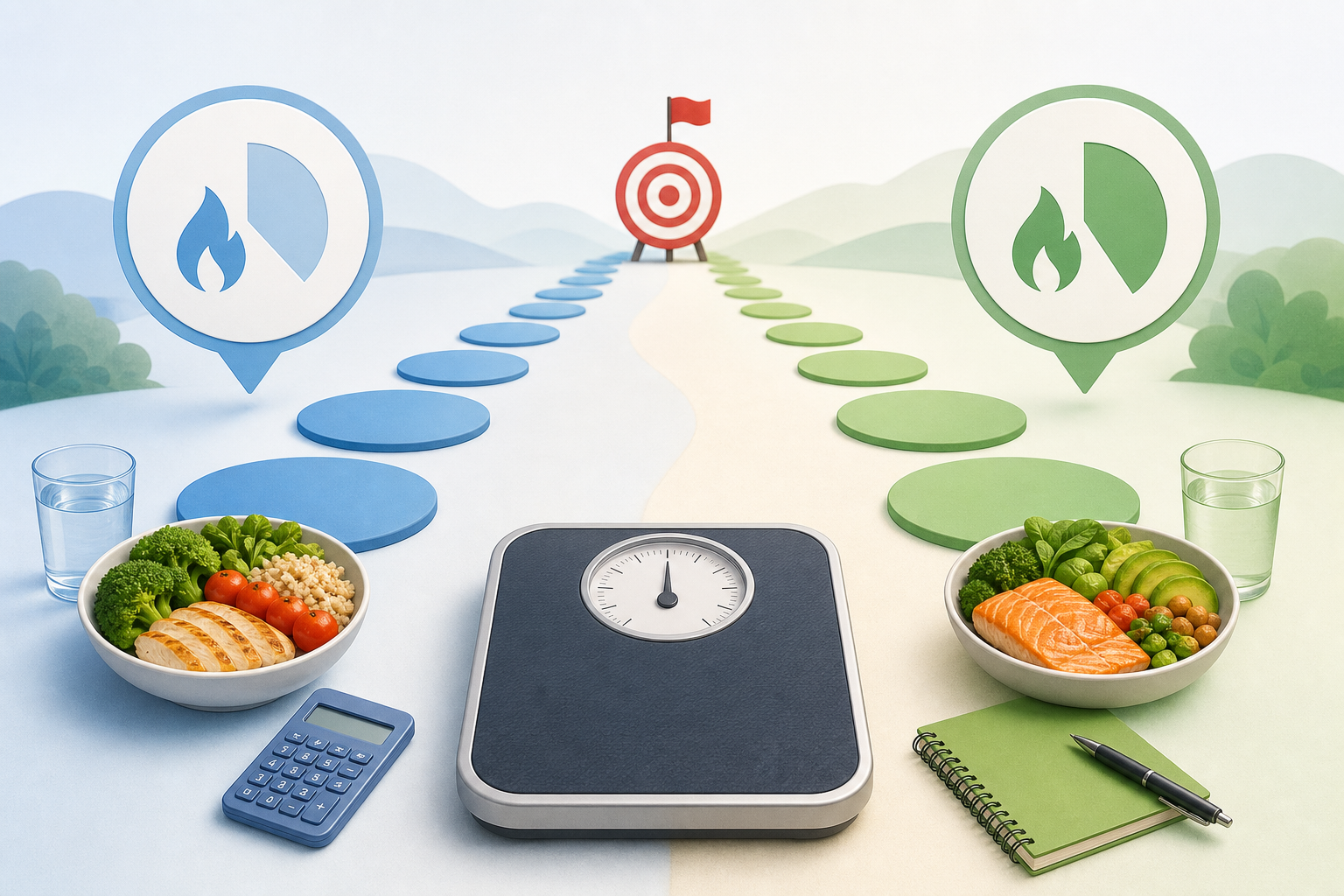
The main difference in a 300 vs 500 calorie deficit is the size of the planned reduction from estimated maintenance calories. A 300-calorie daily deficit is smaller and may be easier to maintain, while a 500-calorie deficit creates a larger nominal energy gap but can make hunger, meal planning and nutrient adequacy more challenging. Neither option is automatically better: the appropriate target depends on estimated energy needs, food preferences, activity, health considerations and long-term adherence.
300 vs 500 calorie deficit: quick comparison
| Planning factor | 300-calorie deficit | 500-calorie deficit |
|---|---|---|
| Daily calorie reduction | 300 kcal below estimated maintenance | 500 kcal below estimated maintenance |
| Nominal weekly deficit | 2,100 kcal | 3,500 kcal |
| Potential advantage | More food flexibility and a smaller adjustment | Larger planned energy gap |
| Potential drawback | Changes may be slower or harder to detect over short periods | May be harder to sustain or may produce an inappropriately low target |
| Best viewed as | A moderate starting estimate | A larger starting estimate that needs an adequacy check |
The weekly figures are mathematical totals, not promises of a particular amount of weight loss. Body weight does not change in a perfectly linear way, and maintenance needs may change as weight, activity and other factors change. The NIDDK Body Weight Planner illustrates why longer-term weight planning is more complex than applying a fixed calorie-to-weight conversion.
Why the same daily calorie deficit affects people differently
An absolute deficit must be considered relative to the person’s estimated total daily energy expenditure, or TDEE. A 500-calorie reduction represents 25% of a 2,000-kcal maintenance estimate but only about 17% of a 3,000-kcal estimate. The first reduction is proportionally more aggressive.
Maintenance calories are also estimates rather than directly measured values. Calculators commonly estimate resting energy expenditure from factors such as age, sex, height and weight, then account for activity. The Mifflin equation is one established method for estimating resting energy expenditure, but any equation can differ from an individual’s actual needs.
Daily activity can vary substantially even when planned exercise stays the same. Work demands, walking, household tasks and time spent sitting can all affect total expenditure. Food intake records also contain uncertainty because portions, recipes and product labels are not perfectly precise.
Trade-offs between a smaller and larger deficit
Adherence and food flexibility
A 300-calorie deficit leaves 200 more calories per day than a 500-calorie deficit based on the same maintenance estimate. That extra room may make it easier to accommodate preferred foods, social meals and day-to-day variation. A target that fits a person’s routine may be more useful than a larger deficit that is followed only intermittently.
Hunger and meal composition
A larger reduction may feel more demanding, particularly for someone whose estimated maintenance intake is already modest. Hunger does not depend only on the calorie target; meal timing, food choices, sleep, activity and personal responses can also matter. Comparing targets therefore requires more than looking at the numerical difference.
Nutrient adequacy
As calorie intake decreases, there is less room for foods that provide protein, fibre, vitamins, minerals and essential fats. A 500-calorie deficit is not inherently inappropriate, but the resulting calorie target needs to be considered. Very low targets may not provide enough flexibility to meet nutritional needs and can require individual professional guidance.
A practical comparison using estimated maintenance calories
Suppose a person’s estimated TDEE is 2,400 kcal per day. The two nominal targets would be:
- With a 300-calorie deficit: 2,400 − 300 = 2,100 kcal per day.
- With a 500-calorie deficit: 2,400 − 500 = 1,900 kcal per day.
In percentage terms, these are approximately 12.5% and 20.8% deficits. This matters because the related calculator applies a selected percentage deficit rather than subtracting the same fixed number for everyone.
For comparison, a 15% deficit from an estimated TDEE of 2,400 kcal gives a target of about 2,040 kcal per day:
2,400 × (1 − 0.15) = 2,040 kcal per day.
These values are planning estimates. They do not account perfectly for metabolic adaptation, changes in spontaneous activity, variations in intake or short-term changes in body water.
What a calorie deficit calculator can and cannot tell you
A calorie deficit calculator first estimates maintenance calories and then applies the percentage deficit selected:
Calorie target = estimated TDEE × (1 − deficit percentage).
The calculator can help with:
- Comparing several percentage-based deficit options.
- Seeing how a deficit relates to estimated maintenance needs.
- Creating an initial calorie target for planning and observation.
- Understanding why the same percentage produces different targets for different maintenance estimates.
It cannot directly measure an individual’s true maintenance calories, guarantee a rate of weight loss or model every change in metabolism and activity. It also cannot determine whether a low target is nutritionally adequate for a particular person.
Because the calculator uses percentages, its result may not equal an exact 300- or 500-calorie reduction. For example, a 15% deficit equals 300 calories when estimated maintenance is 2,000 kcal, but it equals 450 calories when maintenance is 3,000 kcal.
How to choose a reasonable starting estimate
Choosing a daily calorie deficit involves balancing the desired energy gap with practicality. A smaller deficit may suit someone who values food flexibility, experiences substantial hunger with larger reductions or prefers a more gradual adjustment. A larger deficit may appear manageable when estimated maintenance needs are higher, but the resulting intake still needs to support daily functioning and adequate food variety.
Whichever estimate is used, it is helpful to assess patterns over time rather than reacting to individual weigh-ins. Short-term body weight can vary for reasons unrelated to changes in body fat. Changes in activity or tracking habits can also make the real-world deficit different from the planned deficit.
If a target repeatedly feels unmanageable or produces an unusually low calorie allowance, the calculation should be reconsidered rather than treated as a fixed prescription. In the 300 vs 500 calorie deficit comparison, the more useful option is generally the one that remains realistic, nutritionally workable and responsive to observed results.
Frequently asked questions
Is a 500-calorie deficit always faster than a 300-calorie deficit?
A 500-calorie deficit creates a larger planned energy gap, so it may lead to a faster change if all other factors remain equal. In practice, intake and expenditure fluctuate, energy needs can change, and a larger target may be harder to follow consistently. A precise rate cannot be guaranteed from the planned deficit alone.
Can I switch between 300- and 500-calorie deficits?
A daily target does not have to be identical every day. Some people plan around an average intake, provided higher- and lower-intake days remain practical and do not encourage an overly restrictive pattern. The weekly average is still an estimate because both food intake and expenditure are difficult to measure exactly.
Is a percentage deficit better than a fixed calorie deficit?
A percentage deficit automatically scales with estimated maintenance needs, while a fixed deficit does not. This can make percentage-based comparisons more informative across people with different energy requirements. Neither method removes the uncertainty in the underlying maintenance estimate.
What if the calculator’s calorie target seems too low?
Do not assume that a calculated result must be followed. Recheck the entered measurements, unit system and activity selection, and consider using a smaller percentage deficit. Very low calorie targets may be inappropriate and warrant individual assessment from a qualified healthcare professional.
Why is my weight not changing at the rate suggested by the deficit?
The deficit is based on estimated maintenance and recorded intake, both of which contain uncertainty. Body-water changes can also obscure the trend over short periods, while energy requirements may change over time. The mathematical deficit should therefore be treated as a planning tool rather than a forecast.
References
- Mifflin MD et al. Resting energy expenditure equation
- National Institute of Diabetes and Digestive and Kidney Diseases: Body Weight Planner and weight-management resources