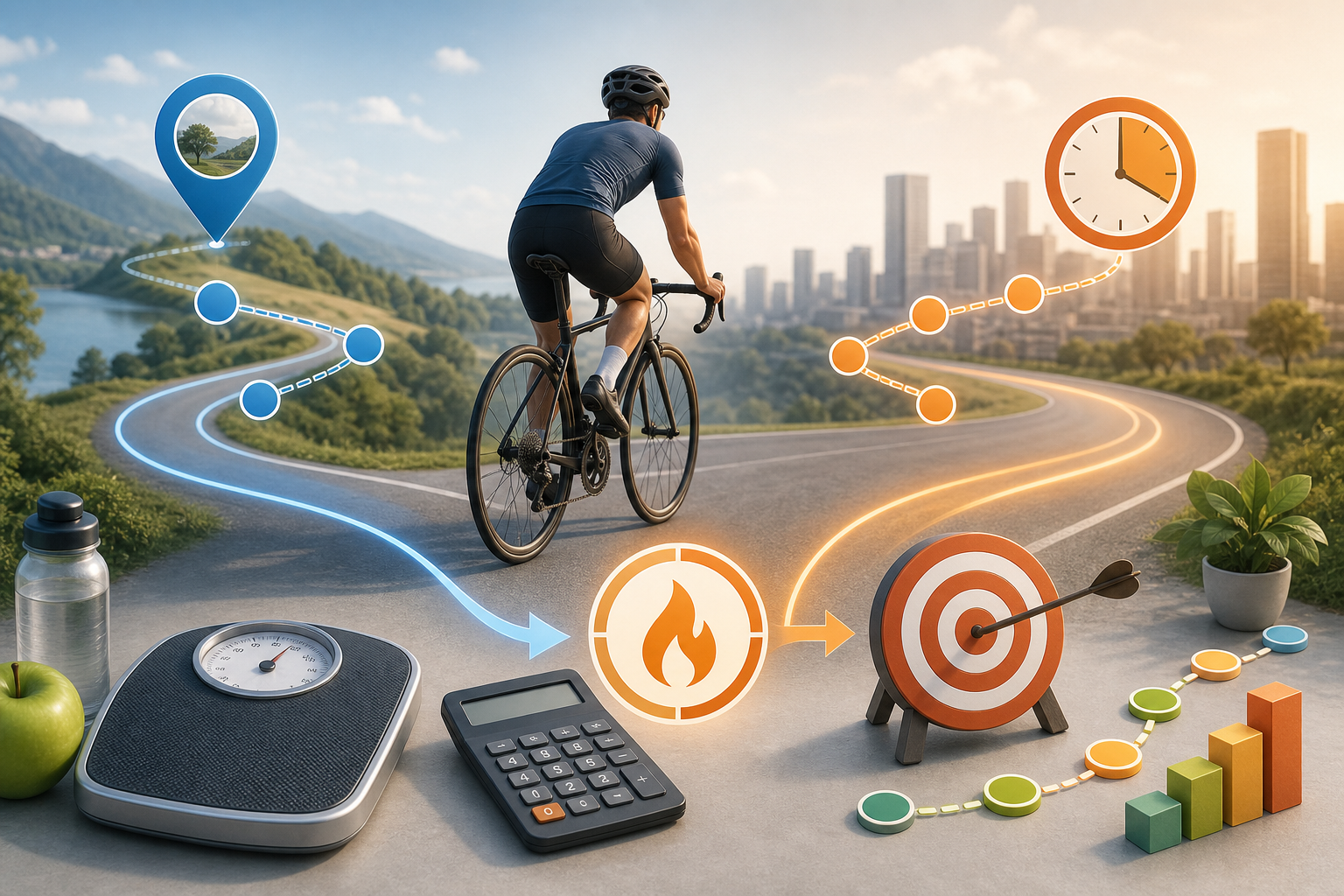
For cycling distance vs duration for calorie burn estimates, duration combined with a realistic intensity level is usually more useful than distance alone. A 20 km ride may be easy or demanding depending on speed, hills, wind, surface, stops and bicycle type. Time shows how long the activity lasted, while intensity represents how hard the work was; body weight is then used to estimate energy expenditure.
- Cycling distance vs duration for calorie burn estimates: which input matters more?
- Why equal cycling distances can produce different estimates
- How duration and intensity are used in calorie estimates
- Practical examples: when distance can be misleading
- A short hilly ride and a longer flat ride
- An outdoor commute with frequent stops
- A stationary cycling session
- What the cycling calories calculator can and cannot tell you
- How to choose better inputs for a cycling estimate
- Frequently asked questions
- Can cycling calories be estimated from kilometres alone?
- Does cycling faster always mean more calories burned?
- Should I enter moving time or elapsed time?
- Why does my fitness watch show a different bike calorie burn?
- Is indoor bike distance useful for estimating calories?
- Key takeaway
Cycling distance vs duration for calorie burn estimates: which input matters more?
Distance describes how far the bicycle travelled, but it does not directly describe the amount of work required. Two riders can cover the same route with very different effort levels and ride times. Even the same rider may use different amounts of energy on that route from one day to another.
Duration is more informative when it is paired with intensity. Riding for 45 minutes at a relaxed pace is different from riding for 45 minutes at a vigorous pace, so time cannot produce a useful estimate by itself either.
| Input | What it helps describe | What it may miss |
|---|---|---|
| Distance | Route length and average speed when time is also known | Hills, wind, stops, drafting, bicycle efficiency and actual effort |
| Duration | How long the cycling effort lasted | How easy or demanding the ride was |
| Intensity | The approximate energy cost per unit of time | Individual fitness, cycling efficiency and day-to-day variation |
| Body weight | Scales the estimate within a MET-based equation | Personal differences in movement efficiency and physiology |
Distance becomes more useful when it is combined with ride time, because those values provide average speed. Speed can help select an intensity category, but it is still an indirect indicator of effort rather than a direct measurement.
Why equal cycling distances can produce different estimates
A flat 15 km ride with a tailwind may take less time and require less effort than 15 km into a headwind. An uphill route may be shorter but more demanding than a longer, mostly downhill route. Road surface, traffic interruptions and equipment can also affect the relationship between distance and bike calorie burn.
Bicycle type matters as well. A road bicycle, mountain bicycle, electric-assist bicycle and stationary bike do not create identical demands at the same displayed speed. On an indoor bike, distance may be generated by the machine’s own algorithm, so it may not be directly comparable with outdoor kilometres.
Drafting behind other cyclists can reduce the effort needed to maintain a particular speed. Carrying luggage, riding on soft ground or using a bicycle with higher rolling resistance may increase effort without producing a large change in distance.
For these reasons, distance is best treated as context. It can help describe the session, but it should not be the only input used to estimate calories burned cycling.
How duration and intensity are used in calorie estimates
Many activity calculators use metabolic equivalent, or MET, values. MET values provide a standardized way to classify the approximate energy cost of activities and intensity levels. The 2024 Adult Compendium of Physical Activities includes MET values for a range of cycling activities.
A commonly used calculation is:
Estimated kcal = MET × 3.5 × body weight in kilograms ÷ 200 × minutes
In this method, duration has a direct effect on the result: more minutes at the same selected MET value produce a higher estimate. Choosing a higher intensity also raises the estimate because the MET value represents a greater estimated energy cost per minute.
For example, consider a person weighing 80 kg who cycles for 45 minutes at an intensity represented by 6.8 MET:
6.8 × 3.5 × 80 ÷ 200 × 45 = approximately 428 kcal
The result is an estimate, not a measured value. It depends heavily on whether 6.8 MET is an appropriate description of the actual ride. If the session alternated between easy coasting, hard climbs and stops, one intensity value may not represent the full ride accurately.
Practical examples: when distance can be misleading
A short hilly ride and a longer flat ride
Suppose one ride covers 12 km over steep terrain in 50 minutes, while another covers 18 km on a flat route in the same time. Distance alone would suggest that the 18 km ride used more energy. However, the climbing ride may have required greater sustained effort.
A duration-and-intensity estimate can reflect this difference by assigning an intensity that better matches each session. The result will still be approximate, but it accounts for more relevant information than kilometres alone.
An outdoor commute with frequent stops
A 40-minute commute may include 10 minutes waiting at junctions. Entering all 40 minutes at the riding intensity could overstate the estimate because the rider was not cycling continuously.
Using active cycling time is generally more consistent when the chosen intensity describes movement. If the ride includes several clearly different periods, each period can be estimated separately—for example, easy cycling, harder cycling and stationary time.
A stationary cycling session
For indoor cycling, duration and resistance or effort level are usually more informative than the distance shown on the console. Different machines may calculate virtual distance differently, even when users cycle for the same amount of time at a similar perceived effort.
If a stationary bike reports power, that information may offer a more individualized view of mechanical work. However, converting mechanical work into calorie expenditure still involves assumptions and should not automatically be treated as a direct measurement of calories used by the body.
What the cycling calories calculator can and cannot tell you
The cycling calories calculator estimates energy expenditure from body weight, cycling intensity and duration. It applies a MET-based equation consistently, making it useful for comparing sessions when inputs are entered in the same way.
The calculator can help with:
- Estimating calories used during a cycling session.
- Comparing different durations at the same body weight and intensity.
- Comparing approximate intensity levels over the same duration.
- Creating a consistent record of similarly structured rides.
It cannot directly determine:
- Your exact physiological energy expenditure.
- Whether the selected intensity accurately matches your effort.
- The full effects of wind, gradient, drafting, road surface or bicycle efficiency.
- How much of the session was spent coasting or stopped unless duration is adjusted.
- Individual differences in cycling technique, fitness or metabolic response.
A calculator result should therefore be read as an estimated value rather than a measured calorie total. Differences between a calculator, fitness watch, bicycle computer and indoor bike are expected because each device may use different inputs and equations.
How to choose better inputs for a cycling estimate
Use the duration that best matches the activity being described. If the selected intensity represents continuous riding, active or moving time will usually be more suitable than total elapsed time that includes long breaks.
Select intensity based on the actual session rather than the planned session. Consider breathing, ability to speak, terrain, resistance, average speed and how consistently the effort was maintained. Speed can provide context, but avoid assuming that the same speed always represents the same effort.
For a variable ride, divide the session into reasonable segments rather than assigning one intensity to the entire route. For example:
- Record the minutes spent cycling easily.
- Record the minutes spent at a moderate or harder effort.
- Estimate each segment using its corresponding intensity.
- Add the segment estimates to obtain an approximate session total.
Use the same approach when comparing rides over time. Consistent input choices often make comparisons more meaningful, even though the individual calorie totals remain estimates.
Frequently asked questions
Can cycling calories be estimated from kilometres alone?
Only very roughly. Distance does not show how long the ride took or how hard the cyclist worked. Combining distance with time provides average speed, but duration, intensity and body weight are still more useful inputs for a MET-based estimate.
Does cycling faster always mean more calories burned?
Not necessarily for the whole session. Faster cycling often indicates greater effort, but wind, slope, drafting, bicycle type and session length affect the result. A faster but much shorter ride may have a different total energy cost from a slower, longer ride.
Should I enter moving time or elapsed time?
Use moving time when elapsed time includes substantial periods of no cycling and the selected intensity describes active riding. Brief pauses may make little practical difference, but long stops should not be counted as though the same cycling effort continued throughout them.
Why does my fitness watch show a different bike calorie burn?
Devices may use heart rate, speed, age, profile data, proprietary equations or sensor information. A MET calculator uses body weight, selected intensity and time. Because the methods and assumptions differ, the estimates do not have to match.
Is indoor bike distance useful for estimating calories?
Indoor distance can help track sessions on the same machine under similar settings, but it may not correspond closely to outdoor distance. Duration, resistance, effort and available power data are generally more informative for indoor cycling estimates.
Key takeaway
When comparing cycling distance vs duration for calorie burn estimates, distance is useful for describing a route, but duration and intensity better represent the factors used in standard calorie equations. Combining realistic active time, an appropriate intensity and body weight produces a more relevant estimate, while still leaving room for individual and environmental variation.