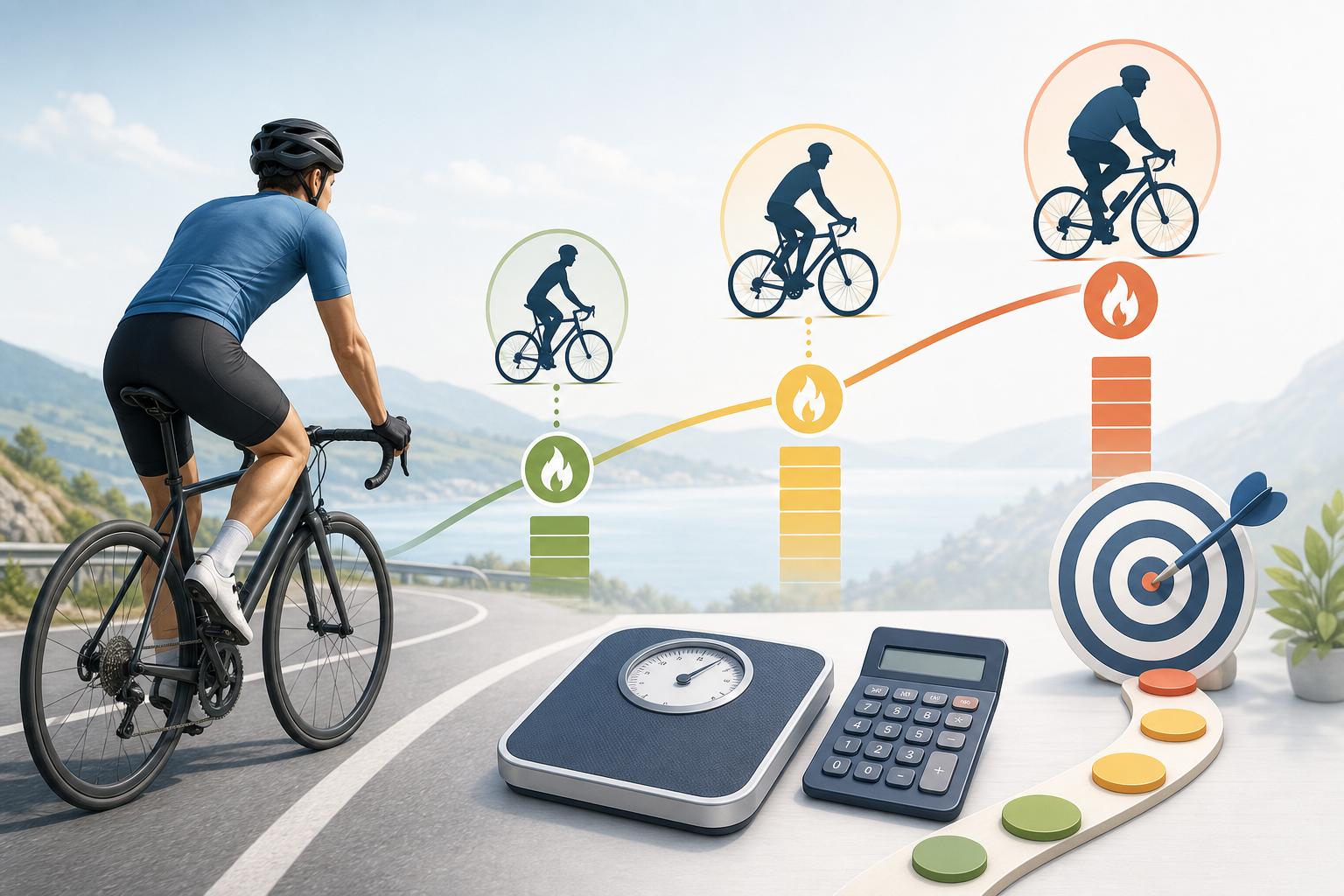
Understanding how body weight affects calories burned while cycling starts with a simple principle: standard calorie equations assign a higher energy estimate to a heavier person completing the same duration and intensity. For example, at an identical cycling intensity, an 80 kg rider will receive a higher calorie estimate than a 60 kg rider. However, body weight is only one part of bike calorie burn; effort, terrain, wind, bicycle type and measurement method also matter.
How body weight affects calories burned while cycling
Most activity-based calorie calculators use body weight because moving and supporting a larger body generally requires more energy. When cycling intensity and duration remain fixed, the estimated calories increase in direct proportion to the weight entered.
This does not mean a heavier rider always burns more calories on every real-world ride. Two people may travel at the same speed while producing different levels of effort because of fitness, riding position, bicycle efficiency, terrain and environmental conditions.
Body weight has a particularly noticeable practical effect when cycling uphill because the rider and bicycle must be moved against gravity. On level ground, aerodynamic resistance, speed and riding position may have a larger influence on effort than differences in body weight alone.
How MET-based cycling estimates use body weight
A common way to estimate calories burned cycling is to use a metabolic equivalent of task, or MET. A MET value represents the standardized energy cost assigned to an activity and intensity. Cycling activities are given different MET values according to factors such as pace, effort or cycling setting in resources including the 2024 Adult Compendium of Physical Activities.
The standard estimation formula is:
Estimated kcal = MET × 3.5 × body weight in kilograms ÷ 200 × duration in minutes
Body weight is multiplied directly within this formula. If duration and MET value stay unchanged, increasing the entered weight by 25% also increases the calculated result by 25%.
This is a mathematical feature of the estimation method, not proof that each person’s measured energy use follows the formula exactly. MET values describe standardized activity costs and cannot account for every individual or environmental difference.
Why intensity changes the result
The MET value is intended to represent cycling intensity. Easy recreational riding has a lower energy estimate than vigorous cycling for the same person and duration. As a result, selecting an intensity that reasonably matches the session is just as important as entering body weight accurately.
Speed can help describe intensity, but it is not a complete measure of effort. A rider may work harder at a lower speed when climbing, riding into a headwind, using an inefficient bicycle or cycling on a difficult surface.
Why body weight is not the only influence on bike calorie burn
Two riders of the same weight can receive the same calculator estimate while using different amounts of energy in practice. Several factors can change the demands of a cycling session:
- Effort and power output: Higher sustained effort generally requires more energy, even if speed does not increase because of hills or wind.
- Duration: Longer sessions produce higher estimates when weight and intensity remain the same.
- Terrain: Climbing usually demands more work than riding on a level route, while descending may require relatively little pedalling.
- Wind and aerodynamics: A headwind and a less aerodynamic position can increase the effort needed to maintain speed.
- Bicycle and equipment: Bicycle type, tyre choice, mechanical condition and carried load can affect efficiency and resistance.
- Indoor versus outdoor cycling: Indoor bikes avoid outdoor wind and terrain changes, while resistance settings and calibration vary between machines.
- Rider differences: Fitness, technique and movement efficiency can make the same route feel and cost differently for different people.
These factors explain why calorie figures from a calculator, fitness watch, exercise bike and cycling app may not agree. Each tool may use different inputs and assumptions.
Practical example at three body weights
Consider three riders cycling for 45 minutes at an intensity represented by 6.8 MET. Using the same MET formula gives the following estimates:
| Body weight | Intensity | Duration | Estimated calories |
|---|---|---|---|
| 60 kg | 6.8 MET | 45 minutes | About 321 kcal |
| 80 kg | 6.8 MET | 45 minutes | About 428 kcal |
| 100 kg | 6.8 MET | 45 minutes | About 536 kcal |
For the 80 kg rider, the calculation is:
6.8 × 3.5 × 80 ÷ 200 × 45 = 428.4 kcal
The table isolates the effect of body weight by keeping the assigned intensity and duration identical. The estimates rise in direct proportion to weight because that is how the formula is constructed.
In an actual group ride, the riders may not experience the same relative difficulty. The same pace could be comfortable for one person and demanding for another. On a climb, total rider-and-bicycle mass may also affect the power required to maintain the same speed.
What a cycling calories calculator can and cannot tell you
A cycling calories calculator combines body weight, selected cycling intensity and duration to produce a standardized energy-expenditure estimate. It is useful for comparing sessions under consistent assumptions.
What the calculator can estimate
- Approximate calories for a selected body weight, intensity and duration
- How the estimate changes when cycling time increases or decreases
- How different intensity categories affect the result
- The mathematical effect of entering different body weights
- Broad differences between planned cycling sessions
What the calculator cannot determine
- Your exact measured energy expenditure
- Your actual power output unless power data are entered and supported
- The precise effects of wind, gradient, road surface or drafting
- How efficiently your body performs the cycling work
- Whether the selected intensity category accurately reflects the whole ride
The result should therefore be described as estimated calories, not calories known to have been burned. A session that alternates between hard climbs, coasting and stops is especially difficult to represent with one average intensity category.
For some cyclists, a calibrated power meter can provide more individualized information about mechanical work performed. Even then, converting cycling work into total energy expenditure requires assumptions, so the resulting calorie figure remains an estimate rather than a direct measurement.
How to compare cycling calorie estimates sensibly
Consistency makes estimates more useful. When comparing similar rides over time, use the same calculator, body-weight unit and method of selecting intensity. Switching between tools can introduce differences caused by their formulas rather than by the ride itself.
Enter a current, reasonably accurate body weight when a calculator asks for it. A small change in weight usually causes a similarly small change in a MET-based result; it does not transform the overall energy cost of the session.
Avoid treating speed alone as proof of intensity. Twelve kilometres per hour on a steep or rough route may require more effort than a faster pace on a smooth, level road with favourable wind.
Also consider the purpose of the comparison. For planning, a rounded estimate may be sufficient. For performance analysis, power, heart-rate trends, route data and perceived effort can add context, although none makes consumer calorie estimates perfectly precise.
In summary, how body weight affects calories burned while cycling is clear within a standard MET calculation: a higher entered weight produces a proportionally higher calorie estimate when intensity and time are held constant. Real cycling energy use is more complex, so the number is best interpreted as an informed estimate rather than an exact personal measurement.
Frequently asked questions
Does a heavier cyclist always burn more calories than a lighter cyclist?
Not in every real-world situation. A MET-based calculator will produce a higher estimate for the heavier cyclist if intensity and duration are entered identically. Actual energy use may differ because the riders can produce different power, ride at different efforts or experience different conditions.
Why does my fitness watch show a different result from a cycling calories calculator?
The devices may use different equations and inputs. A watch may include heart rate, age or movement data, while a calculator may rely mainly on body weight, duration and a selected MET value. Neither figure should automatically be treated as an exact measurement.
Does losing body weight reduce estimated calories burned cycling?
In a formula that multiplies calories by body weight, entering a lower weight reduces the estimate if the MET value and duration remain unchanged. The actual effect on a ride may also depend on changes in fitness, speed, power and route.
Should bicycle weight be included as body weight?
Standard MET calculators normally ask for the rider’s body weight, not the combined weight of rider and bicycle. Bicycle and carried-load weight can affect real-world effort, particularly on climbs, but they are not usually separate inputs in a basic MET calculation.
Are indoor cycling calorie estimates comparable with outdoor cycling?
They can offer a broad comparison when effort and duration are similar, but the environments differ. Outdoor cycling includes wind, terrain, coasting and traffic interruptions, while indoor resistance and machine calibration vary. Identical displayed speeds do not necessarily represent identical effort.