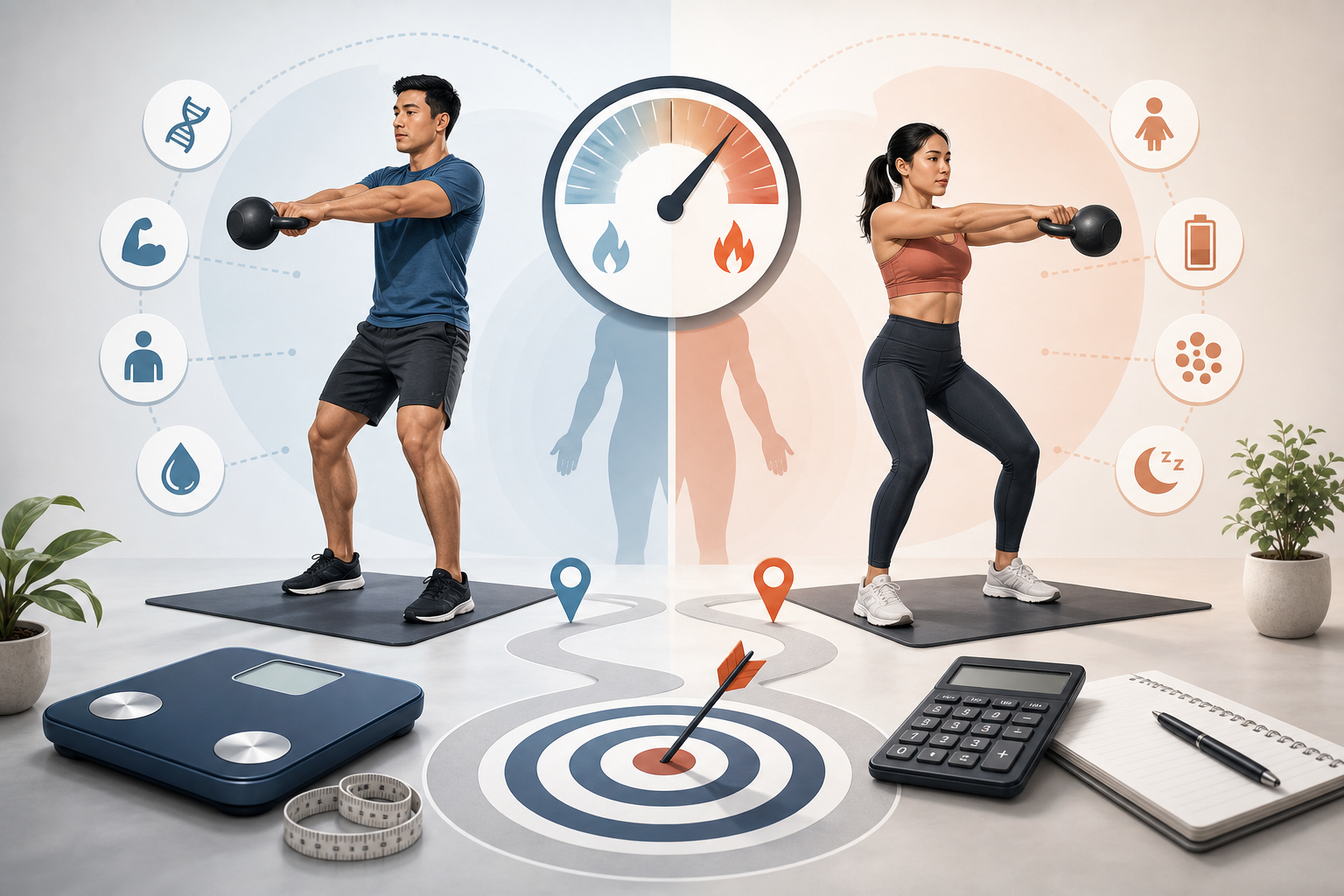
When comparing calories burned same exercise estimates, two people can receive different results because energy use depends on more than the activity name. Body weight, actual intensity, duration, movement efficiency, fitness, terrain and environmental conditions can all affect the estimate. Even when two people exercise together, they may not be doing exactly the same amount of physical work.
- Why calories burned same exercise results are not identical
- The factors that influence exercise calories
- Body weight and the amount of mass moved
- Intensity and workload
- Duration and active time
- Efficiency, technique and fitness
- Terrain, environment and equipment
- A practical comparison between two people
- How a calories burned calculator produces an estimate
- What the calculator can and cannot tell you
- What it can estimate
- What it cannot measure
- How to interpret different calorie estimates
- Frequently asked questions
- Does a heavier person always burn more calories during exercise?
- Can a fitter person burn fewer calories doing the same workout?
- Why does my fitness tracker disagree with a MET calculator?
- Should rest periods count toward workout duration?
- Are exercise machine calorie displays accurate?
A calorie figure from a calculator or fitness device is therefore an estimate, not a direct measurement. It is most useful for comparing activities and planning consistently rather than identifying the precise energy cost of one workout.
Why calories burned same exercise results are not identical
“The same exercise” may mean the same walking route, cycling class or workout video, but that does not guarantee equal energy expenditure. One person may move a larger body, maintain a faster pace, use more resistance or take fewer breaks.
Calculators also rely on standard assumptions. A typical activity may be assigned a metabolic equivalent, or MET, that represents its average intensity relative to rest. Individual energy use can differ from that average.
The main influences are:
- Body size: Moving a heavier body generally requires more energy for weight-bearing activities when pace and duration are similar.
- Actual intensity: Speed, resistance, incline and effort can change the energy cost considerably.
- Duration: More active minutes usually produce a higher total estimate.
- Movement efficiency: Technique and familiarity can affect how much energy a person uses to complete a task.
- Fitness: The same external workload may feel easier to a fitter person, although perceived effort alone does not determine calories.
- Conditions: Terrain, wind, temperature, equipment and carried loads can alter the work involved.
The factors that influence exercise calories
Body weight and the amount of mass moved
Body weight is included in many exercise calorie equations because energy requirements tend to increase when more mass must be moved. This is especially relevant for activities such as walking, running, stair climbing and hiking.
Weight is not the only factor, however. Two people of the same weight can still have different results because the equation does not capture every difference in body composition, technique or physiology. A calculator should not be interpreted as measuring those characteristics.
Intensity and workload
Intensity is often the biggest reason apparently identical sessions produce different estimates. Walking on level ground is not the same workload as walking uphill, and cycling at low resistance is not equivalent to cycling at high resistance even if the display shows the same time.
Intensity may be described by pace, power, resistance, incline or a MET value. These measures are not interchangeable. For example, heart rate can provide useful information about personal effort, but it is not a direct measurement of calories burned.
Duration and active time
Calorie estimates normally rise in proportion to duration when body weight and MET value remain unchanged. In a simple equation, 40 minutes produces twice the estimate of 20 minutes at the same assumed intensity.
Recorded session time may not equal active time. Rest periods, traffic stops, equipment adjustments and pauses between sets can make a 45-minute session contain fewer than 45 minutes at the selected activity intensity.
Efficiency, technique and fitness
People become more familiar with repeated movements. Improved coordination and technique may allow someone to complete the same external task with less unnecessary movement. This is one reason individual energy expenditure may not match a standard activity estimate exactly.
Fitness also changes how demanding a workload feels. A particular cycling power or walking speed may represent moderate effort for one person and hard effort for another. However, feeling more tired does not automatically mean that the person burned more calories; discomfort, heat, fatigue and familiarity can also influence perceived effort.
Terrain, environment and equipment
A smooth treadmill, a muddy trail and a windy outdoor route can involve different workloads despite having the same distance. Inclines, uneven surfaces, headwinds and carried loads may increase the energy required.
Equipment can matter as well. Bicycle type, machine calibration, footwear and movement support can affect the task. General MET categories cannot account for every variation.
A practical comparison between two people
Consider two people who each complete 30 minutes of an activity assigned a value of 5 MET. One weighs 60 kg and the other weighs 80 kg. Using the standard calculator equation, their estimates would be different even though the activity, MET value and duration are the same.
- At 60 kg: 5 × 3.5 × 60 ÷ 200 × 30 = about 158 kcal
- At 80 kg: 5 × 3.5 × 80 ÷ 200 × 30 = about 210 kcal
The difference occurs because body weight is part of the equation. It does not prove that either person’s true expenditure was exactly 158 or 210 kcal. Their actual pace, technique, fitness, rest periods and conditions could move the result above or below the estimate.
Now consider a group exercise class. Two participants may attend for the same 45 minutes, but one uses heavier resistance and keeps moving during transitions while the other takes longer rests. Selecting one MET value for both participants may hide these differences in actual intensity.
How a calories burned calculator produces an estimate
A calories burned calculator combines body weight, activity intensity and duration. Activity intensity is commonly represented by a MET value drawn from standard activity categories, such as those documented in the Adult Compendium of Physical Activities.
The calculation method is:
Estimated kcal = MET × 3.5 × body weight (kg) ÷ 200 × minutes
A MET expresses an activity’s intensity relative to rest. For example, an activity listed as 5 MET represents a standardised intensity level used for estimation. It should not be read as an individually measured metabolic rate.
To use the calculator:
- Select the requested unit system or activity options.
- Enter body weight and the duration of the activity.
- Choose the activity or appropriate MET value.
- Calculate the estimated energy use.
- Review the result together with the stated assumptions and limitations.
An activity should be matched as closely as possible by pace and type. Choosing “fast walking” for a relaxed walk, for example, can overstate the result because the selected MET value assumes a higher intensity.
What the calculator can and cannot tell you
What it can estimate
The calculator can provide a practical estimate of energy used during a defined activity period. It can help compare how changes in body weight, MET value or duration affect the result under the same formula.
It may also be useful for consistent planning. If the same activity selection and input method are used each time, the estimates can show how longer duration or a different assumed intensity changes the calculated total.
What it cannot measure
The calculator does not directly measure metabolism or individual energy expenditure. Direct assessment requires specialised methods and controlled measurements that are not available from basic inputs such as weight and time.
It also cannot determine:
- the exact intensity maintained throughout a session;
- how much time was spent resting or moving slowly;
- individual differences in movement efficiency;
- the effects of terrain, weather or equipment unless reflected in the selected activity;
- whether a fitness tracker’s activity or heart-rate data are accurate;
- the precise energy balance created by food intake and daily activity.
MET values describe typical activity costs rather than personalised measurements. The 2024 Adult Compendium of Physical Activities provides an extensive set of standardised activity values, but individual results can still vary.
How to interpret different calorie estimates
It is common for a calculator, exercise machine and wearable device to report different exercise calories for the same session. They may use different activity categories, body data, heart-rate models, rounding methods or definitions of active and resting energy.
Before comparing figures, check whether each source reports total energy during the session or only energy above resting needs. These are different quantities and can produce different totals without either calculation necessarily containing an error.
For more consistent comparisons, use the same calculator, activity category and time-recording method. Enter active minutes rather than automatically using the full time between starting and finishing when the session includes substantial pauses.
Most importantly, treat the result as a reasonable range or planning estimate. Differences in calories burned same exercise calculations are expected because a standard equation cannot represent every feature of an individual workout.
Frequently asked questions
Does a heavier person always burn more calories during exercise?
Not always. When two people perform the same weight-bearing activity at the same pace and for the same duration, an equation based on body weight will usually estimate more calories for the heavier person. Different intensity, technique, resistance or active time can change the comparison.
Can a fitter person burn fewer calories doing the same workout?
Possibly, particularly if greater movement efficiency reduces the energy required for the same external task. Fitness also makes a workload feel easier, but lower perceived effort does not by itself establish lower calorie use.
Why does my fitness tracker disagree with a MET calculator?
A MET calculator uses an activity average together with weight and duration. A tracker may add heart rate, motion data and its own proprietary assumptions. Neither result should be treated as an exact measurement, and differences between them are normal.
Should rest periods count toward workout duration?
It depends on the activity category and what the estimate is intended to represent. If a MET value assumes continuous movement, including long rest periods at that intensity can overestimate calories. Active time is usually the more suitable input for continuous-activity categories.
Are exercise machine calorie displays accurate?
Machine displays provide estimates. Accuracy may be limited if the machine does not use current body weight, if resistance or power is not calibrated, or if the person relies on handrails or changes technique. Use the figure as an approximate comparison rather than a measured value.