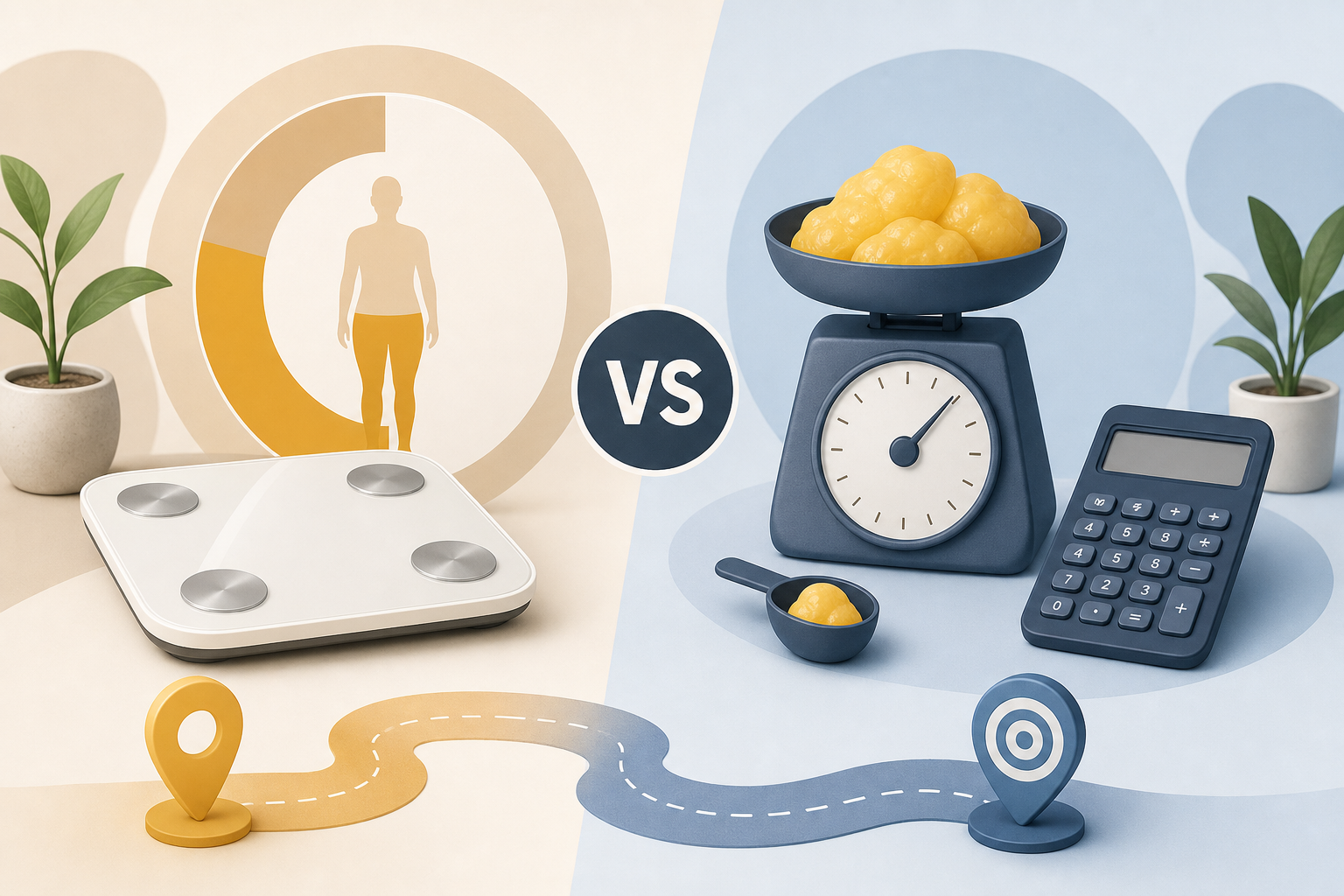
Fat percentage vs grams describes two ways of expressing dietary fat intake. A fat percentage is the share of total calories that comes from fat, while fat grams are the absolute amount of fat eaten or planned per day. Because fat provides about 9 kilocalories (kcal) per gram, the same percentage produces different gram targets at different calorie levels.
Fat percentage vs grams: the key distinction
A percentage target is relative to total calorie intake. For example, “30% of calories from fat” means that 30% of all planned calories would come from dietary fat. It does not mean that 30% of the food’s weight is fat, and it is unrelated to body fat percentage.
Fat grams per day are an absolute quantity. A plan containing 60 grams of fat includes the same amount of fat whether the overall calorie target is 1,600 kcal or 2,400 kcal. However, those 60 grams represent a different percentage of calories in each plan.
- Fat percentage: the proportion of total calories supplied by fat.
- Fat grams: the weight of dietary fat consumed or planned.
- Body fat percentage: an estimate or measurement of body composition, not dietary intake.
- Percentage by food weight: a separate calculation that does not show the percentage of calories from fat.
Percentages are useful for describing how calories are distributed among macronutrients. Grams are often more practical when reviewing food labels, recipes, meal plans or daily intake records.
How to convert a fat percentage into grams
Dietary fat provides approximately 9 kcal per gram. The conversion therefore has two steps: calculate the calories allocated to fat, then divide those calories by 9.
Fat grams per day = total calories × fat percentage ÷ 9
The percentage must be written as a decimal in the calculation. For example, 30% becomes 0.30.
- Multiply the daily calorie target by the selected fat percentage.
- Divide the resulting fat calories by 9 kcal per gram.
- Round the result appropriately for planning.
At 2,000 kcal with 30% of calories from fat:
2,000 × 0.30 = 600 kcal from fat
600 ÷ 9 = 66.7 grams of fat
The estimated result is therefore about 67 grams per day. It is an estimate based on the calorie target and selected percentage, not a measured requirement.
Why total calories change the gram result
A percentage has meaning only in relation to a total. If the calorie target rises while the fat percentage stays unchanged, the corresponding fat grams also rise. If calories fall, the gram amount falls.
| Daily calorie target | Calories from fat at 30% | Estimated fat grams |
|---|---|---|
| 1,500 kcal | 450 kcal | 50 g |
| 2,000 kcal | 600 kcal | 67 g |
| 2,500 kcal | 750 kcal | 83 g |
All three examples allocate 30% of calories to dietary fat, but they do not produce the same gram amount. This is why a percentage alone cannot answer how many fat grams per day a person has planned.
The reverse is also true: a fixed number of grams can account for different percentages at different calorie levels. Sixty grams of fat provides about 540 kcal. That is approximately 34% of a 1,600 kcal plan but only 23% of a 2,400 kcal plan.
To calculate the percentage from known grams, use:
Fat percentage = fat grams × 9 ÷ total calories × 100
A practical meal-planning scenario
Consider two people who both choose to allocate 30% of planned calories to fat. One is using a 1,800 kcal planning target, while the other is using 2,200 kcal.
For the 1,800 kcal target:
1,800 × 0.30 ÷ 9 = 60 grams
For the 2,200 kcal target:
2,200 × 0.30 ÷ 9 = 73.3 grams
Their percentage is identical, but their estimated gram amounts differ by about 13 grams. Neither result is inherently more appropriate based on the calculation alone; each simply reflects a different calorie total.
This distinction also matters when calories change within the same plan. If someone keeps a 30% fat allocation but updates the calorie target from 2,000 to 1,800 kcal, the corresponding estimate changes from about 67 grams to 60 grams. Keeping the old gram value would raise the percentage of calories from fat.
What a fat intake calculator can and cannot tell you
What it calculates
A fat intake calculator converts a calorie target and selected fat percentage into estimated grams per day. It applies the same calculation shown above and can reduce manual arithmetic when comparing several calorie or percentage options.
The inputs are planning values. The result depends entirely on the calorie target and fat percentage entered, so it should be interpreted as a mathematical allocation rather than a personalised assessment.
What it does not assess
The calculator does not determine an individual calorie requirement or decide which fat percentage is suitable. It also does not evaluate medical history, current food intake, activity, food preferences or the balance of other macronutrients.
Most importantly, the result does not distinguish among types or food sources of dietary fat. Two eating patterns can contain the same total fat grams while differing substantially in the foods that provide those grams. The calculation therefore cannot assess overall diet quality.
- It does not measure how much fat a person actually eats.
- It does not estimate body fat percentage.
- It does not separate saturated, monounsaturated or polyunsaturated fat.
- It does not account for the nutrient content of the full diet.
- It does not predict weight change or health outcomes.
How to interpret percentage and gram targets
The National Academies’ Dietary Reference Intakes discuss macronutrients both as energy sources and as proportions of total energy intake. This percentage-based approach helps describe how total calories are distributed, while conversion to grams makes the allocation easier to use in everyday food planning.
When comparing targets, first confirm whether the number refers to a percentage of calories or grams per day. A statement such as “30% fat” is incomplete without a calorie total, while “65 grams of fat” does not reveal the percentage unless total calories are also known.
It is also useful to keep the calculation’s precision in perspective. Calorie targets, recorded food intake and portion sizes may all be estimates. Reporting a result such as 66.666 grams can imply more accuracy than the inputs support, so rounding to about 67 grams is generally clearer for planning.
Total fat is only one feature of an eating pattern. The formula does not show the foods supplying the fat, the overall nutrient balance or how consistently the target is followed. Those questions require information beyond a calorie-and-percentage conversion.
Frequently asked questions
Is 30% fat the same as 30 grams of fat?
No. Thirty percent describes a share of total calories, while 30 grams is a fixed weight. At 2,000 kcal, 30% from fat equals about 67 grams. Thirty grams of fat supplies about 270 kcal, which would be 13.5% of a 2,000 kcal total.
Why is fat divided by 9 in the formula?
Fat provides approximately 9 kcal per gram. After calculating how many calories are allocated to fat, dividing by 9 converts those calories into grams.
Can I calculate fat percentage from a nutrition label?
Yes, if you know both the fat grams and total calories for the same serving or quantity. Multiply the fat grams by 9, divide by total calories, and multiply by 100. The result is an estimate of the percentage of calories from fat.
Does lowering calories automatically lower fat grams?
It does if the selected fat percentage remains the same. For example, 30% of 1,800 kcal produces fewer fat grams than 30% of 2,000 kcal. If the gram target remains fixed instead, the percentage of calories from fat will change.
Does the calculator identify how much saturated fat is included?
No. It calculates total dietary fat only. It cannot determine the types of fat present unless those amounts are assessed separately from food labels, recipes or intake records.
Which is better for tracking: percentages or grams?
Neither format is universally better. Percentages show how fat fits into total calorie allocation, while grams are convenient for comparing a plan with food labels and recorded intake. Understanding fat percentage vs grams allows both figures to be interpreted together rather than treated as interchangeable.