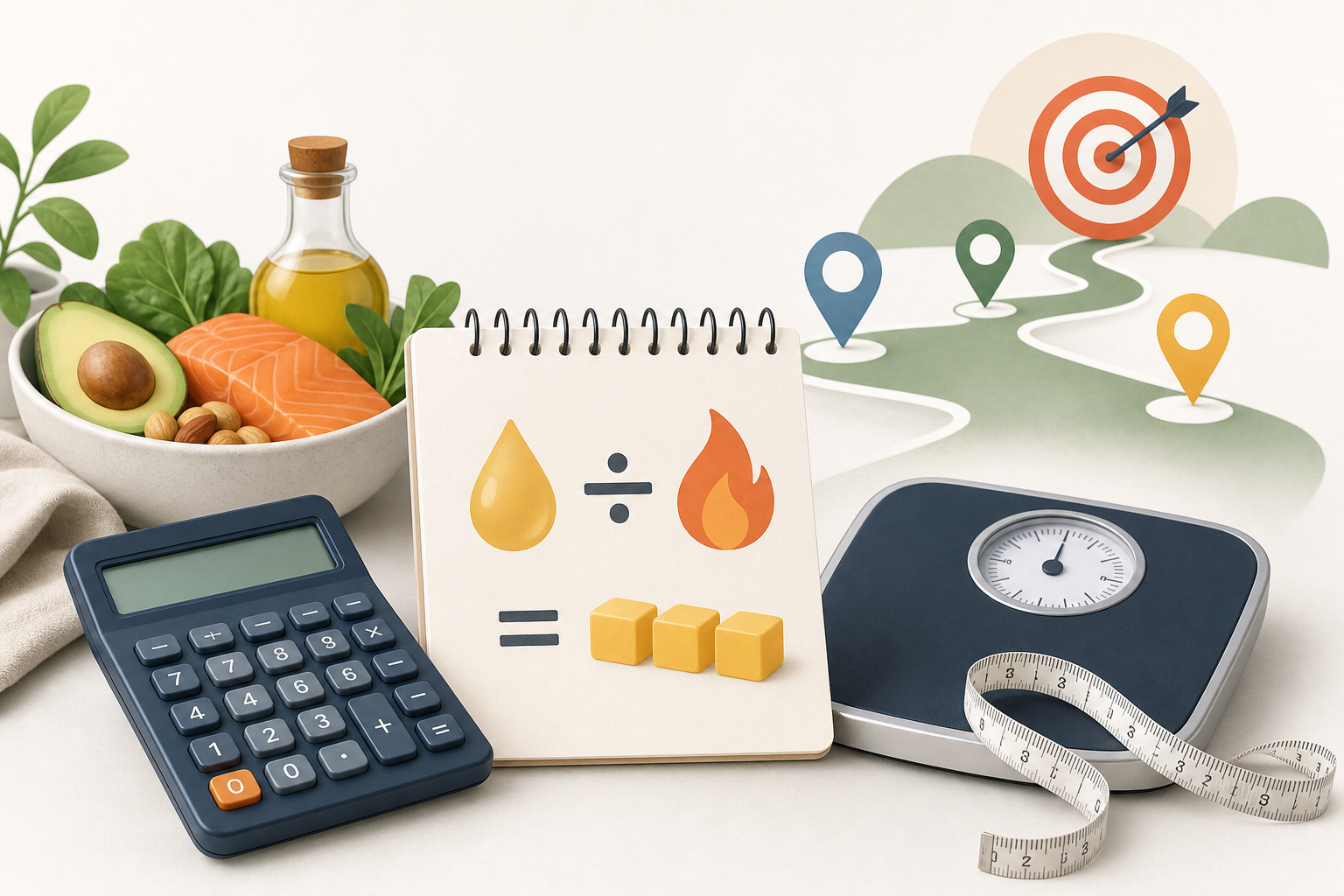
To calculate fat grams, first find the number of calories allocated to fat, then divide by 9 because dietary fat provides approximately 9 kilocalories (kcal) per gram. The basic formula is: fat grams = total calories × fat percentage ÷ 9. If you already know the calories from fat, simply divide that number by 9.
For example, if your daily target is 2,000 kcal and 30% is assigned to fat, 600 kcal come from fat. Dividing 600 by 9 gives about 66.7 grams, usually rounded to 67 grams of fat per day.
How to calculate fat grams step by step
You need two planning values: a calorie target and the percentage of calories you want to obtain from dietary fat. The result is an estimate of fat grams per day, not a measured intake.
- Write down your daily calorie target.
- Convert the fat percentage to a decimal by dividing it by 100.
- Multiply total calories by the decimal to find calories from fat.
- Divide calories from fat by 9 to convert them to grams.
- Round the result to a practical number if needed.
The complete formula is:
Fat grams per day = total daily calories × fat percentage as a decimal ÷ 9
For a 30% fat allocation, use 0.30 in the calculation. Using 30 instead of 0.30 would make the result 100 times too high.
If calories from fat are already known
When a meal plan or nutrition record already gives calories from fat, the percentage step is unnecessary:
Fat grams = calories from fat ÷ 9
For example, 450 kcal from fat divided by 9 equals 50 grams of fat.
Why fat calories are divided by 9
Fat is an energy-providing macronutrient. Standard nutrition calculations use approximately 9 kcal per gram of dietary fat, compared with different energy values for protein and carbohydrate. The National Academies’ Dietary Reference Intakes discuss the energy contribution and nutritional role of macronutrients, including fat.
On food labels and in everyday nutrition language, “Calories” usually refers to kilocalories. Therefore, a label showing 90 Calories from fat represents approximately 10 grams of fat under this conversion.
The calculation is a planning conversion rather than a laboratory measurement. Its precision depends on the accuracy of the calorie target, selected percentage and food information used to track intake.
Practical examples for different calorie targets
Example 1: 2,000 kcal with 30% from fat
- Convert 30% to a decimal: 30 ÷ 100 = 0.30.
- Find calories from fat: 2,000 × 0.30 = 600 kcal.
- Convert to grams: 600 ÷ 9 = 66.7 grams.
The estimated target is about 67 grams of fat per day.
Example 2: 1,800 kcal with 25% from fat
- Convert 25% to a decimal: 0.25.
- Find calories from fat: 1,800 × 0.25 = 450 kcal.
- Convert to grams: 450 ÷ 9 = 50 grams.
The estimated target is 50 grams of fat per day.
Example 3: Converting one meal rather than a full day
Suppose a 600 kcal meal is planned to provide 35% of its calories from fat. Multiply 600 by 0.35 to get 210 kcal from fat, then divide by 9. The result is approximately 23.3 grams of fat for that meal.
| Calories | Fat percentage | Calories from fat | Estimated fat grams |
|---|---|---|---|
| 1,800 kcal | 25% | 450 kcal | 50 g |
| 2,000 kcal | 30% | 600 kcal | 66.7 g |
| 2,200 kcal | 35% | 770 kcal | 85.6 g |
These figures show how the same formula responds to different assumptions. They are examples, not personal intake recommendations.
Choosing the percentage of calories from dietary fat
The arithmetic is straightforward, but the selected percentage is a separate planning decision. Different eating patterns may assign different proportions of calories to fat, so the calculation itself does not determine which percentage is appropriate for an individual.
A fat percentage may come from a structured meal plan, a nutrition professional’s guidance or a general macronutrient plan. If your target is expressed as a range, calculate both ends to obtain a corresponding range in grams.
For example, at 2,000 kcal:
- 25% from fat gives approximately 56 grams per day.
- 30% from fat gives approximately 67 grams per day.
- 35% from fat gives approximately 78 grams per day.
A percentage describes the share of total calories supplied by fat. It does not mean that the same percentage of the food’s weight is fat. Foods also contain water and other components that contribute weight without matching the calorie distribution.
What a fat intake calculator can and cannot tell you
A fat intake calculator automates the same conversion. You enter a calorie target, select the percentage assigned to fat and receive an estimated number of fat grams per day.
What the calculator can show
- The number of calories allocated to fat under the selected percentage.
- The corresponding estimated grams of fat per day.
- How changing the calorie target or percentage changes the gram estimate.
- A consistent conversion without doing the arithmetic manually.
What the calculator cannot assess
- Whether the calorie target is appropriate for a particular person.
- Which fat percentage best fits someone’s health needs or dietary pattern.
- The types or food sources of fat included in the diet.
- Overall diet quality, nutrient adequacy or meal balance.
- Actual intake unless foods and portions are recorded accurately.
The output should therefore be read as a mathematical estimate based on the values entered. A result of 67 grams means that approximately 67 grams of fat would supply 30% of a 2,000 kcal target; it does not show what foods should provide those grams.
Common calculation and interpretation errors
Dividing total calories by 9 too early
Dividing all daily calories by 9 would assume that 100% of those calories come from fat. Apply the fat percentage first, unless you have already been given calories from fat.
Using a whole percentage instead of a decimal
For 30%, multiply by 0.30 rather than 30. Alternatively, multiply by 30 and divide by 100 before dividing by 9.
Confusing grams of fat with calories from fat
A value such as 600 kcal from fat is not the same as 600 grams. Dividing 600 kcal by 9 produces approximately 66.7 grams.
Rounding during each step
Keep the unrounded value until the final step when possible. Early rounding can create small differences, especially when calculating multiple meals or the ends of a percentage range.
Treating the estimate as an exact measurement
The result reflects the numbers entered and the standard 9 kcal-per-gram conversion. Calorie targets, serving sizes and recorded food intake may themselves be estimates, so decimal-level precision is rarely necessary for routine planning.
Frequently asked questions
How many fat grams are in 500 calories from fat?
Divide 500 by 9. The result is approximately 55.6 grams of fat.
How do I calculate a range of fat grams per day?
Calculate the lower and upper percentages separately. For 2,000 kcal with a range of 25% to 35%, the calculations are 2,000 × 0.25 ÷ 9 and 2,000 × 0.35 ÷ 9. This gives an estimated range of about 56 to 78 grams per day.
Should I use total calories or calories remaining for the day?
Use total planned calories when calculating a full-day fat target. Use calories for a specific meal or the calories remaining only when you want the fat allocation for that particular amount.
Does the formula distinguish between different types of fat?
No. The conversion calculates total fat grams from calories and a percentage. It does not separate different types of dietary fat or evaluate their food sources.
Why does my result differ slightly from another calculation?
Small differences commonly result from rounding. One calculation may round calories from fat before dividing by 9, while another keeps the full value until the end.
In summary, to calculate fat grams, multiply the calorie target by the selected fat percentage as a decimal and divide by 9. The result is a useful planning estimate, but its meaning depends on the calorie and percentage assumptions used.