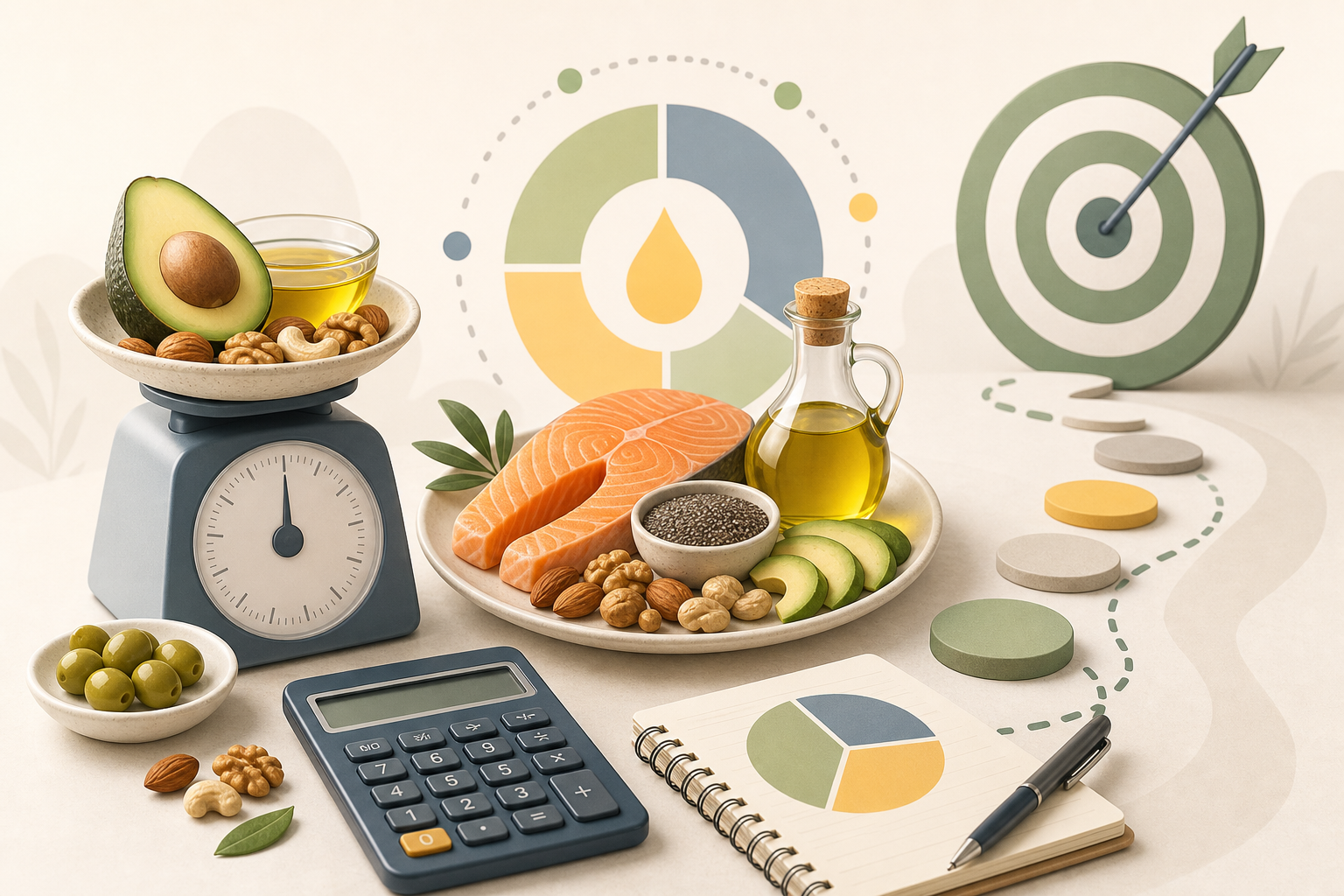
If you are wondering how much fat per day to plan for, there is no single gram target that suits everyone. For adults, the National Academies identifies an acceptable range of 20% to 35% of total calories from fat. Your corresponding fat grams depend on your calorie target: multiply calories by the chosen percentage, then divide by 9 because each gram of fat provides about 9 kilocalories.
How much fat per day is a reasonable planning range?
A practical starting point for many adults is to allocate 20% to 35% of total calories to dietary fat. This range is known as an Acceptable Macronutrient Distribution Range, or AMDR. It is intended to support adequate nutrient intake while allowing different eating patterns.
The range comes from the National Academies’ Dietary Reference Intakes for macronutrients. It is a population-level reference range rather than a personalised prescription.
The percentage must be connected to a calorie amount before it can be expressed in grams. For example, 30% of a 1,600-kilocalorie plan produces fewer fat grams than 30% of a 2,500-kilocalorie plan.
- At 1,600 kcal and 30% fat: about 53 grams per day
- At 2,000 kcal and 30% fat: about 67 grams per day
- At 2,500 kcal and 30% fat: about 83 grams per day
These are calculated planning estimates. They are not measured requirements for a particular person.
How to convert a calorie percentage into fat grams per day
Fat provides approximately 9 kcal per gram. The calculation therefore has two steps: find the calories allocated to fat, and then convert those calories into grams.
Fat grams = total calories × (fat percentage ÷ 100) ÷ 9
For a 2,000-kcal target with 30% of calories from fat:
- Convert 30% to a decimal: 30 ÷ 100 = 0.30.
- Calculate calories from fat: 2,000 × 0.30 = 600 kcal.
- Convert fat calories to grams: 600 ÷ 9 = 66.7 grams.
- Round the result for practical planning: about 67 grams per day.
The same calorie target can produce different gram amounts depending on the selected percentage.
| Daily calorie target | Calories from fat | Estimated fat grams |
|---|---|---|
| 2,000 kcal at 20% | 400 kcal | About 44 g |
| 2,000 kcal at 25% | 500 kcal | About 56 g |
| 2,000 kcal at 30% | 600 kcal | About 67 g |
| 2,000 kcal at 35% | 700 kcal | About 78 g |
Rounding explains why a hand calculation and a calculator may occasionally differ by a fraction of a gram.
Why the appropriate amount of dietary fat varies
A fat target is affected by both the calorie target and the proportion of calories assigned to fat. Two people selecting the same percentage will not receive the same gram estimate if their calorie targets differ.
Total energy intake
A higher calorie target produces more fat grams at a fixed percentage. A lower calorie target produces fewer. If the calorie input is only an estimate, the resulting fat target is also an estimate.
Overall macronutrient pattern
Fat, carbohydrate and protein together account for most food energy. Increasing the percentage allocated to one macronutrient changes the proportion available for the others, assuming total calories stay the same.
Different eating patterns can therefore fit within the adult reference range. One plan might allocate 25% of calories to fat, while another might use 35%. The calculation alone cannot determine which allocation is more suitable.
Age and life stage
Macronutrient reference ranges can differ by age. Children should not automatically be assigned an adult percentage. Pregnancy, breastfeeding, athletic training and other circumstances may also affect overall nutrition planning, even though the mathematical conversion remains unchanged.
Individual health and nutrition needs
A general calculator does not account for medical history, symptoms, medicines, laboratory results or therapeutic diets. A percentage chosen for general meal planning may not match an individually developed nutrition plan.
Why the type and source of fat still matter
Dietary fat supplies energy and supports essential physiological functions. It also contributes essential fatty acids and helps the body use fat-soluble nutrients. However, calculating total fat grams does not describe the nutritional quality of the foods supplying those grams.
Foods contain different combinations of saturated, monounsaturated and polyunsaturated fats. A total such as 67 grams groups all of them together. It does not show how much came from nuts, seeds, fish, oils, dairy products, meat, fried foods or packaged foods.
The rest of the diet also matters. A gram target cannot assess fibre, vitamins, minerals, food variety, sodium or the balance of other macronutrients. Two eating patterns with identical calories and total fat can have substantially different food compositions.
For this reason, total dietary fat is best treated as one planning variable rather than a complete measure of diet quality.
A practical fat-intake scenario
Consider someone using a daily planning target of 1,800 kcal. They decide to allocate 30% of those calories to fat.
- 1,800 × 0.30 = 540 kcal from fat.
- 540 ÷ 9 = 60 grams of fat.
The estimated target is therefore 60 fat grams per day. If the same person selected 25%, the estimate would be 50 grams. At 35%, it would be 70 grams.
This example shows why asking only for a gram amount leaves out important information. The calorie target and selected percentage are both required to explain how the result was produced.
The result should also be interpreted with reasonable flexibility. Food labels and serving sizes involve rounding, and actual portions may not match listed serving sizes exactly. A calculated value such as 60 grams is a planning estimate, not a precisely measured daily requirement.
What a fat intake calculator can and cannot tell you
A fat intake calculator performs the percentage-to-grams conversion automatically. It is useful when comparing different calorie targets or fat percentages without repeating the arithmetic by hand.
What the calculator can do
- Convert a daily calorie target and selected fat percentage into grams.
- Show how changing the percentage changes the estimated gram amount.
- Provide a consistent result using approximately 9 kcal per gram of fat.
- Help compare possible macronutrient allocations during meal planning.
What the calculator cannot do
- Determine whether the entered calorie target is appropriate.
- Select the best fat percentage for an individual.
- Distinguish between different types or food sources of fat.
- Assess overall diet quality or nutrient adequacy.
- Account for medical conditions, therapeutic diets or laboratory findings.
- Measure how much fat someone actually eats.
The output is only as useful as the inputs. If the calorie target is inaccurate or the percentage was chosen without considering the broader diet, the resulting number may have limited value.
Frequently asked questions
Is 30% of calories from fat the same as eating 30 grams?
No. A percentage describes the share of total calories supplied by fat, while grams describe weight. At 2,000 kcal, 30% from fat is about 67 grams. At 1,500 kcal, the same percentage is 50 grams.
Can I calculate fat grams without knowing my calorie target?
Not with this method. The formula requires both a calorie target and a percentage. Body weight alone does not provide the information needed to convert a percentage of calories into fat grams.
Does the calculator include fat from every food?
The calculator does not analyse foods. It only produces a target from the numbers entered. When comparing intake with that target, total fat listed for all foods, drinks and ingredients would contribute to the daily amount.
Do I need to reach the calculated number exactly each day?
The result is an estimate rather than a precise threshold. Minor day-to-day differences, label rounding and portion variation are expected. The number is more appropriately used as a general planning reference than as an exact pass-or-fail limit.
Why does my food-tracking application show a different target?
The application may use a different calorie target, fat percentage or rounding method. Check both inputs before comparing results. Some applications may also apply their own default macronutrient settings.
What is the main point to remember about how much fat per day?
The gram amount cannot be separated from the calorie target and chosen percentage. For adults, 20% to 35% of calories is a broad reference range, but the resulting fat grams per day vary with total energy intake. The calculation estimates quantity; it does not assess fat type, food quality or individual suitability.