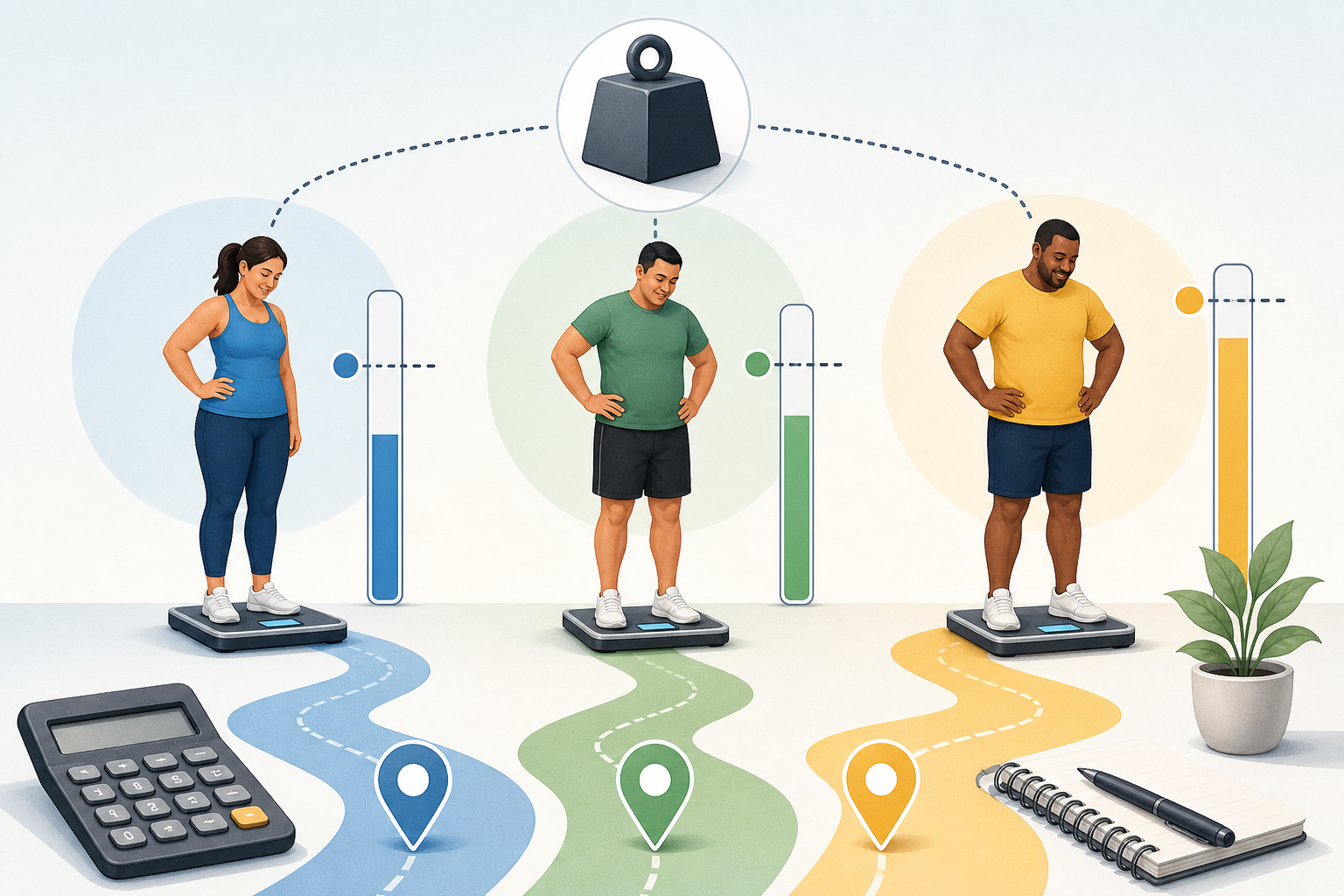
The key to understanding weight loss percentage starting weight comparisons is that the starting weight is the denominator in the calculation. Two people can lose the same number of kilograms or pounds but have different percentage results because that change represents a different share of each person’s starting body weight.
Why weight loss percentage starting weight changes the result
Weight loss in kilograms or pounds is an absolute change. Weight loss percent is a relative change: it shows how large the change is compared with the weight at the beginning of the period.
For example, consider two people who each lose 8 kg:
| Starting weight | Current weight | Weight change | Percentage change |
|---|---|---|---|
| 80 kg | 72 kg | 8 kg loss | 10% |
| 120 kg | 112 kg | 8 kg loss | 6.7% |
The change on the scale is identical, but 8 kg is one-tenth of 80 kg and only about one-fifteenth of 120 kg. Therefore, the first person has a larger percentage change.
This does not mean that one person’s result is inherently better. The percentage simply expresses each change relative to a different starting point.
The formula for percentage weight change
The standard calculation is:
Percentage change = (starting weight − current weight) ÷ starting weight × 100
Suppose a person’s weight changes from 100 kg to 92 kg:
- Subtract current weight from starting weight: 100 − 92 = 8 kg.
- Divide the change by starting weight: 8 ÷ 100 = 0.08.
- Multiply by 100: 0.08 × 100 = 8%.
The result is an 8% weight loss. The same calculation works in pounds because the unit cancels during division, provided the starting and current weights use the same unit.
If current weight is higher than starting weight, the formula produces a negative number. For example, changing from 80 kg to 84 kg gives −5%, indicating a 5% gain under this loss-based formula. Some tools may label the result as weight gain rather than displaying a negative loss.
Examples of the same loss producing different percentages
A 5 kg change from three starting weights
| Starting weight | Current weight | Amount lost | Weight loss percentage |
|---|---|---|---|
| 60 kg | 55 kg | 5 kg | 8.3% |
| 80 kg | 75 kg | 5 kg | 6.25% |
| 100 kg | 95 kg | 5 kg | 5% |
As starting weight increases, the same 5 kg loss represents a smaller percentage. The amount lost has not changed; only its size relative to the starting value has changed.
The same percentage can mean different amounts
The relationship also works in reverse. People with different starting weights must lose different amounts to have the same percentage change.
| Starting weight | Amount lost | Current weight | Percentage lost |
|---|---|---|---|
| 60 kg | 3 kg | 57 kg | 5% |
| 100 kg | 5 kg | 95 kg | 5% |
| 140 kg | 7 kg | 133 kg | 5% |
Although the scale changes range from 3 kg to 7 kg, all three examples represent 5% of starting weight. This is why percentage weight change can be more useful than kilograms or pounds alone when describing relative changes.
How to interpret the percentage accurately
A percentage is meaningful only when the starting point and time period are clear. A change from the beginning of a month is not directly equivalent to a change measured from several years earlier, even if the displayed percentages are the same.
Use the weight recorded at the beginning of the period you want to evaluate. If you later choose a new starting date, the denominator changes, so the resulting percentage will also change.
Scale weight can vary over short periods because of hydration and other temporary factors. For that reason, a percentage calculated from one isolated measurement may differ from a percentage based on a longer-term weight trend.
For more consistent comparisons:
- Use the same unit for starting and current weight.
- Compare measurements taken under reasonably similar conditions.
- Record the dates associated with both weights.
- Avoid changing the starting value midway through a comparison without noting it.
- Consider the broader trend rather than treating one scale reading as definitive.
Percentage change describes scale weight only. It does not show how much of the change came from body fat, muscle, body water or other components.
What a weight loss percentage calculator can and cannot tell you
A weight loss percentage calculator performs the relative-change calculation using the starting and current weights entered. It can reduce arithmetic errors and make it easier to compare changes involving different starting weights.
What the calculator can show
- The difference between starting and current weight.
- The percentage of starting body weight represented by that difference.
- Whether the entered values indicate a loss or gain, depending on how the result is displayed.
- Comparable results in kilograms or pounds when one unit is used consistently.
What the calculator cannot show
- Whether the change came from fat, muscle, water or another component.
- Why body weight changed.
- Whether a particular percentage is appropriate for an individual.
- How quickly future weight change will occur.
- Whether a single measurement reflects a sustained trend.
The result is calculated from the entered values rather than directly measured as a separate health marker. If either weight is entered incorrectly or represents an unusual short-term fluctuation, the calculated percentage will reflect that input.
A percentage calculator also differs from a weight-planning model. Planning resources, such as the National Institute of Diabetes and Digestive and Kidney Diseases Body Weight Planner, use additional information and assumptions to explore possible changes over time. A basic percentage calculator reports what proportion of starting weight has already changed; it does not forecast future results.
Frequently asked questions
Does a higher starting weight always produce a lower percentage?
Only when the amount lost is held constant. For example, a 5 kg loss is a smaller percentage of 100 kg than of 60 kg. If both the starting weight and the amount lost differ, the formula must be applied to determine the result.
Should I use my highest-ever weight as the starting weight?
Use the weight that matches the period you want to evaluate. If you are measuring change since a specific date or programme began, use the weight recorded at that point. Using a highest-ever weight answers a different question: the percentage change from that historical maximum.
Can I calculate weight loss percentage in pounds?
Yes. Enter both starting and current weight in pounds and apply the same formula. Do not mix kilograms and pounds in one calculation unless one value is converted first.
Why does my percentage change when I choose a new starting weight?
The starting weight is the denominator. Changing it changes the reference point, even when current weight remains the same. Both the value and date of the starting measurement should therefore be included when tracking results.
Can weight loss percentage be more than 100%?
Not for a valid body-weight loss calculation using positive starting and current weights. A 100% loss would imply a current weight of zero. A result above 100% usually indicates an input or unit error.
How often should I recalculate the percentage?
You can recalculate whenever a new current weight is recorded, while keeping the same starting value for that tracking period. Because individual scale readings may fluctuate, comparing results over time may be more informative than focusing on every small change.
Putting the result in context
The central point in weight loss percentage starting weight comparisons is that the same scale change does not represent the same relative change for everyone. Dividing by starting weight places the loss in proportion to each person’s own starting point.
The percentage is a concise description of body-weight change, not a complete assessment of health, body composition or progress. Interpret it alongside the dates, measurement conditions and longer-term pattern behind the two weights.