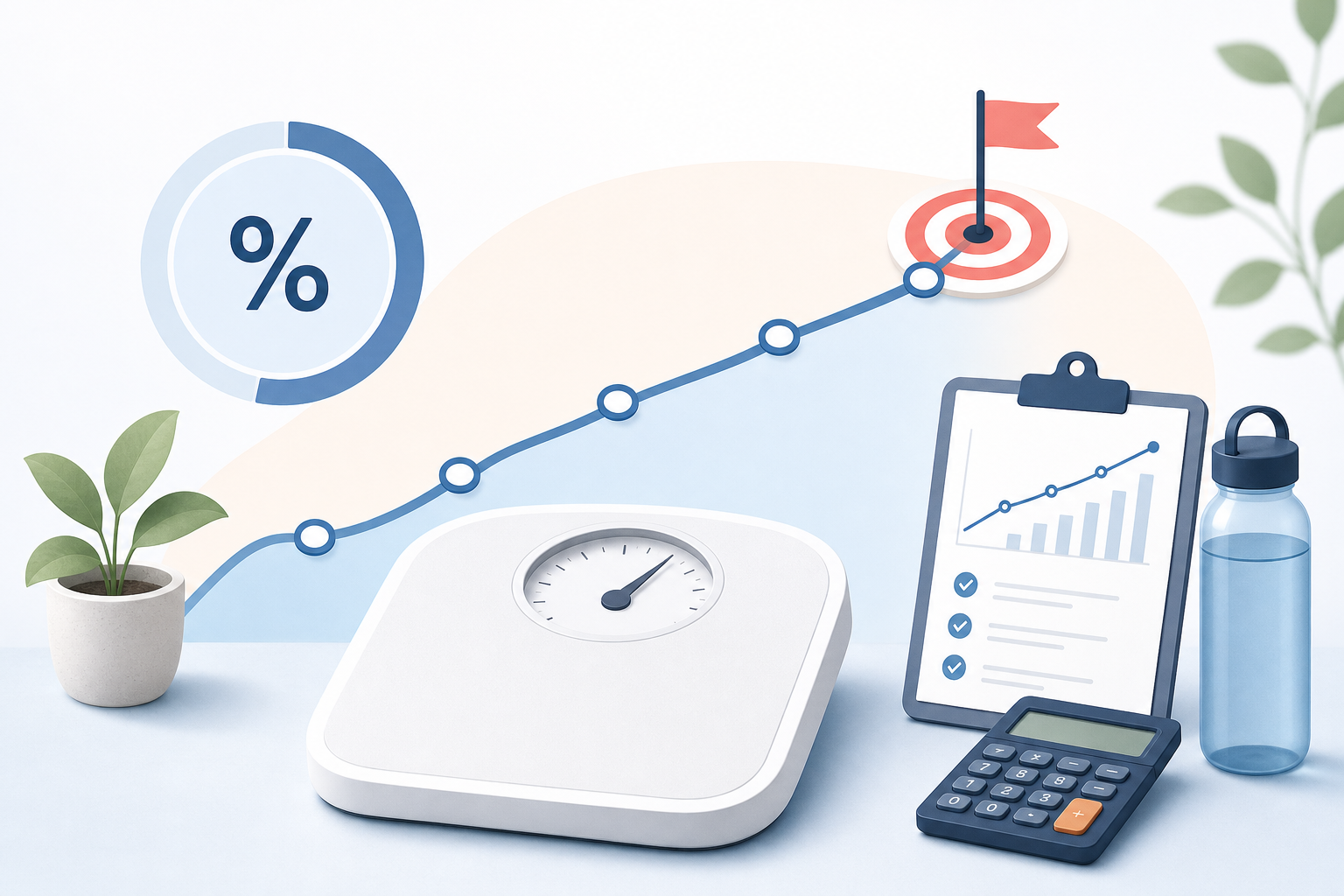
To track weight loss percentage over time, keep one clearly defined starting weight, record current weights under reasonably consistent conditions, and calculate each change relative to the same starting point. This shows how much of your initial body weight has changed, making progress easier to compare across different starting sizes than kilograms or pounds alone.
- How to track weight loss percentage consistently
- Calculate percentage weight change
- Build a record that shows the trend
- Keep measurement conditions reasonably similar
- Choose a review schedule you can interpret
- Why short-term fluctuations need context
- How to compare progress fairly
- What the weight loss percentage calculator can and cannot tell you
- Frequently asked questions
- Should I reset my starting weight after every loss?
- Can I calculate the percentage using pounds?
- What does a negative weight loss percentage mean?
- Should I use my highest-ever weight as the baseline?
- Why did my percentage get smaller even though I had previously lost weight?
- Is percentage change better than tracking kilograms or pounds?
Short-term scale changes should not dominate the interpretation. Hydration, meals, clothing and measurement timing can affect individual readings, so the direction across several measurements is usually more informative than one result.
How to track weight loss percentage consistently
Weight loss percentage compares your weight change with your starting weight. The main requirement for useful tracking is consistency: keep the same baseline unless you deliberately begin a new tracking phase.
- Choose a starting weight and record its date.
- Use the same unit for starting and current weights.
- Record new weights under similar measurement conditions where practical.
- Calculate every result against the original starting weight.
- Review the sequence of percentages rather than focusing on one reading.
For example, if your starting weight is 100 kg, continue using 100 kg as the denominator when calculating later results. Changing the baseline after every measurement would show only the change since the previous reading, not the total percentage change from the beginning.
If you start a separate phase after a long break or a major change in circumstances, you can create a new baseline. Keep the earlier phase in your records so the two periods are not accidentally combined.
Calculate percentage weight change
The formula is:
Percentage change = (starting weight − current weight) ÷ starting weight × 100
If someone moves from 100 kg to 92 kg, the calculation is:
(100 − 92) ÷ 100 × 100 = 8%
The result is an 8% weight loss. The same method works with pounds or another weight unit, provided both measurements use the same unit.
When current weight is higher than starting weight, the formula produces a negative result. For example, moving from 100 kg to 103 kg gives −3%, indicating a 3% gain relative to the starting weight. A result of 0% means the recorded current and starting weights are the same.
A weight loss percentage calculator performs this arithmetic automatically. It does not remove the need to choose comparable measurements or interpret the result in context.
Build a record that shows the trend
A useful tracking record includes more than the latest weight loss percent. Record the date, body weight, percentage change from the original baseline and any brief context that may explain an unusual measurement.
| Date | Weight | Change from 100 kg | Context |
|---|---|---|---|
| Starting date | 100.0 kg | 0% | Baseline |
| Later reading 1 | 98.0 kg | 2.0% loss | Usual measurement routine |
| Later reading 2 | 98.7 kg | 1.3% loss | Later measurement time |
| Later reading 3 | 97.5 kg | 2.5% loss | Usual measurement routine |
In this example, the middle reading rises by 0.7 kg compared with the previous one. However, the broader record still moves from 100 kg to 97.5 kg. The percentage series—0%, 2.0%, 1.3% and 2.5% loss—makes both the temporary increase and the longer-term direction visible.
Keep measurement conditions reasonably similar
Where practical, use the same scale on a stable surface and measure at a similar time of day with comparable clothing. Perfect control is neither possible nor necessary, but a repeatable routine reduces avoidable variation.
Also check that the scale has not been moved to an uneven surface and that records have not mixed kilograms with pounds. These simple data errors can create changes that do not represent an actual difference in body weight.
Choose a review schedule you can interpret
There is no single tracking frequency that suits everyone. Frequent measurements provide more data but also show more short-term variation. Less frequent measurements may look simpler, although each reading can still be affected by that day’s conditions.
The important point is to define a schedule and avoid changing your interpretation based on one unexpectedly high or low value. Some people also compare averages from consistent time periods, but the same averaging method should be used throughout the record.
Why short-term fluctuations need context
Scale weight is not a direct measurement of body fat. It includes water and the contents of the digestive system, as well as other body tissues. Hydration, recent food intake and measurement conditions can therefore change the number without indicating an equivalent change in body fat.
This is why percentage weight change should be interpreted as a trend measure. A single higher reading does not necessarily reverse the longer pattern, just as one unusually low reading does not establish a lasting change.
Useful questions when reviewing an unexpected result include:
- Was the measurement taken at the usual time?
- Was the same scale used in the same location?
- Were clothing and other measurement conditions similar?
- Is this one isolated result or part of a repeated direction?
- Was the starting weight entered correctly?
Do not delete an inconvenient reading simply because it differs from expectations. Keeping it preserves the real pattern and prevents the record from presenting an artificially smooth line.
How to compare progress fairly
Absolute weight change and percentage weight change answer different questions. Kilograms or pounds show the amount of weight change, while the percentage shows that amount relative to the starting size.
For example, a 5 kg change represents 5% of a 100 kg starting weight but 10% of a 50 kg starting weight. The number of kilograms is identical, but its proportion of starting body weight is different.
This makes percentage weight change useful when comparing separate phases or people with different starting weights. However, it does not make those situations medically or personally equivalent. Differences in body composition, health, duration, measurement methods and individual circumstances remain important.
For tracking one person over time, compare like with like. If the baseline is a single measurement, label it that way. If it is an average from a defined baseline period, use the same type of averaged data for later comparisons rather than mixing an average with a single unusually high or low reading.
What the weight loss percentage calculator can and cannot tell you
The calculator can determine the percentage difference between a starting weight and a current weight. It can also show percentage weight gain when the current value is above the starting value.
It can tell you:
- the absolute difference between two entered weights;
- the percentage change relative to the starting weight;
- whether the entered values represent a loss, no change or a gain;
- a standardised result that can be recorded at several dates.
It cannot tell you:
- how much of the change came from body fat, water or other tissues;
- whether one measurement reflects a lasting trend;
- why body weight changed;
- whether a particular rate or amount of change is appropriate for an individual;
- what future weight change will occur.
The result is a calculation based entirely on the entered values, not a measured assessment of body composition. Incorrect weights, mixed units or an unsuitable baseline will produce a mathematically correct result that may still be misleading.
Weight-management planning also differs from percentage tracking. The US National Institute of Diabetes and Digestive and Kidney Diseases provides a Body Weight Planner and related weight-management information for exploring planning variables over time. Such planning tools address different questions from a calculator that simply reports percentage change between two weights.
Frequently asked questions
Should I reset my starting weight after every loss?
No, not if your aim is to measure total change from the beginning. Keep the original starting weight for that tracking phase. You may separately calculate the change between two recent dates, but label it as an interval change rather than total progress.
Can I calculate the percentage using pounds?
Yes. The formula works with pounds, kilograms or another consistent weight unit because the units cancel during the division. Do not enter the starting weight in one unit and the current weight in another.
What does a negative weight loss percentage mean?
A negative result means the current weight is above the starting weight. For example, −2% represents a 2% gain relative to the starting value. It is not a calculator error if the entered weights are correct.
Should I use my highest-ever weight as the baseline?
Use the weight that genuinely marks the beginning of the period you want to evaluate. A highest-ever weight may not be the right baseline if it was recorded long before the current tracking phase or under different conditions.
Why did my percentage get smaller even though I had previously lost weight?
The percentage becomes smaller when the current recorded weight moves closer to the starting weight. This can happen because of a short-term fluctuation or a sustained increase. Several measurements are needed to distinguish a temporary movement from a broader direction.
Is percentage change better than tracking kilograms or pounds?
Neither measure is universally better. Absolute change is easy to understand, while percentage weight change adds context by relating that change to the starting weight. Using both can provide a clearer record.
To track weight loss percentage meaningfully, preserve a consistent baseline, record comparable measurements and review the sequence over time. The calculation is simple, but its value depends on treating short-term changes as individual data points rather than allowing one reading to define the whole trend.