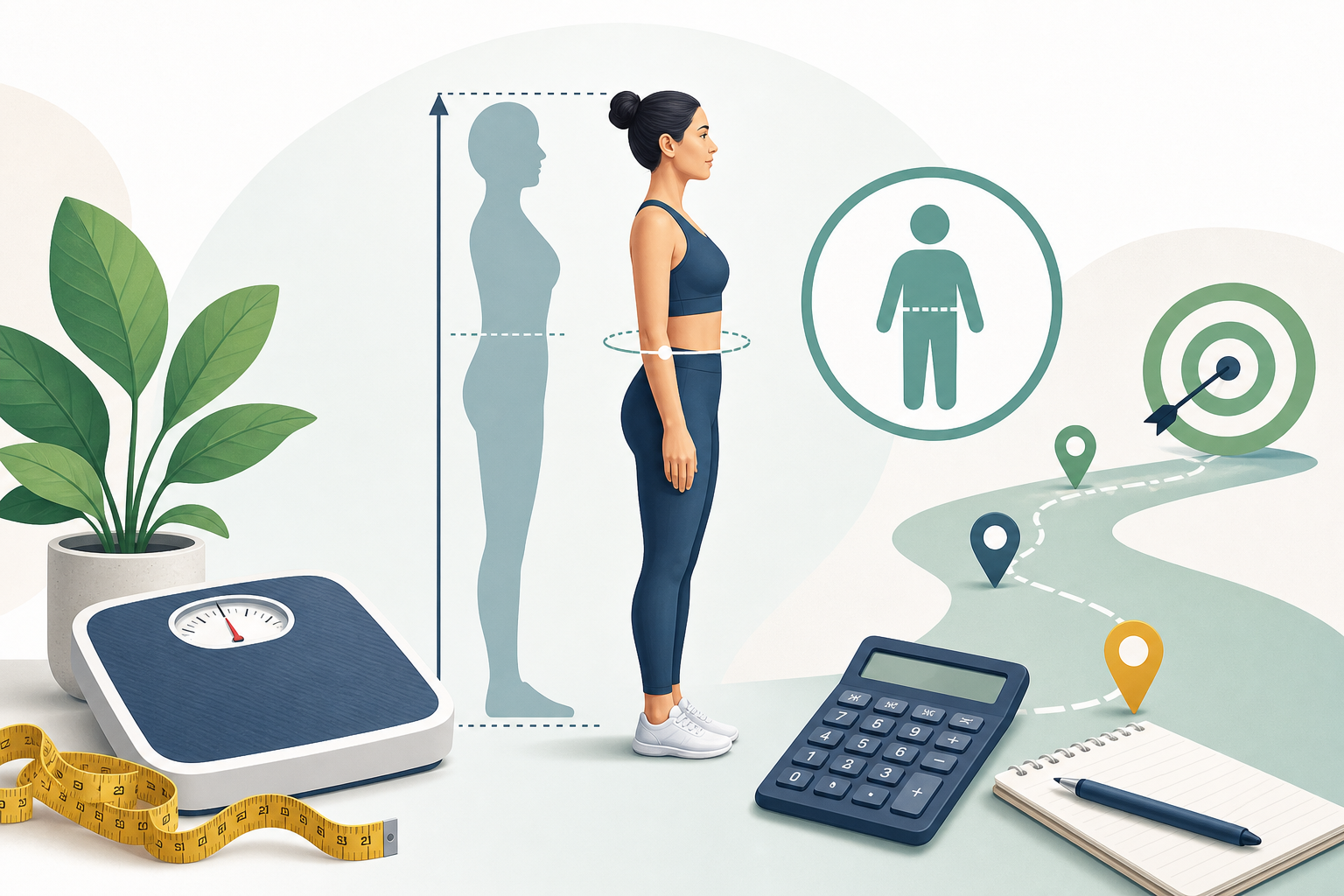
What is waist to height ratio? It is a calculated comparison between your waist circumference and your height. Also called the waist-height ratio, it provides a simple indication of central body size and can add context to body mass index (BMI). It does not directly measure body fat, health or disease risk.
What is waist to height ratio, and how is it calculated?
Waist-to-height ratio expresses the size of your waist relative to your height. The calculation uses two measured values:
Waist-to-height ratio = waist circumference ÷ height
Both measurements must use the same unit. You can divide centimetres by centimetres or inches by inches. The resulting ratio is unitless, so a correctly calculated result is the same whichever unit system you use.
For example, a waist circumference of 85 cm and a height of 175 cm produce the following calculation:
85 ÷ 175 = 0.486
Rounded to two decimal places, the waist-to-height ratio is 0.49. This means the waist circumference is approximately 49% of the person’s height. It is a calculated result based on the measurements entered, not a direct measurement of body composition.
How to measure waist circumference and height
The arithmetic is straightforward, but the quality of the result depends on the quality of the measurements. Small differences in tape position, posture or technique can change the calculated ratio.
Measuring your waist
- Use a flexible, non-stretch measuring tape.
- Follow one consistent waist-measurement location. If a calculator or healthcare professional provides a specific protocol, use that method.
- Stand upright in a relaxed position rather than pulling in or pushing out your abdomen.
- Keep the tape horizontal around your body.
- Make the tape snug without compressing the skin.
- Take the reading consistently, such as after a normal breath out.
Waist location matters because different protocols may use the narrowest point, the midpoint between anatomical landmarks or another defined location. Measurements taken at different locations should not be treated as directly interchangeable.
Measuring your height
- Remove shoes and bulky headwear.
- Stand upright on a level surface with your back against a vertical wall, if practical.
- Look straight ahead and avoid stretching upward or slouching.
- Record height in the same unit used for waist circumference.
If you are monitoring the ratio over time, try to use the same equipment, measurement location and technique. Repeating an unusual reading can help identify a tape-position or data-entry error.
What waist-to-height ratio shows
The ratio describes waist size in relation to overall height. Because the waist measurement reflects the circumference of the central part of the body, the result can be used as a simple indicator of central body size.
However, the calculation cannot identify what contributes to that circumference. It does not distinguish among fat tissue, muscle, bone structure, skin, abdominal contents or temporary changes such as bloating. It also does not provide a body-fat percentage.
A lower or higher result is therefore descriptive rather than diagnostic. Interpretation may also depend on factors that the formula does not include, such as age, growth stage, pregnancy, medical history and the measurement method used.
A single reading is best viewed as one piece of body-size information. When repeated under similar conditions, it may also show whether the measured relationship between waist and height has changed, but it cannot explain why a change occurred.
How waist-to-height ratio can complement BMI
BMI and waist-to-height ratio describe different aspects of body size. BMI compares weight with height, while waist-to-height ratio compares waist circumference with height.
- BMI: Uses body weight and height. It provides a general weight-for-height classification but does not show where body mass is carried.
- Waist-to-height ratio: Uses waist circumference and height. It adds information about central body size but does not measure total body mass or body composition.
Two people can have the same BMI but different waist circumferences. Conversely, people with similar waist-to-height ratios may have different body weights, muscle mass or body proportions. Neither calculation captures the complete picture on its own.
The National Institute of Diabetes and Digestive and Kidney Diseases provides broader information about weight management and the use of body-size information in health assessment. Such measures are generally most useful when considered alongside health history, physical findings and other relevant information rather than in isolation.
Waist-to-height ratio should not be treated as a replacement for professional assessment. Its practical value is that it offers an additional, simple comparison focused on the central body area.
What the waist to height ratio calculator can and cannot tell you
A waist to height ratio calculator performs the division after you enter your waist circumference and height. It can reduce arithmetic errors and may display the result with supporting explanatory information.
What the calculator can tell you
- Your waist circumference divided by your height.
- Your ratio as a decimal, based on the values entered.
- How your waist measurement compares proportionally with your height.
- Whether repeated calculated results have changed, provided measurements were taken consistently.
What the calculator cannot tell you
- Your body-fat percentage or the amount of internal abdominal fat.
- The cause of your waist measurement or a change in that measurement.
- Whether you have a medical condition.
- Your fitness, nutritional status or overall health.
- How your result should be interpreted without considering personal circumstances.
- Whether the measurements entered were taken accurately.
The calculator does not independently measure your body. Its output is a calculated value, while waist circumference and height are measured inputs. If an input is inaccurate or the units are mixed, the result will also be inaccurate.
Limitations and common calculation mistakes
Waist-to-height ratio is simple, but simplicity also limits the amount of information it can provide. Body proportions vary, and the formula does not adjust for factors such as body build, muscle distribution, pregnancy or changes in height and posture.
Common errors include:
- Entering waist circumference in centimetres and height in inches, or the reverse.
- Measuring over thick clothing.
- Allowing the tape to slope rather than remain horizontal.
- Pulling the tape too tightly or leaving it loose.
- Changing the waist-measurement location between readings.
- Confusing waist circumference with clothing size.
- Rounding measurements too early in the calculation.
Results may also be less straightforward to interpret during pregnancy, periods of growth, or when a health condition substantially affects abdominal size or posture. A single ratio should not be used to diagnose a condition or make treatment decisions.
Frequently asked questions
Is waist-to-height ratio the same as waist circumference?
No. Waist circumference is a direct tape measurement, such as 85 cm. Waist-to-height ratio is a calculated comparison that divides that waist measurement by height.
Can I use inches instead of centimetres?
Yes. Use inches for both waist and height, or centimetres for both. Do not divide a measurement in one unit by a measurement in another unit unless you convert them first.
Is waist-to-height ratio a body-fat measurement?
No. It describes waist size relative to height. It does not determine body-fat percentage or distinguish fat from muscle and other tissues.
Why might my result change between measurements?
The result can change because of tape placement, posture, breathing, clothing, measurement timing or an actual change in waist circumference. Using the same method each time makes comparisons more meaningful.
Is waist-to-height ratio better than BMI?
They answer different questions. BMI describes weight relative to height, while waist-to-height ratio describes central body size relative to height. Using both may provide more context than relying on either figure alone, but neither is a complete health assessment.
What is waist to height ratio useful for in practice?
It is useful as a quick, unitless description of waist size in relation to height. It can complement BMI and help track consistently measured central body size, while its limitations and the wider health context remain important.