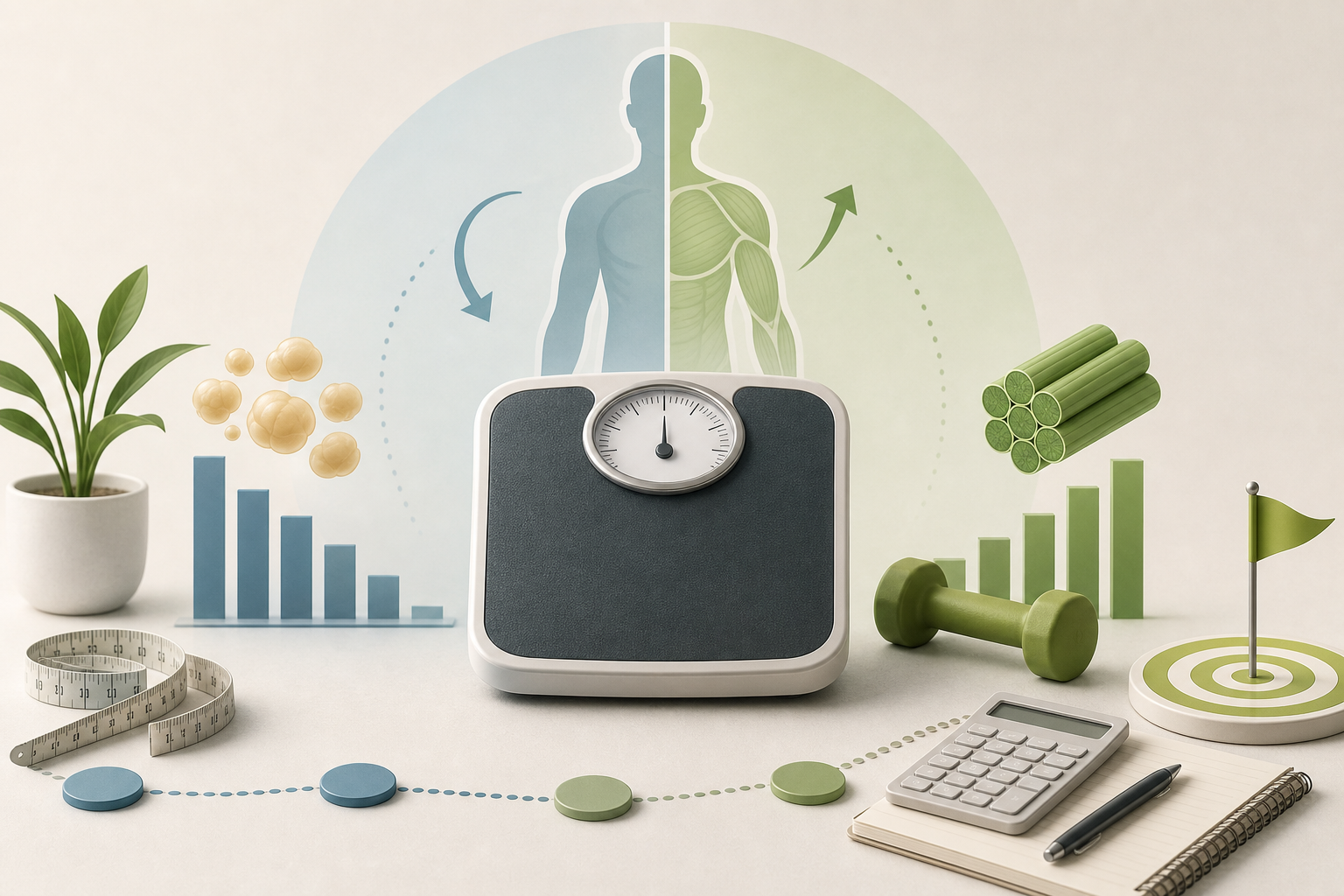
Yes. A lean body mass change can occur even when scale weight stays the same. If fat mass decreases while muscle or another component of fat-free mass increases by a similar amount, total body weight may barely move. Changes in body water can also temporarily hide or imitate changes in body composition.
How can lean body mass change without a change in weight?
Scale weight is the combined weight of fat mass and lean body mass. Lean body mass is body weight minus fat mass and includes muscle, bone, organs, water and other non-fat tissues.
Because the scale displays only the total, different changes can offset one another. For example, losing 2 kg of fat while gaining 2 kg of lean tissue would leave total weight unchanged. This is commonly described as body recomposition.
The same scale reading can therefore represent different proportions of fat and lean mass. However, unchanged weight does not prove that recomposition has occurred. Measurement error, food intake, hydration and normal day-to-day variation may also explain the pattern.
What scale weight does and does not show
A standard scale measures total body weight at one moment. It does not separate that weight into muscle, fat, water, bone or organs.
This makes the scale useful for following longer-term weight trends, but less useful for identifying exactly what has changed. Two people with the same height and weight can have different body compositions, and one person can have the same weight at two points in time with different amounts of fat mass and fat free mass.
When weight remains stable, several situations are possible:
- Fat mass decreased while lean mass increased by a similar amount.
- Fat mass changed, but a shift in body water temporarily offset it.
- There was little meaningful change in either fat or lean tissue.
- Ordinary variation in weighing conditions obscured a small trend.
For this reason, a single weigh-in provides limited information. Repeated measurements under reasonably consistent conditions are generally more informative than comparing isolated readings.
Fluid shifts can resemble a lean body mass change
Water is part of lean body mass. A higher estimate of fat-free mass does not necessarily mean that the body has gained the same amount of muscle.
Body water may vary with recent food and fluid intake, carbohydrate intake, sodium intake, exercise, sweating, alcohol use, menstrual-cycle changes and the time of day. The amount of food and drink still in the digestive system can also affect scale weight without representing a lasting tissue change.
These shifts matter because many body-composition methods are influenced by hydration. A measurement taken when someone is more or less hydrated than usual may produce a different lean-mass result even if muscle tissue has not meaningfully changed.
Short-term fluctuations should therefore be interpreted cautiously. A sustained pattern across several weeks is usually more useful for evaluating body composition than a result from one day.
How to assess body-composition trends in practice
No single home measurement shows the complete picture. Combining several indicators can help distinguish a possible body-composition trend from temporary variation.
- Body-weight trend: Compare averages or repeated measurements rather than focusing on one reading.
- Waist or other circumference measurements: Use the same anatomical position and measuring technique each time.
- Clothing fit: A consistent change may provide supporting context, although it is not a precise measurement.
- Training performance: Changes in strength or exercise capacity can add context but do not directly measure muscle mass.
- Body-composition testing: When precision matters, a suitable direct or instrument-based assessment may provide more information than an equation alone.
A practical scenario
Consider a person who weighs 75 kg at the beginning of a training period and still weighs 75 kg eight weeks later. Their waist measurement has become smaller, their clothes fit differently and repeated body-composition assessments suggest less fat mass and more fat-free mass.
One possible explanation is recomposition: fat mass decreased while lean mass increased enough to offset the loss on the scale. Another possibility is that part of the apparent lean-mass increase reflects hydration or measurement variability. The evidence is more convincing when several measurements show a consistent pattern under similar conditions.
Keeping comparisons more consistent
If you track weight or measurements at home, try to compare like with like. Use the same scale, similar clothing, the same measuring locations and approximately the same time of day. Consistency cannot eliminate all variation, but it makes the trend easier to interpret.
Avoid treating small differences as exact tissue changes. Home devices and equations produce estimates, and even professionally administered methods have assumptions and sources of error.
What a lean body mass calculator can and cannot tell you
The lean body mass calculator estimates lean body mass from height, weight and sex. It uses the Boer equations:
- Male estimate: 0.407 × weight in kg + 0.267 × height in cm − 19.2
- Female estimate: 0.252 × weight in kg + 0.473 × height in cm − 48.3
For example, the male equation for a height of 175 cm and weight of 80 kg produces an estimated lean body mass of about 60.1 kg. The estimated fat mass would be approximately 19.9 kg because body weight minus estimated lean mass equals estimated fat mass.
This is an equation-based estimate, not a measured body-composition result. The formula is based on population data and may be less accurate for people at body-size extremes or those with unusually high muscularity.
What the calculator can do
- Provide a rough estimate of current lean mass.
- Help explain how total weight may be divided into estimated fat and non-fat mass.
- Offer a consistent equation for broad comparisons when the inputs change.
- Provide background information for planning discussions in which an estimated lean-mass value is relevant.
What the calculator cannot do
- Directly measure muscle, bone, organs or body water.
- Confirm that a change in estimated lean mass represents muscle gain.
- Detect recomposition when height, weight and the selected sex option remain unchanged.
- Separate temporary fluid shifts from lasting tissue changes.
- Replace a suitable body-composition assessment when greater precision is needed.
The third limitation is especially important. If scale weight remains exactly the same, the calculator receives the same height, weight and sex inputs and returns the same estimate. Actual body composition could have changed even though the equation cannot detect it.
Frequently asked questions
Is lean body mass the same as muscle mass?
No. Muscle is one part of lean body mass. Lean body mass also includes body water, bone, organs and other non-fat tissues, so an increase in lean mass should not automatically be labelled as muscle gain.
Are lean body mass and fat free mass interchangeable?
They are often used in similar ways in general weight-management discussions. In this calculator, lean body mass means body weight minus fat mass and therefore includes the body’s non-fat components.
Can I lose body fat while my weight remains stable?
It is possible if the reduction in fat mass is offset by an increase in lean tissue or body water. Stable weight alone cannot confirm that this has happened, so other consistent measurements are needed for context.
Why did my estimated lean mass change quickly?
A rapid change may reflect hydration, recent food intake, weighing conditions or the assumptions of the measurement method. Large amounts of new muscle tissue should not be inferred from a short-term change in an estimate alone.
How often should I compare results?
There is no single interval that suits everyone. Comparisons should be far enough apart to reduce the influence of ordinary daily variation, and measurements should be taken under similar conditions. Focus on the broader pattern rather than small changes between adjacent readings.
Which method should I trust if my scale and calculator disagree?
First check whether the methods are measuring the same thing. A standard scale reports total weight, a calculator provides an equation-based estimate, and a body-composition device uses its own method and assumptions. Differences do not necessarily mean that one result captures an exact tissue change.
Putting lean body mass change in context
Stable scale weight does not always mean that nothing has changed. Fat loss, lean-tissue gain and fluid shifts can offset one another, leaving total weight similar while body composition differs.
At the same time, a reported lean body mass change is not automatically proof of muscle gain. Interpret estimates alongside repeated weight, circumference and body-composition measurements, and remember that an equation based only on height, weight and sex cannot identify recomposition when those inputs remain unchanged.
References
- National Institute of Diabetes and Digestive and Kidney Diseases: Weight Management — general information on weight management and the role of appropriate assessment methods.