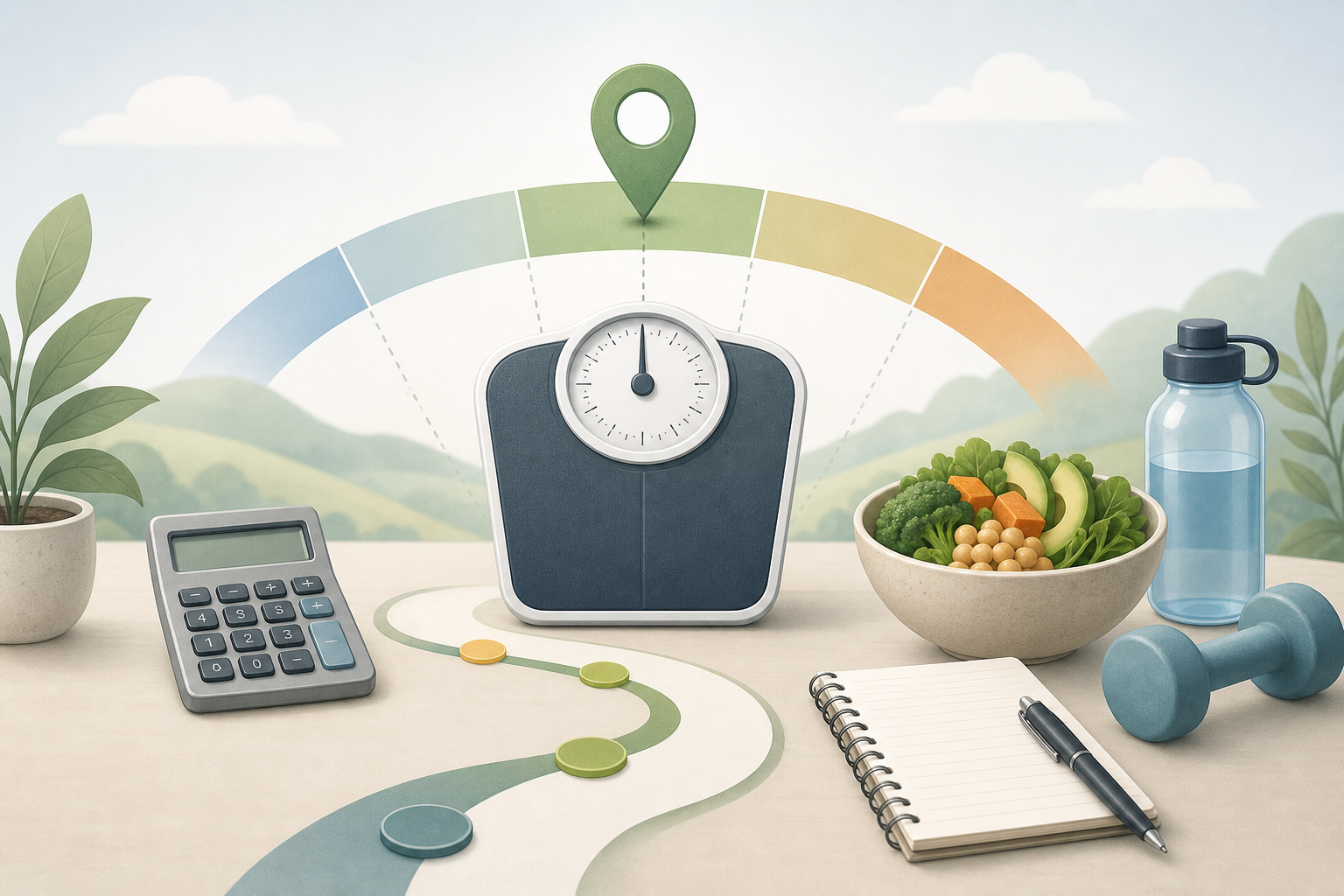
A healthy weight range is a broad screening estimate, not one perfect number that everyone of the same height should reach. People naturally differ in body composition, skeletal build, age-related changes and personal health circumstances. A single scale reading cannot capture all of those factors.
For adults, healthy-weight calculators commonly show the body weights corresponding to a body mass index (BMI) of 18.5 to 24.9 at a given height. This can provide useful context, but it does not identify an individually ideal weight or directly measure health.
Why a healthy weight range is more useful than one target
Body weight can vary within a meaningful interval rather than needing to match one exact figure. Even BMI, which is based only on height and weight, uses categories spanning a range of values rather than assigning a single “correct” BMI.
A range also reflects the limits of what height and weight can tell us. Two adults can have the same height and weight while differing in muscle mass, body-fat distribution, bone mass and other characteristics. Their BMI will be identical, but their bodies and personal health contexts may not be.
Day-to-day scale readings are not perfectly fixed either. Food, fluid balance, clothing and measurement conditions can affect a reading. Treating one number as a precise dividing line may therefore give it more importance than it deserves.
How a BMI weight range is estimated
BMI is calculated by dividing weight in kilograms by height in metres squared. A BMI-based weight range reverses that calculation to find the weights associated with the commonly used adult healthy BMI category.
The method is:
- Lower weight estimate = 18.5 × height²
- Upper weight estimate = 24.9 × height²
- Height must be expressed in metres for the result to be in kilograms.
For example, at a height of 1.75 metres:
- Lower estimate: 18.5 × 1.75² = approximately 56.7 kg
- Upper estimate: 24.9 × 1.75² = approximately 76.3 kg
The resulting BMI weight range is approximately 56.7–76.3 kg. This interval is much wider than a single target because every BMI value from 18.5 through 24.9 is included.
The category boundaries should not be interpreted as precise biological cut-offs. A person just below or above a boundary is not automatically in a substantially different state from someone just inside it. The US Centers for Disease Control and Prevention describes adult BMI as a screening measure that should be considered alongside other factors.
Why people at the same height may differ
Body composition
Body weight includes muscle, fat, bone, organs and body water. BMI does not separate these components. Someone with more muscle may weigh more than another person of the same height without the difference having the same meaning as a difference in body fat.
Conversely, being within the BMI-based range does not reveal how much of a person’s weight comes from fat or where that fat is distributed. The calculation reports a relationship between height and weight, not a direct body-composition measurement.
Skeletal build and proportions
People differ in skeletal dimensions and overall body proportions. Terms such as “small frame” and “large frame” are sometimes used informally to describe this variation, but there is no frame-size adjustment in the standard adult BMI formula.
This does not make BMI useless. It means that the result is one screening estimate rather than a complete evaluation of an individual body.
Personal circumstances
The relevance of a calculated range can also depend on personal context. Age, pregnancy, health conditions, medicines, mobility and recent unintentional weight change may affect how a weight result is interpreted. BMI categories designed for adults are also not intended to be applied unchanged to children and teenagers.
For an individual, weight may be considered alongside information such as weight history, physical function, nutrition, waist measurement, clinical findings and relevant test results. No single measurement provides the full picture.
A practical example of interpreting the range
Consider two adults who are both 1.75 metres tall and weigh 75 kg. Their calculated BMI is about 24.5, placing both within the commonly used adult healthy category. The calculator therefore gives them the same result.
One person might have substantial muscle mass and stable measurements over several years. The other might have experienced a recent, unexplained change in weight or have different body-composition and health indicators. BMI cannot show these distinctions because it uses only height and weight.
Now consider a third person at the same height who weighs 77 kg. This is slightly above the calculated upper boundary of about 76.3 kg. The small numerical difference does not by itself establish that 76.3 kg is suitable and 77 kg is unsuitable; it only places the measurements on different sides of a screening threshold.
This scenario illustrates why the range is best read as an initial reference point. It can help describe where weight falls in relation to adult BMI categories, but the decimal places should not be mistaken for individualized precision.
What the healthy weight calculator can and cannot tell you
The healthy weight calculator estimates the body-weight interval corresponding to adult BMI values of 18.5–24.9 for the height entered. It automates the formula and can display the result in familiar units.
What it can tell you
- The approximate lower and upper weights associated with the adult healthy BMI category at your height.
- How the same BMI category translates into different weight ranges at different heights.
- A consistent screening reference based on height and weight.
- A starting point for understanding an adult BMI result.
What it cannot tell you
- Your exact or ideal personal weight.
- Your body-fat percentage, muscle mass, bone mass or fat distribution.
- Whether a particular weight is appropriate in every personal or clinical circumstance.
- Why your weight has changed or what any change means.
- How you feel, function or perform at a given weight.
- A complete assessment of health or future health risk.
The output is calculated rather than measured. Your height and weight are measurements when obtained with appropriate equipment; the displayed range is an estimate produced from those inputs and fixed BMI boundaries.
How to use the result without focusing on one exact number
A calculator result is easier to interpret when its precision is kept in perspective. Although the output may contain decimal places, the method does not become individually precise simply because the arithmetic is detailed.
Useful interpretation principles include:
- Read the full interval. Avoid selecting the midpoint or either boundary as an automatically superior target.
- Consider patterns rather than isolated readings. Measurements taken under different conditions can vary, while longer-term trends provide different information.
- Keep the method in view. The range comes entirely from height, weight and standard adult BMI boundaries.
- Include personal context. Body composition, weight history, function and relevant health information may change how the estimate is understood.
- Avoid treating category edges as cliffs. A small difference around a BMI threshold is still a small numerical difference.
The most accurate conclusion is therefore not that every adult has one ideal number. A healthy weight range offers a standard screening interval, while an appropriate weight for a particular person may require broader information than a calculator can provide.
Frequently asked questions
Is the middle of the range the healthiest weight?
Not necessarily. The midpoint is simply halfway between two calculated boundaries. The BMI method does not establish that the centre of the interval is better than another point within it for every person.
Why does the calculator give such a wide range?
The calculation includes all weights corresponding to adult BMI values from 18.5 to 24.9. Because this is an interval of BMI values rather than one value, it produces an interval of body weights.
Does being within the BMI range prove that my weight is healthy?
No. It shows that your height and weight fall within a commonly used adult BMI category. BMI is a screening measure and does not directly assess body composition, medical conditions, physical function or all other aspects of health.
Does being just outside the range mean my weight is unhealthy?
Not by itself. Category boundaries help standardize screening, but a small difference around a boundary should not be treated as a definitive judgement. Other measurements and personal circumstances may be relevant.
Can the range be used for children or during pregnancy?
The standard adult BMI range is not designed to be applied unchanged in these situations. BMI interpretation for children and teenagers is age- and sex-specific, while pregnancy involves expected changes that an ordinary adult healthy weight calculator does not account for.
Should my weight remain exactly the same every day?
No. Scale readings can fluctuate because of fluid, food, clothing and measurement conditions. An individual reading should be interpreted as one observation rather than a permanent or perfectly precise value.