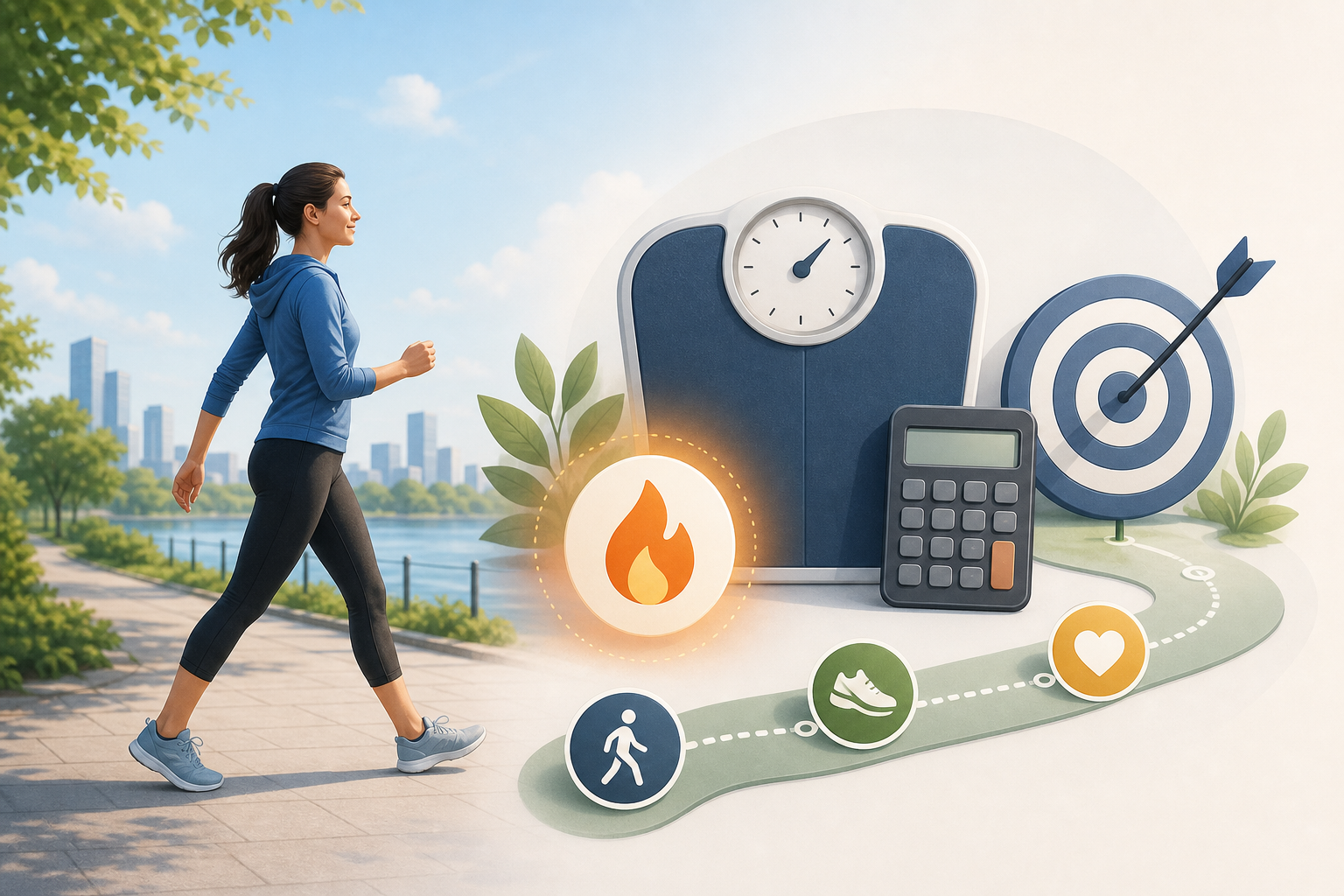
So, how many calories does walking burn? The answer depends mainly on body weight, walking pace and duration, with terrain, carried weight, gait and individual efficiency also affecting the result. For example, an 80 kg person walking briskly for 45 minutes at an estimated 4.3 MET uses roughly 271 calories according to a standard MET-based calculation. This is a planning estimate, not a measured value.
How many calories does walking burn at different body weights?
For the same pace and duration, a person with a higher body weight will generally have a higher estimated energy expenditure. This is because moving a larger total mass requires more energy, although actual expenditure still varies between individuals.
The table below shows estimated calories burned walking for 45 minutes at 4.3 MET. The figures are calculated estimates rather than guaranteed amounts.
| Body weight | Duration | Walking intensity | Estimated calories |
|---|---|---|---|
| 60 kg | 45 minutes | 4.3 MET | About 203 kcal |
| 70 kg | 45 minutes | 4.3 MET | About 237 kcal |
| 80 kg | 45 minutes | 4.3 MET | About 271 kcal |
| 90 kg | 45 minutes | 4.3 MET | About 305 kcal |
| 100 kg | 45 minutes | 4.3 MET | About 339 kcal |
These comparisons assume that the MET value and duration remain unchanged. They do not account for hills, uneven surfaces, changes in speed or differences in walking technique.
How walking calorie estimates are calculated
A walking calorie calculator commonly assigns an approximate metabolic equivalent, or MET, to the selected pace. MET values provide a standard way to describe and compare the energy cost of different activities.
The calculator uses this formula:
Estimated kcal = walking MET × 3.5 × body weight in kilograms ÷ 200 × minutes
For an 80 kg person walking for 45 minutes at 4.3 MET, the calculation is:
4.3 × 3.5 × 80 ÷ 200 × 45 = approximately 271 kcal
The result should usually be rounded rather than treated as an exact figure. Reporting 271 calories does not mean that precisely 271 calories were used; the apparent precision comes from the arithmetic, not from direct measurement.
MET values are useful for comparing activities and estimating population-level energy expenditure. They cannot fully represent differences in fitness, movement efficiency, body composition or walking mechanics.
What affects calories burned walking?
Body weight
Body weight is included directly in the MET formula. If pace, duration and MET value stay the same, the estimate increases in proportion to body weight.
This does not mean that two people of the same weight will necessarily burn the same amount. Their stride, fitness, gait and effort may differ.
Pace and effort
Faster walking usually receives a higher MET value because it generally requires more energy per minute. However, the relationship is not perfectly linear, and pace categories may not capture how hard a particular speed feels for an individual.
A comfortable pace for one person may feel demanding to another. Wind, temperature and fatigue can also change the effort involved even when the recorded speed is similar.
Duration
Longer walks produce higher estimates when all other inputs remain constant. In the formula, doubling the duration doubles the calculated calories.
Real walks may include stops, slower sections or changes in pace. Entering the full elapsed time can therefore overestimate active walking time if much of the session was spent stationary.
Terrain and incline
Walking uphill generally requires more effort than walking at the same speed on level ground. Soft sand, trails, mud, stairs and uneven ground may also increase the work involved.
A basic calculator may not capture these conditions unless it offers a specific terrain or incline option. A level-walking estimate may therefore be less representative for a hilly route.
Carrying a load
A backpack, shopping bags or other carried weight can increase energy expenditure. The effect depends on the load, how it is carried, the terrain and the walking speed.
Do not simply add the load to body weight unless the tool specifically instructs you to do so. The calculator’s underlying MET value may not have been designed for loaded walking.
Individual movement efficiency
Stride length, gait, balance, fitness and familiarity with walking can influence actual energy use. Two people completing the same route in the same time may therefore have different measured expenditure.
A practical walking example
Consider an 80 kg person who completes a 45-minute brisk walk. If the selected pace corresponds to 4.3 MET, the estimate is about 271 kcal.
If the person walks for only 30 minutes at the same assumed intensity, the formula gives approximately 181 kcal. If the duration increases to 60 minutes, the estimate becomes approximately 361 kcal.
These differences arise from duration alone. If the route includes steep hills or the walker alternates between fast and slow sections, a single 4.3 MET value may not describe the entire session accurately.
For a variable-pace walk, one option is to estimate separate sections. For example, calculate an easier 20-minute section and a brisker 25-minute section independently, then add the results. This can be more representative than assigning one pace to the full 45 minutes, but it remains an estimate.
What the walking calorie calculator can and cannot tell you
The walking calorie calculator estimates energy expenditure from body weight, selected pace and duration. It is most useful for comparing sessions using a consistent method.
What it can help with
- Estimating calories used during a walking session.
- Comparing shorter and longer walks at the same pace.
- Seeing how different pace categories affect the estimate.
- Reviewing approximate energy expenditure across a walking routine.
- Keeping planning calculations consistent over time.
What it cannot determine
- Your exact measured calorie expenditure.
- The full effect of hills, wind, surfaces or carried loads unless these are included as inputs.
- How much body weight will change as a result of one walk.
- Your individual movement efficiency or metabolic response.
- The accuracy of a pace selection when speed changes throughout the session.
Laboratory equipment can measure energy expenditure more directly, but even measured values depend on the method and conditions. A calculator result should therefore be treated as an informed approximation rather than a personal metabolic measurement.
Using walking for weight loss planning
Walking for weight loss can contribute to overall activity-related energy expenditure, but a calorie estimate does not predict a specific amount of weight change. Body weight over time is influenced by food intake, activity, fluid balance and other individual factors.
It is also unwise to assume that every estimated exercise calorie can be matched exactly with additional food. Both activity estimates and food calorie values contain uncertainty, so treating them as precise accounting figures can produce misleading totals.
A more practical use is to compare like with like. For example, use the same walking calorie calculator settings to compare a 30-minute walk with a 45-minute walk, or a comfortable pace with a brisk pace.
Consistency in recording matters more than false precision. If the route or pace changes substantially, note the difference rather than assuming that two walks of equal duration used the same amount of energy.
Frequently asked questions
Does walking faster always burn more calories?
Walking faster generally increases estimated calories used per minute because a higher pace is assigned a higher MET value. The exact difference depends on the pace categories used by the calculator and how closely they represent your actual effort.
Are treadmill and outdoor walking estimates the same?
They may be similar when speed and incline are comparable, but outdoor terrain, wind and speed variation can change the effort involved. A treadmill’s displayed calorie figure is also an estimate and may use a different formula.
Should rest stops count as walking time?
Enter active walking time when possible. Including long stationary breaks as walking time may overestimate the session because the formula assumes the selected walking intensity continued for all entered minutes.
Does walking uphill burn more calories than level walking?
Uphill walking usually requires more effort than level walking at the same speed. A calculator based only on level-walking pace may not capture the additional expenditure unless it includes an incline or hill option.
Why does my fitness tracker show a different result?
Fitness trackers may use heart rate, movement data, age, sex or proprietary formulas, while a MET calculator uses weight, time and an assigned activity value. Different inputs and methods can produce different estimates, and neither should automatically be treated as exact.
How many calories does walking burn in 30 minutes?
It depends on body weight and pace. Using 4.3 MET as an example, an 80 kg person would have an estimated expenditure of about 181 kcal over 30 minutes. Terrain, gait and actual speed may make the real value higher or lower.