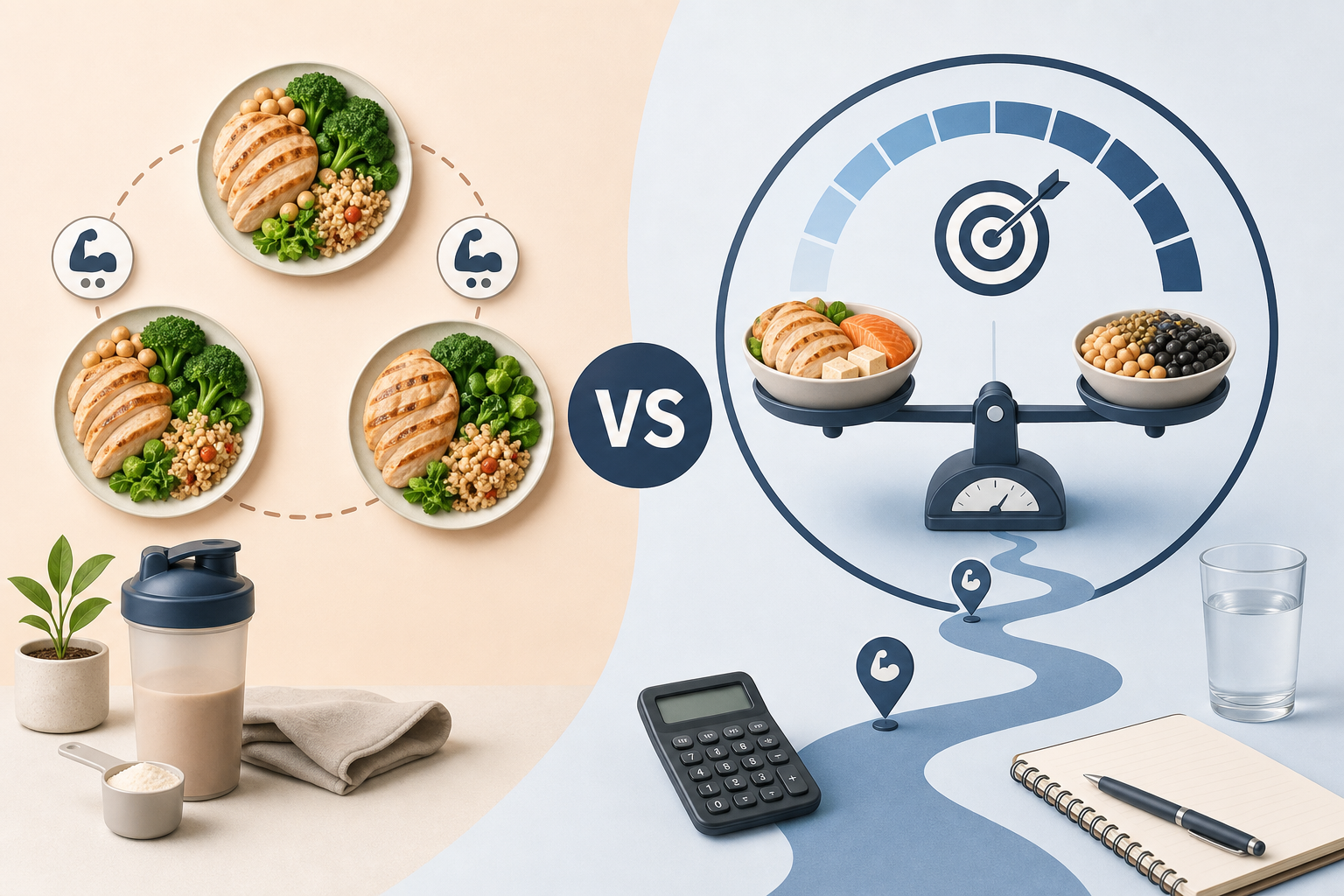
Protein per meal vs per day is best understood as two related planning questions. Your total daily protein intake describes how much protein you consume across the entire day, while protein per meal describes how that total is distributed. The daily amount is usually the starting point; meal distribution can then be adjusted around appetite, routine, food preferences, and training schedule.
Protein per meal vs per day: which matters first?
Total protein per day provides the overall nutrition target. If your estimated target is 96 grams per day, eating 20 grams at breakfast does not indicate whether your daily intake is adequate unless the rest of the day is also considered.
Protein per meal is a practical way to organise that total. A reasonably balanced distribution may make meals easier to plan, but there is no single meal pattern that suits everyone. Some people eat three main meals, while others prefer smaller meals and snacks.
In practical terms, estimate a suitable daily amount first and then decide how to divide it. A per-meal figure should not be treated as an additional requirement on top of the daily estimate.
How total daily protein intake is estimated
Protein requirements vary with factors including body size, activity, age, health status, and the overall diet. A common planning method expresses protein intake in grams per kilogram of body weight:
Daily protein grams = body weight in kilograms × selected grams per kilogram
The grams-per-kilogram value is a planning assumption rather than a measurement of your individual biological requirement. Selecting a higher level produces a higher estimate, but that does not automatically make it more appropriate.
For example, an 80 kg person using a planning level of 1.2 grams per kilogram would calculate:
80 kg × 1.2 g/kg = 96 grams of protein per day
The body weight may be a measured input, while the resulting 96 grams is an estimate based on the selected planning level. Dietary Reference Intakes from the National Academies provide broader scientific context for protein and other macronutrients, but individual needs can differ.
How to divide a daily total between meals
Once you have a daily estimate, divide it according to the number and size of meals you normally eat. Equal division is a convenient starting point, not a rule.
Using the 96-gram example, possible distributions include:
- Three meals: about 32 grams at each meal
- Four eating occasions: about 24 grams at each
- Uneven distribution: 25 grams at breakfast, 30 grams at lunch, 35 grams at dinner, and 6 grams from a snack
Each pattern adds up to the same daily total. The most workable option may depend on meal timing, appetite, cultural eating patterns, food availability, and whether meals are prepared at home or eaten elsewhere.
You do not need to hit the same number at every meal. Instead, consider whether concentrating almost all your protein in one meal happens by preference or simply because earlier meals contain very little.
Practical ways to plan protein across the day
Start with your usual meal pattern
A three-meal plan does not need to be converted into six eating occasions solely to distribute protein. Begin with the schedule you can maintain and identify which meals already include meaningful protein sources.
Review the whole meal
Protein comes from both animal and plant foods. Depending on dietary preferences, sources may include dairy foods, eggs, fish, meat, poultry, beans, lentils, soy foods, nuts, seeds, and combinations of grains and legumes.
Actual protein content varies by food, portion, brand, and preparation. Nutrition labels, reliable food-composition databases, or weighed portions can help estimate intake, but food logging still involves some uncertainty.
Adjust rather than rebuild
If one meal is consistently low in protein, a modest adjustment may be simpler than changing the entire day. For example, someone whose breakfast contributes little protein might add yoghurt, eggs, soy food, beans, or another suitable option rather than forcing every meal to be identical.
Protein planning in a weight-management diet
People searching for protein for weight loss may focus heavily on a per-meal number. However, protein does not operate separately from total food intake, dietary pattern, activity, sleep, preferences, and health considerations.
A protein target can help organise meals during weight management, but it does not predict how much weight a person will lose. It is also important not to let a protein goal displace other nutritious foods or make the overall diet unnecessarily restrictive.
When body weight changes, a weight-based estimate may also change. Recalculating periodically can be useful, but small day-to-day scale fluctuations do not necessarily require a new protein plan.
What the protein calculator can and cannot tell you
The protein calculator estimates daily grams from body weight and a selected grams-per-kilogram planning level. It can show how different assumptions change the result and can provide a starting point for meal planning.
The calculator can:
- convert body weight into an estimated daily protein amount;
- compare selectable grams-per-kilogram planning levels;
- provide a total that you can divide across meals and snacks; and
- make the calculation consistent and easy to repeat.
The calculator cannot:
- measure your exact physiological protein requirement;
- determine the ideal amount for each meal;
- assess the quality or nutritional balance of your food choices;
- account fully for age, training demands, medical conditions, medications, pregnancy, or recovery from illness; or
- decide whether a higher-protein intake is appropriate for you.
Higher intakes may not be suitable for everyone, particularly when individualised medical nutrition guidance is needed. The result should therefore be treated as a planning estimate rather than a prescription.
Frequently asked questions
Is protein per meal more important than protein per day?
They answer different questions, but the daily total is generally the more useful starting point. Per-meal planning helps distribute that total in a way that fits your schedule.
Do I need exactly the same amount of protein at every meal?
No. Equal portions can simplify planning, but meals can contain different amounts while still adding up to the same daily intake.
Can I make up for a low-protein breakfast at dinner?
Protein consumed later still contributes to the daily total. However, if one meal is routinely very low, adjusting it may create a more balanced and practical eating pattern.
Does the calculator provide a per-meal target?
The calculator estimates a daily amount. To create a simple per-meal figure, divide the result by your usual number of meals or eating occasions, then adjust the distribution to match your routine.
Should I calculate protein using current body weight or goal weight?
The calculator’s formula uses the body weight entered. Choosing which weight is most appropriate can depend on the purpose of the estimate and individual circumstances, especially when current and intended weights differ substantially.
Is a higher protein estimate always better for weight loss?
No. A higher calculated value is simply the result of selecting a higher grams-per-kilogram assumption. It does not guarantee better weight-management results and may not be appropriate for every person.
Putting the two numbers together
The central distinction in protein per meal vs per day is that one is a total and the other is a distribution strategy. Estimate daily protein first, divide it across your normal meals, and treat both figures as planning tools rather than exact measured needs.