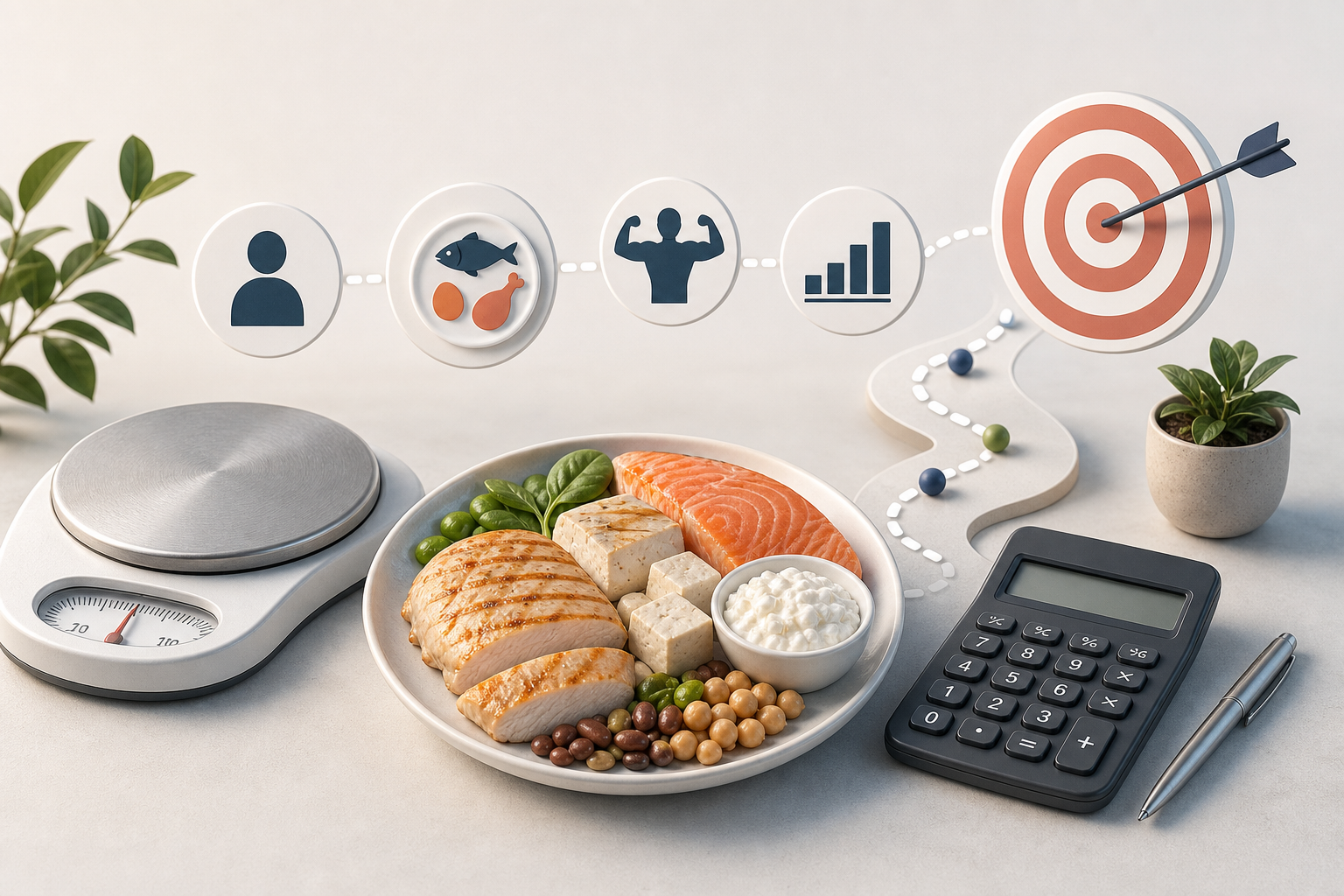
If you are wondering how much protein do you need per day, a practical starting point is to multiply your body weight in kilograms by a suitable grams-per-kilogram planning level. For example, an 80 kg adult using 1.2 grams per kilogram would estimate 96 grams of protein per day. The appropriate planning level varies with age, activity, health status, life stage, energy intake and personal goals, so the result is an estimate rather than a measured requirement.
- How much protein do you need per day based on body weight?
- Understanding body-weight-based protein planning levels
- What a lower planning level means
- What a higher planning level means
- Why “grams per day” and “grams per kilogram” are different
- Why daily protein intake varies between people
- Age and life stage
- Physical activity
- Total energy intake
- Diet quality and protein sources
- Health status
- Protein for weight loss: what the calculation means
- A practical meal-planning scenario
- What the protein calculator can and cannot tell you
- What it can tell you
- What it cannot tell you
- How to use a protein estimate in everyday eating
- Food-first planning and supplements
- Frequently asked questions
- Is 0.8 grams per kilogram enough protein?
- Should I calculate protein using kilograms or pounds?
- Should protein be based on current or goal body weight?
- Do I need to eat the same amount of protein every day?
- Can I get enough protein from plant foods?
- When is a protein calculator not enough?
Protein supports the maintenance and repair of body tissues and provides essential amino acids that the body must obtain from food. A body-weight-based calculation can make protein planning easier, but it cannot account for every factor that may affect individual needs.
How much protein do you need per day based on body weight?
The basic calculation is:
Daily protein estimate in grams = body weight in kilograms × selected grams of protein per kilogram
The National Academies’ Dietary Reference Intakes set an adult Recommended Dietary Allowance of 0.8 grams per kilogram of body weight per day. This is a population reference intended to meet the needs of nearly all healthy adults in the group; it is not a personalised target for every situation.
Some people use higher planning levels because of their activity, age, dietary pattern or body-composition goals. A higher calculation should not automatically be interpreted as better, necessary or suitable. It simply shows what a chosen grams-per-kilogram assumption means in daily grams.
| Body weight | At 0.8 g/kg | At 1.0 g/kg | At 1.2 g/kg |
|---|---|---|---|
| 50 kg | 40 g/day | 50 g/day | 60 g/day |
| 60 kg | 48 g/day | 60 g/day | 72 g/day |
| 70 kg | 56 g/day | 70 g/day | 84 g/day |
| 80 kg | 64 g/day | 80 g/day | 96 g/day |
| 90 kg | 72 g/day | 90 g/day | 108 g/day |
| 100 kg | 80 g/day | 100 g/day | 120 g/day |
The 1.0 and 1.2 g/kg columns are examples of planning calculations, not universal recommendations. Their purpose is to illustrate how changing the selected level changes the result.
Understanding body-weight-based protein planning levels
Protein estimates expressed in grams per kilogram scale the calculation to body size. This is generally more informative than giving every adult the same fixed number of grams, because a person weighing 50 kg and a person weighing 90 kg do not receive the same estimate.
To use the formula, first convert weight in pounds to kilograms if necessary:
Body weight in kilograms = body weight in pounds ÷ 2.2046
A person weighing 176 pounds is approximately 79.8 kg. At a selected planning level of 1.2 g/kg, the calculation is about 95.8 grams per day, which may be rounded to 96 grams for practical meal planning.
What a lower planning level means
A lower grams-per-kilogram level produces a lower daily estimate. The adult reference value of 0.8 g/kg may be a useful baseline when discussing protein needs for generally healthy adults, but it does not describe every life stage or individual circumstance.
What a higher planning level means
A higher level increases the estimated grams per day. People may explore higher planning assumptions when considering frequent exercise, maintaining lean tissue during an energy deficit, ageing-related changes or other circumstances.
These calculations do not prove that a person needs the higher amount or will benefit from it. They are planning scenarios that should be interpreted alongside the person’s overall diet, energy intake, training and health.
Why “grams per day” and “grams per kilogram” are different
Grams per kilogram describes the assumption used to generate a target. Grams per day is the resulting amount of protein from all foods, drinks and supplements combined.
For example, 1.2 g/kg is not 1.2 grams of protein per day. For an 80 kg person, it represents 96 grams per day.
Why daily protein intake varies between people
No single protein figure is suitable for every person. Even when two people have the same body weight, their circumstances may support different planning decisions.
Age and life stage
Protein requirements and nutrition priorities can change across the lifespan. Growth, pregnancy and lactation require separate consideration, while older adults may need to pay closer attention to total intake, food quality and how protein is distributed across meals.
A general adult calculation should not be assumed to represent the needs of a child, adolescent, pregnant person or breastfeeding person. Life-stage-specific reference values are more appropriate in those situations.
Physical activity
The type, frequency and intensity of activity can affect protein planning. Someone doing regular resistance training may assess protein differently from someone who is mostly sedentary, while endurance training introduces its own recovery and fuelling considerations.
Protein is only one part of an active person’s diet. Total energy, carbohydrate, fat, fluids and meal timing can also affect performance and recovery.
Total energy intake
The body uses dietary protein for several functions. When total food energy is restricted, protein planning may receive more attention because maintaining lean tissue can be one objective of the diet.
However, increasing protein does not remove the need for a balanced eating pattern or an appropriate energy intake. A high calculated protein target can also be difficult to fit into a very restricted diet without displacing fibre-rich foods, fats or carbohydrates.
Diet quality and protein sources
Protein comes in a wider food package that may also provide fat, carbohydrate, fibre, vitamins, minerals and sodium. For that reason, meeting a gram target is not the only consideration.
Protein can come from dairy products, eggs, fish, poultry, meat, beans, lentils, peas, soya foods, nuts, seeds and suitable alternatives. A varied diet can combine different sources rather than depending heavily on one food or supplement.
Health status
Some health conditions can change how protein intake should be assessed. Kidney function, liver function, wounds, recovery from major illness, digestive limitations and prescribed therapeutic diets may all require individual evaluation.
In these cases, a standard body-weight calculation may not be suitable on its own. The appropriate amount may depend on clinical information that a general online tool does not collect.
Protein for weight loss: what the calculation means
People often search for information about protein for weight loss because protein can be incorporated into meals while reducing overall energy intake. A protein estimate may help organise meals and identify whether a proposed eating pattern supplies a chosen amount.
It does not predict weight change. Body weight is influenced by total energy intake and expenditure over time, along with behaviour, sleep, medicines, health conditions and other individual factors.
A higher protein number also does not make a diet automatically more effective or nutritionally complete. Foods selected to meet the target still contribute energy, and an eating pattern needs room for vegetables, fruit, whole grains or other carbohydrate foods, fats and sources of fibre and micronutrients.
A practical meal-planning scenario
Consider an 80 kg adult who selects 1.2 g/kg as a planning assumption. The resulting estimate is:
80 kg × 1.2 g/kg = 96 g protein per day
The person could use 96 grams as a daily planning figure and divide it across meals and snacks. An even division is not required, but spreading protein-containing foods through the day may be more manageable than trying to obtain most of the amount in one meal.
The next step would be to compare the estimate with the person’s usual intake. Food labels, reliable food-composition data or a short food record can help approximate intake, although these methods also involve measurement and reporting error.
If the estimate is substantially different from current intake, that does not mean an immediate large change is necessary. It may be useful first to reconsider whether the selected g/kg level fits the person’s circumstances and whether the resulting diet remains practical and balanced.
What the protein calculator can and cannot tell you
The protein calculator estimates daily protein grams from body weight and a selected planning level. It performs the same core calculation shown above and allows different assumptions to be compared consistently.
What it can tell you
- Your estimated protein grams per day at the selected g/kg level.
- How body weight affects the calculated amount.
- How the result changes when you select a different planning assumption.
- A practical number that can be compared with food labels, meal plans or an estimated food record.
What it cannot tell you
- Your exact biological protein requirement.
- Whether the selected planning level is medically appropriate.
- How much protein your current diet provides unless your food intake is assessed separately.
- Whether your diet provides enough energy, fibre, vitamins, minerals or essential fats.
- Whether a particular protein intake will change your weight, muscle mass, appetite or exercise performance.
- How pregnancy, ageing, illness, medicines or impaired kidney or liver function should affect your intake.
A calculator result is an estimate, not a laboratory measurement. Its accuracy as a planning figure depends on the body weight entered and, more importantly, whether the selected grams-per-kilogram assumption is appropriate.
Body weight can also fluctuate because of hydration, food in the digestive tract and other short-term factors. Small changes on the scale therefore do not always require recalculating a daily target.
How to use a protein estimate in everyday eating
A daily protein intake estimate becomes useful when it is translated into realistic food choices. The goal is not necessarily to count every gram indefinitely, but to understand whether the overall pattern is reasonably aligned with the selected plan.
- Enter a current, representative body weight rather than reacting to a single unusual reading.
- Select a grams-per-kilogram level that reflects the purpose of the calculation.
- Note that the output is an estimated daily total from all sources.
- Compare the estimate with a typical day of eating using labels or dependable food-composition information.
- Review whether the plan also includes varied foods and enough overall nourishment.
- Reassess the planning assumption when activity, body weight, life stage or health status changes meaningfully.
Protein listed on packaged-food labels is usually given per serving or per 100 grams. Check the amount actually eaten rather than assuming the labelled serving matches your portion.
For mixed meals, protein may come from several ingredients. A grain bowl, for example, might include protein from beans, grains, seeds, vegetables and a dairy or soya-based topping. Looking only at the most obvious “protein food” can underestimate the meal’s total.
Food-first planning and supplements
Protein powders and ready-to-drink products can make intake easier in some circumstances, but they are not required to perform the calculation or to meet every protein plan. Whole and minimally processed foods may also provide fibre, vitamins, minerals and other nutrients.
If supplements are used, their protein and energy still count toward daily totals. Product composition and serving sizes vary, so the label is more informative than the size of the scoop alone.
Frequently asked questions
Is 0.8 grams per kilogram enough protein?
The National Academies identify 0.8 g/kg per day as the Recommended Dietary Allowance for healthy adults. It is a population reference rather than a personalised optimum for every activity level, goal, life stage or medical situation. Some people may use a different planning level after considering their circumstances.
Should I calculate protein using kilograms or pounds?
The standard body-weight formula uses kilograms. If your weight is in pounds, divide it by 2.2046 to convert it to kilograms before multiplying by the selected g/kg level. A calculator can perform the unit conversion automatically.
Should protein be based on current or goal body weight?
A general calculator usually uses the body weight entered, which is commonly current weight. Using a goal weight changes the result and may not represent present needs. When body composition, a substantial weight change or a clinical condition makes weight selection uncertain, individual assessment is more informative than choosing a different number without context.
Do I need to eat the same amount of protein every day?
Daily intake naturally varies. A calculated result is generally more useful as a planning reference than as a number that must be reached exactly each day. Consistent overall eating patterns are easier to interpret than small day-to-day differences.
Can I get enough protein from plant foods?
Plant foods can contribute substantial protein when appropriate foods and portions are included. Beans, lentils, peas, soya foods, nuts, seeds and grains can all contribute. Variety and total food intake matter because individual foods differ in their amino acid and nutrient profiles.
When is a protein calculator not enough?
A general estimate is not enough when medical nutrition needs may alter the appropriate intake. This can include kidney or liver conditions, major illness, wounds, digestive problems, pregnancy, lactation or a prescribed diet. These situations may require clinical information and an individual nutrition assessment.
In summary, the answer to how much protein do you need per day begins with body weight but does not end there. Multiplying kilograms by a selected g/kg level provides a clear estimate, while age, activity, life stage, total diet and health determine how that estimate should be interpreted.