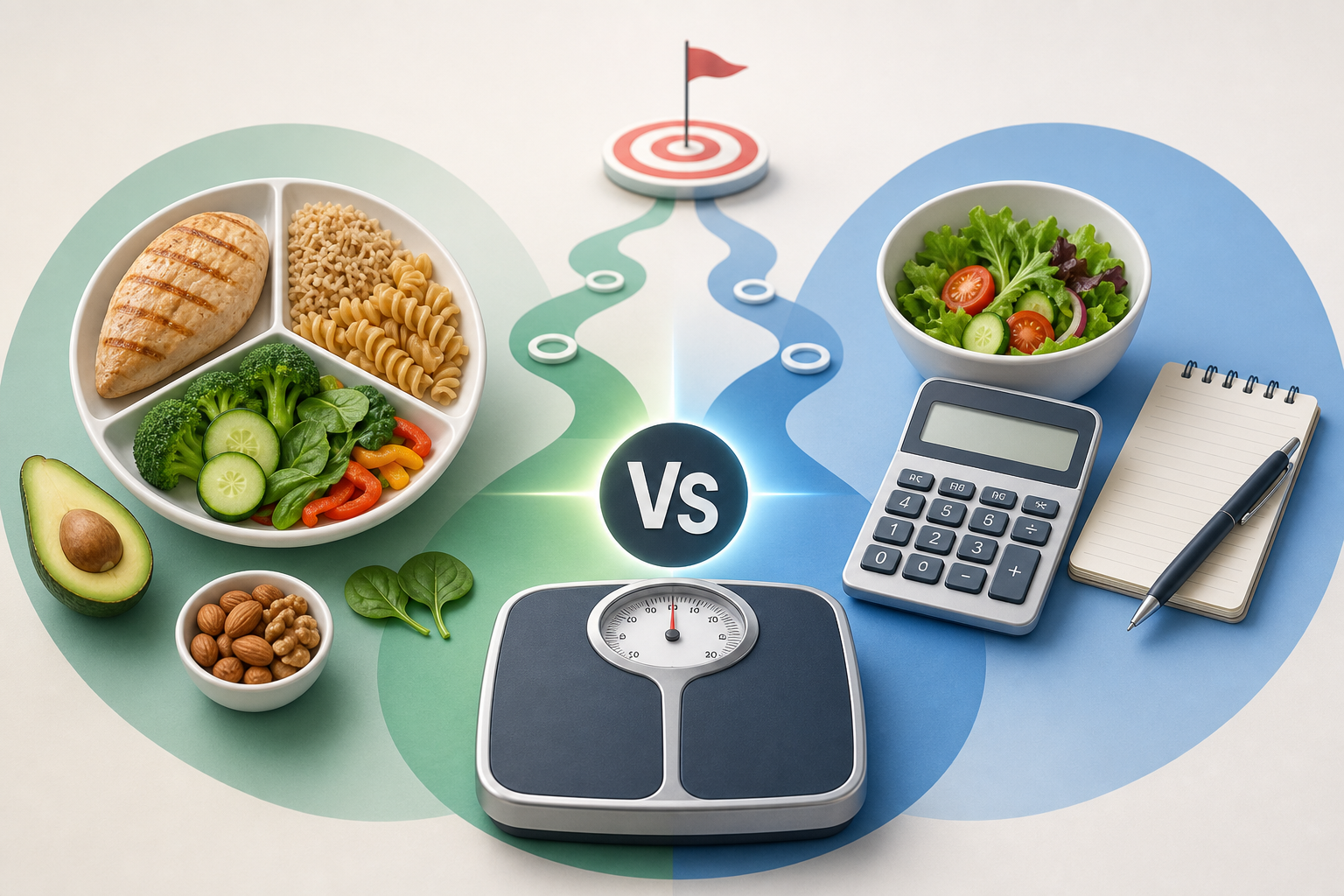
When comparing macros vs calories for weight loss, the two concepts answer different planning questions. Calories describe the total dietary energy in a food or daily intake, while macros describe where most of that energy comes from: protein, carbohydrate and fat. A calorie target can help frame energy intake, and a macro target can divide that energy into practical gram amounts.
Macros vs calories for weight loss: which matters more?
Calories are the starting point for estimating total energy intake. Changes in body weight are influenced by the relationship between energy consumed and energy used, although both sides of that relationship are estimates in everyday life.
Macronutrients affect how a calorie target is organised. Two eating patterns can provide a similar number of calories while containing very different amounts of protein, carbohydrate and fat.
| Planning tool | Question it answers | What it does not answer |
|---|---|---|
| Calorie target | How much total dietary energy is planned? | How that energy is divided among nutrients |
| Macro target | How many grams of protein, carbohydrate and fat fit the calorie target? | Whether the calorie target is suitable or whether the foods are nutrient-rich |
For weight planning, it is therefore not necessary to choose calories or macros as competing systems. Calories set the overall energy framework; macros provide a way to structure food choices within it.
How protein, carbs and fat relate to calories
Protein, carbohydrate and fat are the main energy-providing macronutrients. Standard planning calculations use approximately 4 kilocalories per gram for protein, 4 kilocalories per gram for carbohydrate and 9 kilocalories per gram for fat.
- Protein: about 4 kcal per gram
- Carbohydrate: about 4 kcal per gram
- Fat: about 9 kcal per gram
These values explain why changing macro percentages changes the gram targets. Fat provides more energy per gram, so a fat target expressed in grams will be lower than a carbohydrate or protein target assigned the same number of calories.
Macronutrient needs and acceptable intake ranges are discussed in the National Academies’ Dietary Reference Intakes. However, there is no single macro ratio that is ideal for every person. Preferences, food availability, activity, age and individual nutritional needs can all affect what is practical.
A practical macro calculation example
Consider a daily target of 2,000 kcal divided into 30% protein, 40% carbohydrate and 30% fat. This example demonstrates the calculation only; it does not mean that 2,000 kcal or this macro split is appropriate for every reader.
| Macronutrient | Calorie share | Calculation | Estimated grams |
|---|---|---|---|
| Protein | 30% or 600 kcal | 600 ÷ 4 | 150 g |
| Carbohydrate | 40% or 800 kcal | 800 ÷ 4 | 200 g |
| Fat | 30% or 600 kcal | 600 ÷ 9 | About 67 g |
The three macro estimates account for approximately 2,000 kcal. Small differences may appear because gram targets are rounded.
Now imagine using a different split at the same calorie level. The protein, carbohydrate and fat gram targets would change, but the planned total energy would remain 2,000 kcal. This illustrates why changing macros does not automatically change the calorie target.
What a macro calculator can and cannot tell you
A macro calculator converts a daily calorie target into estimated grams of protein, carbohydrate and fat. It applies the selected percentages using the standard energy values of approximately 4 kcal per gram for protein and carbohydrate and 9 kcal per gram for fat.
What it can tell you
- The percentage of daily calories assigned to each macronutrient.
- The estimated daily grams of protein, carbohydrate and fat.
- How different macro patterns change gram targets at the same calorie level.
- A consistent set of planning numbers that can be compared with food records or meal ideas.
What it cannot tell you
- Whether the entered calorie target is appropriate for your body or goals.
- Which macro pattern is universally best, because no single ratio suits everyone.
- Whether the foods selected provide enough fibre, vitamins, minerals or other important dietary components.
- Whether a macro pattern is appropriate for a medical condition or individual clinical need.
- Exactly how body weight will change in response to the targets.
The results are calculated planning estimates, not measured nutritional requirements. Their usefulness depends on the calorie target, selected pattern and accuracy of any food information used alongside them.
How to use calories and macros together
Start by treating the calorie figure and macro split as separate decisions. The calorie figure represents the intended total energy intake, while the split describes how that energy will be distributed.
- Choose or estimate a daily calorie target using an appropriate planning method.
- Select a macro pattern that appears practical for your food preferences and routine.
- Convert the percentages into grams with a macro calculator.
- Use the gram estimates to compare possible meals or review usual intake.
- Remember that matching the numbers does not by itself establish dietary quality or adequacy.
Exact daily matches are rarely necessary for understanding the plan. Food labels, serving sizes and tracking records can involve rounding or measurement error, so macro and calorie totals should be interpreted as estimates rather than laboratory measurements.
Food quality remains a separate consideration. A macro target does not identify how varied the diet is or whether it includes suitable sources of fibre and essential micronutrients. Calories, macros and broader food selection each provide different information.
Frequently asked questions
Can I plan weight loss using calories without tracking macros?
Yes. A person can use an overall calorie estimate without setting precise macro targets. However, looking at macros may make it easier to understand how protein, carbohydrate and fat contribute to the plan.
Does hitting macro targets guarantee weight loss?
No. Macro targets divide an entered calorie amount; they do not guarantee a particular change in body weight. Actual intake, energy use, measurement error and individual variation can affect the outcome.
Is a low-carbohydrate split always better?
No single carbohydrate, protein or fat ratio is universally best. Different patterns can fit the same calorie target, and practicality can vary with preferences, activity and nutritional needs.
Why do my macro calories not exactly match my calorie target?
Minor differences commonly result from rounding calculated grams. Food-label rounding and differences in how some food components are counted may also cause logged totals to vary slightly.
Can a macro calculator determine how much protein I personally need?
A general calculator can show protein grams produced by a selected percentage, but that is not the same as measuring an individual requirement. Personal needs cannot be established from a percentage calculation alone.
Should I change calories or macros first?
That depends on the planning issue. If the question concerns total energy, review the calorie estimate. If the calorie target is already set but the planned meals are difficult to organise, comparing different macro patterns may be more relevant. In short, macros vs calories for weight loss is not an either-or decision: each addresses a different part of the plan.