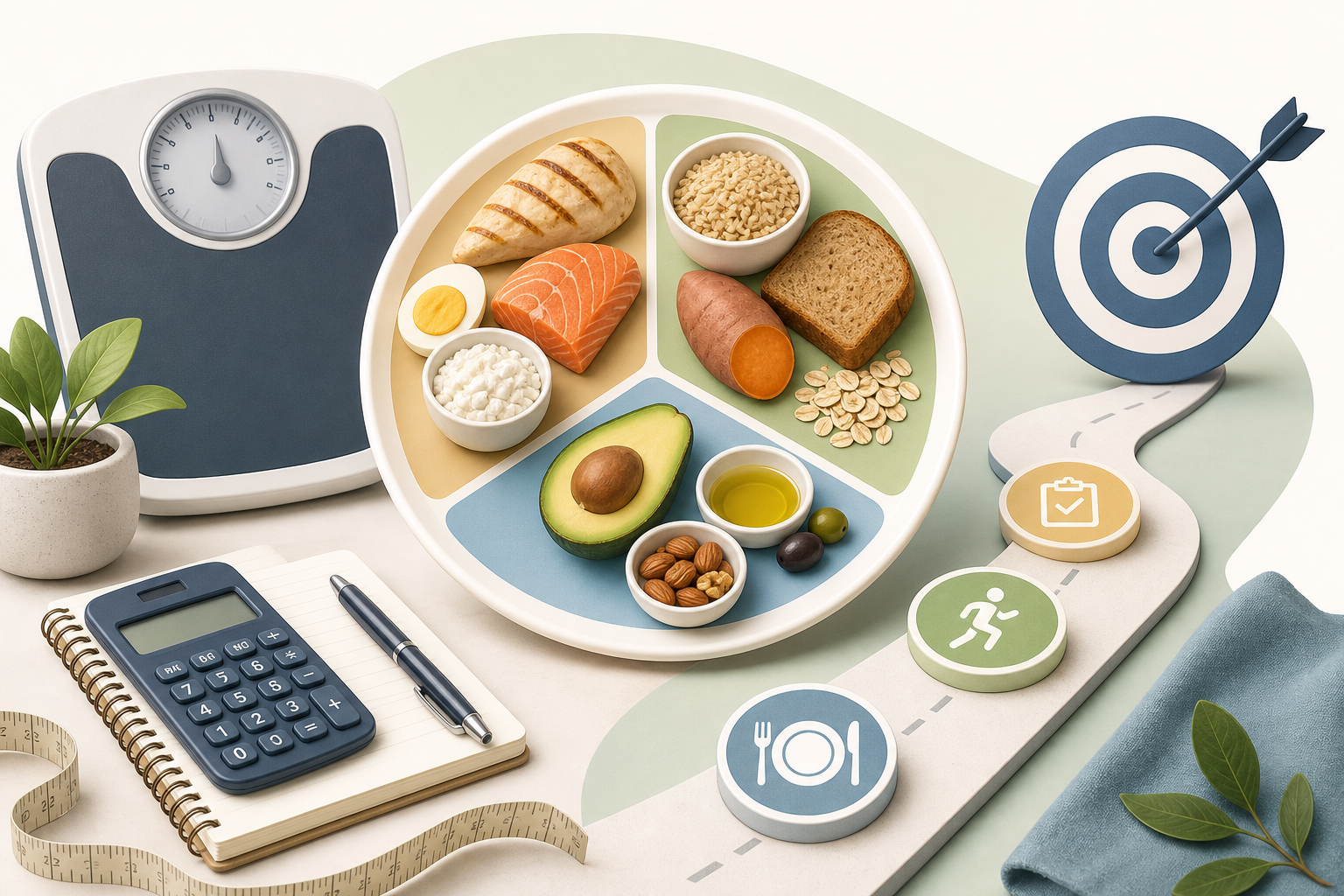
What are macronutrients? They are the nutrients the body needs in relatively large amounts: protein, carbohydrate and fat. These three nutrients provide most dietary energy, while also supporting functions such as tissue maintenance, everyday activity and cell structure. A person’s macro balance describes how their daily calories are divided among protein, carbs and fat.
Macronutrient targets can be expressed as percentages of calories or as grams per day. These figures are useful for meal planning, but they do not show the full nutritional quality of a diet. Food variety, fibre, vitamins, minerals and the types of carbohydrate and fat also matter.
What are macronutrients and why do they matter?
Macronutrients perform different but overlapping roles. The body can use all three for energy, although each also has functions that cannot be understood from calorie values alone.
- Protein supplies amino acids used to build and maintain body tissues and make many enzymes, hormones and other compounds.
- Carbohydrate includes sugars, starches and fibre. Digestible carbohydrate is an important energy source, while different types of fibre support digestive and dietary quality.
- Fat is a concentrated energy source. It also contributes to cell structure, provides essential fatty acids and helps the body absorb fat-soluble vitamins.
The amount of each nutrient that suits a person can vary with their total energy needs, food preferences, activity, life stage and health considerations. There is no single macro ratio that is ideal for everyone.
Protein, carbohydrate and fat explained
Protein
Protein is found in foods such as fish, meat, eggs, dairy products, beans, lentils, soy foods, nuts and seeds. Most people obtain protein from a mixture of foods rather than one source.
Protein intake is often discussed in relation to muscle, but its role is broader. Amino acids are involved in the maintenance and renewal of tissues throughout the body. Protein-containing foods can also contribute vitamins, minerals, fats or fibre, depending on the source.
A gram target does not reveal the quality or variety of the foods supplying it. For example, beans provide protein along with carbohydrate and fibre, while fish may provide protein and unsaturated fat.
Carbohydrate
Carbohydrate is present in grains, potatoes, fruit, vegetables, pulses, milk, yoghurt, sweets and many other foods. Its nutritional value depends partly on the food source and degree of processing.
Whole grains, fruit, vegetables and pulses can supply carbohydrate together with fibre and micronutrients. Foods high in added sugars may provide carbohydrate and energy with fewer beneficial nutrients. This is why a carbohydrate total by itself is not a complete measure of diet quality.
Fibre is classified as a form of carbohydrate, but its digestion and energy contribution differ from those of sugars and starches. Macro calculations commonly use the general estimate of 4 kilocalories per gram of carbohydrate rather than modelling each type separately.
Fat
Dietary fat occurs in oils, nuts, seeds, avocado, dairy products, eggs, fish, meat and many prepared foods. Because fat contains more energy per gram than protein or carbohydrate, relatively small portions can make a substantial contribution to daily calories.
The type and source of fat matter as well as the total amount. A calculated fat target does not distinguish among unsaturated fats, saturated fats or different food sources. Meal planning therefore requires more than reaching a daily number of fat grams.
How macronutrients contribute energy
Standard macro calculations use approximate energy values of 4 kilocalories per gram for protein, 4 kilocalories per gram for carbohydrate and 9 kilocalories per gram for fat. These are planning values rather than a direct measurement of the exact energy absorbed from a particular meal.
| Macronutrient | Approximate energy per gram | Example calculation |
|---|---|---|
| Protein | 4 kcal | 100 g provides about 400 kcal |
| Carbohydrate | 4 kcal | 200 g provides about 800 kcal |
| Fat | 9 kcal | 60 g provides about 540 kcal |
To convert a calorie percentage into grams, multiply the daily calorie target by the selected percentage and then divide by the nutrient’s energy value. Protein and carbohydrate calories are divided by 4, while fat calories are divided by 9.
Food labels and tracking tools may not add up perfectly because of rounding, fibre treatment, serving-size differences and variation in foods. Macro figures should therefore be treated as practical estimates rather than laboratory measurements.
Macro balance is only one part of diet quality
Two diets can have the same protein, carbohydrate and fat totals while differing greatly in food variety, fibre and micronutrient content. A macro split does not show whether meals regularly include vegetables, fruit, pulses, whole grains or other nutrient-dense foods.
It also does not identify the types of fat consumed or distinguish naturally occurring sugars from added sugars. Nor does it assess how foods are distributed across meals, how satisfying the plan feels or whether it is practical for the person following it.
When considering macros for weight loss, the overall calorie target remains an important part of the estimate. However, a calculated calorie or macro target cannot promise a particular change in body weight. Actual outcomes can differ because estimated energy needs, food tracking, activity and individual responses are not perfectly predictable.
Macro planning is most useful as one layer of a broader eating pattern. Food quality, adequate nutrient intake, preferences, culture, budget and long-term practicality all deserve consideration alongside the numbers.
What a macro calculator can and cannot tell you
A macro calculator converts a daily calorie target into estimated grams of protein, carbohydrate and fat. It applies a selected percentage pattern to the calorie target rather than determining a universally correct split.
The basic process is:
- Enter or select the requested planning information.
- Choose a macro pattern expressed as percentages of calories.
- Calculate the estimated daily grams of protein, carbohydrate and fat.
- Review the result as a planning starting point rather than an exact requirement.
A macro calculator can show how changing the percentages changes the gram targets. It can also make calorie-based percentages easier to use when reading labels, planning meals or reviewing a food log.
It cannot measure the exact amount of energy a person needs or absorbs. It also cannot assess food quality, vitamin and mineral adequacy, fibre intake, allergies, digestive tolerance or whether a macro pattern is suitable for a medical condition.
The output depends on the calorie target entered. If that target is only an estimate, the resulting protein, carbs and fat figures are estimates as well.
Practical macro calculation example
Consider a daily target of 2,000 kcal with a pattern of 30% protein, 40% carbohydrate and 30% fat. The percentages describe the share of calories from each macronutrient, not the share of food weight.
| Macronutrient | Calorie calculation | Gram calculation | Estimated target |
|---|---|---|---|
| Protein | 2,000 × 30% = 600 kcal | 600 ÷ 4 | 150 g |
| Carbohydrate | 2,000 × 40% = 800 kcal | 800 ÷ 4 | 200 g |
| Fat | 2,000 × 30% = 600 kcal | 600 ÷ 9 | About 67 g |
The calculated result is approximately 150 g protein, 200 g carbohydrate and 67 g fat per day. Fat is rounded because 600 divided by 9 gives a repeating decimal.
This example explains the arithmetic, but it does not establish that a 30/40/30 pattern is appropriate for every person. Another pattern could produce the same total calories with different gram targets. The meals chosen to reach those targets would still determine much of the diet’s fibre, micronutrient content and overall quality.
Frequently asked questions
Are calories and macros the same thing?
No. Calories describe energy, while macros describe the amounts of protein, carbohydrate and fat providing that energy. A calorie target can be divided into different macro patterns.
Do macro percentages refer to food weight?
No. Macro percentages usually refer to the percentage of total calories supplied by each nutrient. Because fat provides about 9 kcal per gram while protein and carbohydrate provide about 4 kcal per gram, equal calorie percentages do not produce equal gram amounts.
Is there one best protein, carbohydrate and fat ratio?
No single ratio is suitable for everyone. A practical balance may depend on total energy needs, activity, preferences, food access and individual health considerations. Calculator patterns are planning options, not universal standards.
Do I need to hit every macro target exactly each day?
Macro calculator results are estimates, and food records also involve rounding and portion uncertainty. For general planning, the figures are better understood as reference points than as perfectly precise measurements.
Can I judge diet quality from macro totals alone?
No. Macro totals do not fully describe fibre, vitamins, minerals, food variety or the types of carbohydrate and fat consumed. Foods with similar macros can have different nutritional characteristics.
What are macronutrients used for in meal planning?
They provide a framework for distributing daily energy among protein, carbohydrate and fat. This can help organise meals and compare eating patterns, but it should be considered alongside food quality, nutrient adequacy and practicality.