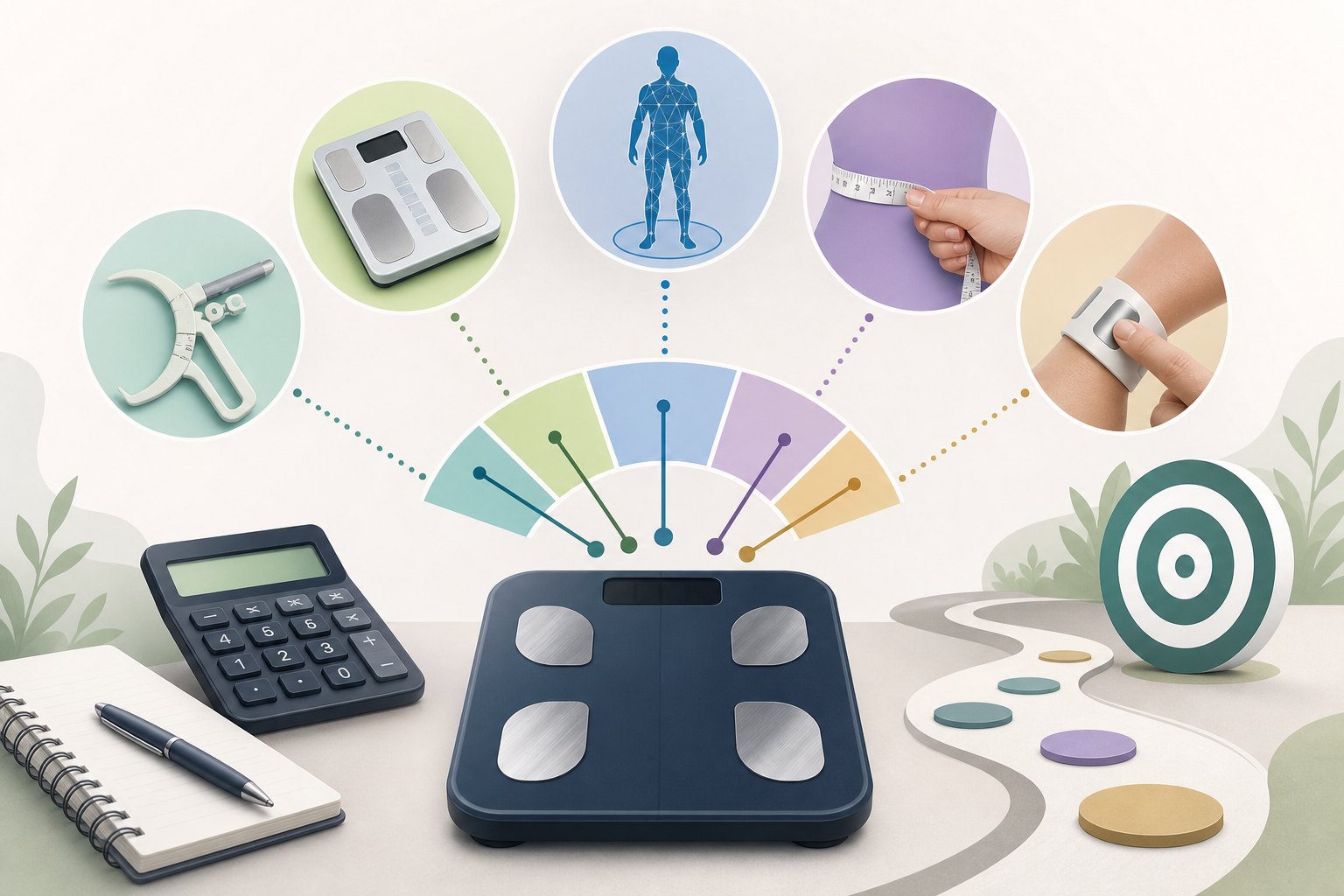
If you are wondering why body fat estimates differ, the short answer is that each method measures different inputs and applies its own assumptions to estimate body composition. Circumference equations, bioelectrical impedance devices, skinfold callipers and imaging systems do not assess fat in the same way. Hydration, measurement technique, timing and device algorithms can also change the result, so differences do not necessarily mean that one test or calculator is faulty.
Why body fat estimates differ across common methods
Body-fat percentage is the estimated proportion of total body weight made up of fat mass. Most methods do not directly separate and weigh every type of tissue. Instead, they use measurements such as body circumferences, electrical resistance, skinfold thickness or imaging data to infer body composition.
Each method relies on a different relationship between its measured input and body fat. Those relationships are based on equations, reference data or software models. An individual body may not match every assumption equally well, which creates normal method-to-method variation.
- Circumference methods estimate body fat from the relationship between measurements such as height, waist, neck and hips.
- Bioelectrical impedance analysis estimates body composition from how an electrical current travels through the body.
- Skinfold assessment uses the thickness of selected folds of skin and underlying fat.
- DXA uses low-dose X-ray measurements and software models to estimate fat, lean tissue and bone-related values.
Even advanced equipment produces a model-based result rather than a direct inventory of every fat cell. For this reason, results from different methods should not be expected to match exactly.
Different methods use different assumptions
A body composition method may assume that certain measurements have a predictable relationship with total body fat. Circumference equations, for example, assume that patterns involving the waist, neck, hips and height can provide a useful population-based estimate.
The U.S. Navy circumference approach uses sex-specific logarithmic equations. The male equation uses height, neck and waist measurements, while the female equation also uses hip circumference. These equations are convenient because they do not require specialised equipment, but they cannot account fully for every difference in muscle development, fat distribution or body shape.
Other methods use different assumptions. A bioelectrical impedance device estimates body water and then applies an algorithm to infer fat-free mass and fat mass. A skinfold equation relates measurements at selected sites to total body composition. Because the starting measurements and equations differ, the final body fat percentage may differ as well.
Hydration, timing and recent activity can affect results
Hydration is especially relevant to bioelectrical impedance analysis because water influences electrical conductivity. A reading taken when hydration status differs from usual may not be directly comparable with an earlier reading.
Recent meals, exercise and the timing of a test can also influence some inputs. Exercise can temporarily alter fluid distribution, while eating or drinking changes body mass and abdominal fullness. These effects do not necessarily represent a meaningful change in body fat.
Circumference measurements are less directly dependent on body water than impedance readings, but they are not completely isolated from short-term changes. Abdominal contents, posture and the way the person breathes during a waist measurement can affect the tape reading.
For trend tracking, consistency is usually more informative than trying to find a perfect testing moment. Using the same method under similar conditions reduces avoidable variation.
Measurement technique and device algorithms matter
Tape placement
A small difference in where a tape is positioned may affect a circumference-based estimate. The tape should follow the measurement locations specified by the chosen method, remain level and sit against the body without compressing the skin.
Mixing instructions from different protocols can produce inconsistent inputs. For example, “waist circumference” does not always refer to the same anatomical location across methods.
Operator technique
Skinfold results can vary with the site selected, the amount of tissue grasped, calliper placement and the person taking the measurement. Circumference readings can similarly vary with tape tension, posture and rounding.
Proprietary calculations
Two impedance scales may show different results even when used within minutes of each other. Manufacturers may use different electrical frequencies, electrode arrangements and undisclosed algorithms. Some devices also incorporate age, height, sex and activity information into the estimate.
Software updates or changes to a user profile may therefore alter a displayed body fat percentage without a corresponding change in body tissue.
A practical comparison scenario
Consider someone who uses a circumference calculator in the morning and a household impedance scale after an evening workout. The calculator uses measured body dimensions and a published equation. The scale uses electrical impedance and its own algorithm while the person’s fluid distribution may be different after exercise.
If the two results do not match, it is not reasonable to conclude from that difference alone that body fat changed during the day. The tests used different inputs, assumptions and testing conditions.
A more useful approach would be to choose one method for routine tracking, repeat it under broadly similar conditions and record the unrounded result when available. Occasional comparison with another method can provide context, but values from different systems should not be combined as though they form one continuous trend.
What the body fat calculator can and cannot tell you
The body fat calculator uses the U.S. Navy circumference method. It estimates body-fat percentage from height and specified neck, waist and, where required by the equation, hip measurements. If body weight is supplied, it can also estimate fat mass and fat-free mass.
The calculator can provide:
- A convenient circumference-based estimate without specialised equipment.
- A repeatable way to monitor a trend when measurement technique stays consistent.
- An approximate division of body weight into fat mass and fat-free mass when weight is entered.
The calculator cannot provide:
- A direct measurement of body fat or the location of individual fat deposits.
- The same result that would necessarily be produced by DXA, skinfold assessment or an impedance device.
- A complete assessment of health, fitness or nutritional status.
- Certainty that a short-term change reflects a true gain or loss of fat tissue.
Fat-free mass is also not identical to muscle mass. It includes water, bone, organs and other non-fat tissues, so the calculator’s fat-free mass estimate should not be interpreted as a direct muscle measurement.
How to interpret differences without overreacting
First, check whether the same method and protocol were used. Confirm the measurement locations, unit system, device settings and personal details entered. Repeating a clearly unusual reading can help identify a tape-placement or data-entry error.
Next, focus on patterns rather than isolated values. A series of measurements taken with the same method may be more useful for personal tracking than comparisons between unrelated devices.
A result should also be viewed with appropriate precision. A calculator may display decimal places because of how the equation is programmed, but those digits do not remove uncertainty from the tape measurements or the underlying model.
Ultimately, why body fat estimates differ comes down to the combination of method assumptions, individual body shape, hydration, testing conditions, measurement technique and software calculations. Treat each result as an estimate produced by a particular method, not as an exact and universally interchangeable value.
Frequently asked questions
Which body fat method is the most accurate?
No method is perfect for every setting or person. Clinical imaging may provide more detailed body-composition information than a home calculator, but it still uses equipment-specific analysis and modelling. For routine self-monitoring, a practical method applied consistently may be more useful than frequently switching between methods.
Why does my body fat percentage change overnight?
A large overnight change is unlikely to represent an equivalent change in fat tissue. Hydration, food and fluid intake, bathroom use, measurement conditions or device variability may have affected the estimate.
Should circumference and smart-scale results match?
No. A circumference equation uses body dimensions, while a smart scale generally uses electrical impedance and a manufacturer’s algorithm. The results may move in similar directions over time, but they are not expected to be identical.
Can I average results from several methods?
An average may look precise, but it combines estimates based on different assumptions and does not guarantee a better answer. It is generally clearer to keep each method’s results in a separate series and compare trends within that method.
How can I make circumference estimates more consistent?
Follow the same anatomical landmarks each time, use the same tape, maintain consistent tape tension and avoid rounding measurements more than necessary. Measure in a similar posture and under broadly similar conditions, and repeat a measurement if it appears inconsistent.