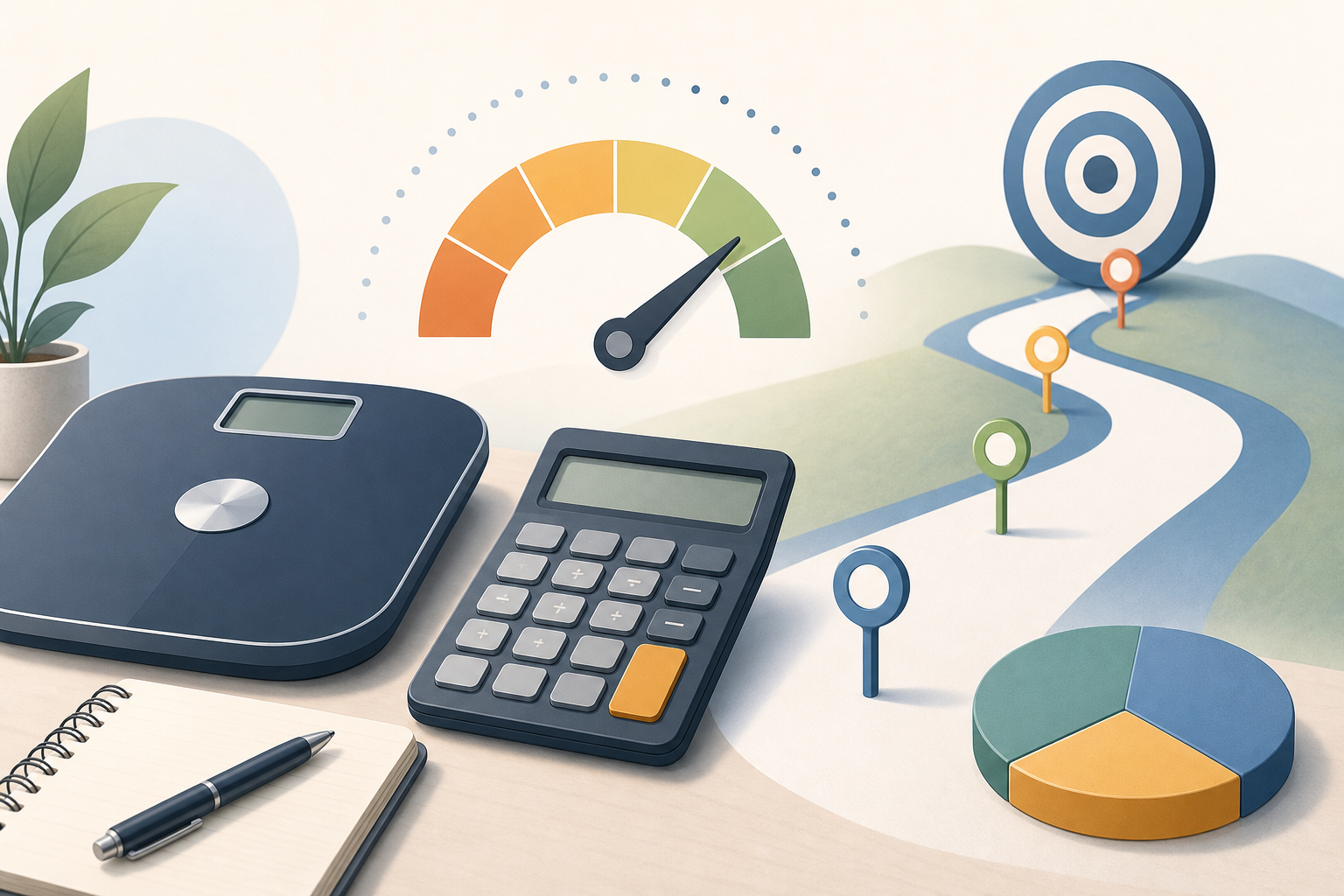
How accurate are tdee calculators? They are usually best treated as starting estimates rather than precise measurements. A calculator can provide a practical estimate of total daily energy expenditure and maintenance calories, but the result may differ from actual needs because resting-energy equations, activity multipliers and daily movement all introduce uncertainty.
How accurate are tdee calculators in practice?
A TDEE result is a model-based estimate. It is calculated from an estimated basal or resting energy requirement and a selected activity factor. It does not directly measure how much energy a particular person uses.
The basic method is:
TDEE = estimated BMR × activity factor
Each part can introduce error. Basal metabolic rate is usually predicted from variables such as age, sex, height and weight. The activity factor then attempts to account for exercise, work, household tasks and other movement using a broad category.
For some people, the result may be reasonably close to their average expenditure. For others, it may be noticeably higher or lower. Accuracy also depends on whether the information entered and the selected activity level reflect the person’s typical routine.
Why a TDEE estimate can differ from actual expenditure
The BMR is estimated
Most online calculators do not measure basal metabolic rate. They use a predictive equation derived from population data. One commonly used option is the Mifflin-St Jeor equation, which estimates resting energy expenditure from body weight, height, age and sex.
The original research behind the Mifflin resting-energy equation supports its use as an estimation method, but an equation cannot account for every biological difference between individuals. Two people with similar input values may not have identical resting requirements.
Activity multipliers are broad categories
An activity multiplier compresses a complex routine into a single choice such as sedentary, lightly active, moderately active or very active. These labels can be interpreted differently by different people.
For example, two people may both exercise four times per week. One may work at a desk and spend most of the remaining day seated, while the other may stand, walk and lift items throughout a work shift. Selecting the same category may not reflect their different total activity.
Everyday movement changes
Planned exercise is only one part of daily activity. Walking between locations, standing, household work, commuting and spontaneous movement also contribute to expenditure. These activities may vary substantially between weekdays, weekends and seasons.
A single TDEE number therefore represents an intended average, not a fixed amount used every day. A long walk, an inactive day or a change in work routine can move actual expenditure above or below that average.
Inputs and records are not always exact
An outdated body weight, an incorrect height entry or the wrong unit system can affect the calculation. Self-selected activity levels can also be overestimated or underestimated, especially when the category descriptions are vague.
Observed food intake has uncertainty too. Portion estimates, restaurant meals, cooking oils, drinks and differences between labelled and served amounts can make recorded intake differ from actual intake. This matters when comparing a calculated TDEE with body-weight trends.
What a TDEE calculator can and cannot tell you
A TDEE calculator can organise basic information into a useful planning estimate. It is particularly helpful when there is no personal intake and weight history available yet.
| What it can provide | What it cannot establish |
|---|---|
| An estimated BMR based on the calculator’s equation | A directly measured resting metabolic rate |
| An estimated TDEE using an activity factor | Exact energy expenditure on every individual day |
| A starting estimate for maintenance calories | A guarantee that body weight will remain unchanged at that intake |
| A consistent way to compare different activity assumptions | A complete account of individual biology, routine and intake-recording error |
The result should be read as “approximately this amount under the selected assumptions,” not “this is the exact number of calories my body uses.” It also does not determine what someone must eat or predict a specific rate of weight change.
Repeating the calculation every day is generally less informative than using one reasonable estimate and comparing it with an observed trend. Recalculation may be useful after a meaningful change in body weight, work demands, exercise volume or general routine.
How to refine maintenance calories with observed trends
Personal observations can help test whether a calculator estimate fits real life. This requires more than comparing one day of eating with one scale reading because both intake and body weight can vary from day to day.
- Use the calculator result as an initial estimate rather than a fixed target.
- Keep intake records as consistently as practical, using the same approach to portions and meal entries.
- Record body weight under reasonably similar conditions when possible.
- Look at the direction of the trend across several weeks rather than reacting to isolated readings.
- Compare the trend with the intended outcome and adjust the planning estimate cautiously if needed.
If average body weight appears broadly stable while average recorded intake is close to the estimate, the calculated maintenance level may be useful for planning. If there is a sustained upward or downward trend, actual maintenance needs may differ from the original result, or the intake records may not capture actual consumption fully.
Short-term scale changes do not necessarily represent a change in body tissue. Meals, hydration, sodium intake, digestion and other factors can affect scale weight. For that reason, one reading should not be used to declare a TDEE estimate accurate or inaccurate.
Observed trends are not laboratory measurements either. They are practical feedback affected by recording quality, routine changes and normal variation. Their value comes from combining repeated observations rather than treating any single data point as definitive.
A practical TDEE estimation example
Suppose a calculator estimates a BMR of 1,680 kcal per day. If the selected activity factor is 1.55, the calculation is:
1,680 × 1.55 = 2,604 kcal per day
The estimated TDEE is therefore about 2,604 kcal per day. This is an arithmetic result based on two assumptions: that the BMR estimate is suitable and that 1.55 accurately represents average activity.
Imagine the person uses approximately 2,600 kcal as an initial maintenance estimate and keeps reasonably consistent intake and weight records. If the longer-term weight trend appears stable, the estimate may be close enough for practical planning, even if actual expenditure is not exactly 2,604 kcal every day.
If weight trends gradually downward while recorded intake remains close to that amount, several explanations are possible. Actual expenditure may be higher than estimated, recorded intake may be lower than assumed, or activity may have changed. The sensible response is to review the inputs, records and routine before making a large adjustment based on the calculator alone.
Frequently asked questions
Is a TDEE calculator more accurate than a fitness tracker?
They estimate expenditure in different ways. A TDEE calculator applies a resting-energy equation and activity category, while a tracker may use movement, heart-rate and personal data. Neither should automatically be treated as a direct measurement, and both can differ from actual expenditure.
Which activity level should I choose?
Choose the category that best represents the whole day, not only scheduled workouts. Consider work, commuting, walking, household activity and time spent sitting. If uncertain between two categories, calculating both can provide a reasonable planning range.
Why does my calculated maintenance intake not maintain my weight?
The activity multiplier may not match your routine, the BMR equation may not fit you closely, or recorded intake may differ from actual intake. Your activity and body weight may also have changed since the calculation. Review the trend over time before concluding that a short-term change reflects incorrect maintenance calories.
Should exercise calories be added to the TDEE result?
Usually, the selected activity factor is intended to include a typical amount of activity. Adding estimated exercise expenditure again may count some activity twice. Whether an adjustment is appropriate depends on how the original estimate was calculated and whether a particular day is substantially different from the routine it represents.
How often should TDEE be recalculated?
There is no need to recalculate in response to every weight fluctuation. It may be helpful after a sustained change in body weight, activity, occupation or training routine. Personal intake and weight trends can then be used to assess the revised estimate.
Using the estimate sensibly
When asking how accurate are tdee calculators, the most useful answer is that their accuracy is individual and conditional. They provide a structured estimate from limited information, not a measured personal energy budget.
Use the output as a starting point, check that the activity category reflects your full routine, and compare the estimate with consistent observations over time. A number that supports practical planning is useful even when it cannot represent exact expenditure on every day.