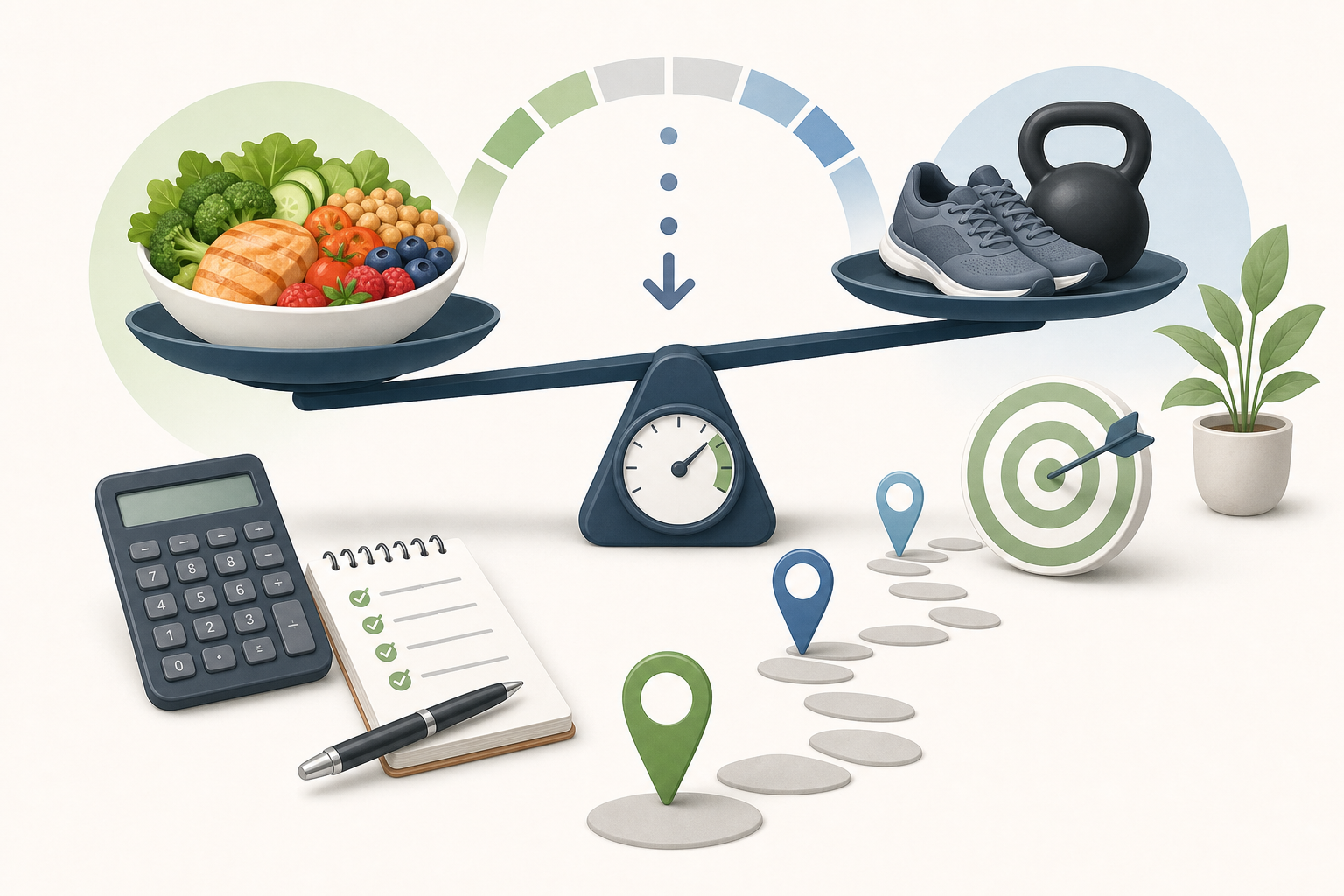
What is a calorie deficit? It is a state in which energy intake from food and drink is lower than the energy the body uses. Over time, this energy gap can contribute to weight loss because the body must draw on stored energy. However, the result is not perfectly predictable or linear: body weight, activity and energy needs can change during the process.
- What is a calorie deficit in practical terms?
- How energy intake and expenditure create a deficit
- Energy intake
- Energy expenditure
- The energy gap
- Using a calorie deficit for weight loss planning
- Percentage deficits
- Diet quality still matters
- Special situations need individual consideration
- What the calorie deficit calculator can and cannot tell you
- How to use the calculator
- What it can estimate
- What it cannot determine
- Example calculation and real-world interpretation
- How the estimate might be reviewed
- A daily target is not a measured daily outcome
- Common questions about calorie deficits
- Is a calorie deficit necessary for weight loss?
- What is the best daily calorie deficit?
- Can I calculate a deficit without tracking every food?
- Why does weight sometimes stop changing during a planned deficit?
- Should exercise calories be added back to the calorie target?
- Can a calorie deficit calculator predict when I will reach a particular weight?
- Putting the estimate in context
A calorie deficit is therefore a planning concept, not a guarantee of a particular outcome. A calorie deficit calculator can estimate a calorie target below maintenance, but the result should be treated as a starting estimate rather than a precisely measured requirement.
What is a calorie deficit in practical terms?
Calories are units of energy. In nutrition, the word “calorie” usually refers to a kilocalorie, written as kcal on many food labels and tracking tools.
Your body uses energy continuously. It needs energy for basic functions such as breathing, circulation and temperature regulation, as well as for digestion, daily movement and structured exercise. The total amount used across a day is commonly called total daily energy expenditure, or TDEE.
Energy balance can be described in three broad states:
- Energy balance: Energy intake is approximately equal to energy expenditure. Body weight may remain relatively stable over time.
- Calorie deficit: Energy intake is below energy expenditure. This can contribute to weight loss over time.
- Calorie surplus: Energy intake is above energy expenditure. This can contribute to weight gain over time.
These relationships are most useful when considered over days and weeks rather than as a strict calculation for one meal or one day. Intake, movement, hydration and scale weight naturally vary from day to day.
How energy intake and expenditure create a deficit
Energy intake
Energy intake includes calories from food, drinks and ingredients used in cooking. Estimating it may involve nutrition labels, recipe information, portion measurements or a food-tracking database.
Even careful tracking remains an estimate. Portion sizes may differ from the amount listed on a label, recipes can vary, and restaurant meals may not have exact nutrition information. This does not make tracking useless, but it means apparent precision should be interpreted cautiously.
Energy expenditure
Total daily energy expenditure includes several components:
- Resting energy expenditure: Energy used to maintain essential body functions at rest.
- Thermic effect of food: Energy used to digest, absorb and process nutrients.
- Everyday activity: Walking, standing, household tasks, work and other non-exercise movement.
- Planned exercise: Activities such as running, cycling, swimming or resistance training.
Resting energy expenditure can be estimated with equations based on details such as age, sex, height and weight. The Mifflin-St Jeor equation is one established method for estimating resting energy needs, but it still produces a calculated estimate rather than a direct metabolic measurement.
TDEE is usually estimated by combining resting energy needs with an activity assumption. This introduces further uncertainty because broad activity categories cannot capture every person’s routine, exercise intensity or changes in daily movement.
The energy gap
A deficit exists when estimated intake is lower than estimated expenditure. For example, if someone’s estimated TDEE is 2,400 kcal per day and their planned intake is 2,040 kcal, the estimated daily calorie deficit is 360 kcal.
This arithmetic describes the planned gap, not an exact amount of stored body energy used each day. Energy expenditure can fluctuate, and the body may adapt as weight, food intake and activity change. The scale can also be affected by water, food in the digestive system and other short-term factors.
Using a calorie deficit for weight loss planning
A calorie deficit for weight loss is usually created by changing energy intake, increasing activity, or combining both. The most appropriate approach depends on the person’s health, routine, food access, preferences and ability to maintain the plan.
A larger calculated deficit is not automatically more suitable. A very low calorie target may make it harder to meet nutritional needs or maintain normal daily activities, and it may be inappropriate in some circumstances. The mathematical output should therefore be checked for practical suitability rather than accepted solely because it creates a larger gap.
Percentage deficits
One way to set a target is to subtract a selected percentage from estimated TDEE. A percentage method adjusts the size of the planned deficit relative to the person’s estimated maintenance needs.
The calculation is:
Calorie target = estimated TDEE × (1 − deficit percentage)
For the formula, the percentage is written as a decimal. A 15% deficit is entered as 0.15, so the calculation uses 1 − 0.15, or 0.85.
The selected percentage is a planning input rather than a prediction. Two people using the same percentage may not experience the same change because their estimated needs, activity patterns, body composition and individual responses differ.
Diet quality still matters
A calorie target indicates an estimated quantity of energy; it does not assess the overall quality or suitability of the foods providing that energy. Foods vary in protein, fibre, vitamins, minerals and other characteristics that may affect meal planning, fullness and nutritional adequacy.
It is also possible for the same calorie target to be distributed across meals and snacks in many different ways. A deficit calculation does not determine a required meal schedule, macronutrient split or list of foods.
Special situations need individual consideration
Standard calorie estimates may be unsuitable for children, adolescents, people who are pregnant or breastfeeding, those with a history of disordered eating, and people whose health conditions or medicines affect weight, appetite or fluid balance. Individual support may also be useful when a calculated target is very low or difficult to follow.
This is not a limitation that can be corrected simply by entering more precise numbers. General equations are designed for broad estimation and do not replace an individual assessment.
What the calorie deficit calculator can and cannot tell you
The calculator estimates maintenance calories first and then applies the deficit percentage you select. Its main purpose is to turn an estimated TDEE and a chosen percentage into a daily calorie target that can be used for planning.
How to use the calculator
- Choose the unit system or other options requested by the tool.
- Enter the required measurements and planning information.
- Select an activity level that most closely reflects your usual routine, if requested.
- Choose the percentage deficit you want to explore.
- Select Calculate to view the estimated target and supporting details.
- Review the assumptions and limitations before using the result.
Inputs should represent current information where possible. However, entering exact-looking values does not make the final TDEE exact. Height and weight may be measured, while activity level and future intake are typically selected or estimated.
What it can estimate
- Estimated maintenance calories based on the information and equation used.
- A target below estimated maintenance using the chosen percentage.
- The mathematical difference between estimated maintenance and the target.
- Alternative planning targets when different deficit percentages are selected.
What it cannot determine
- Your exact daily energy expenditure under all real-life conditions.
- The precise amount or rate of weight change that will occur.
- How metabolism, spontaneous movement or exercise performance may change over time.
- Whether the target provides adequate nutrition for your individual needs.
- Whether a particular deficit is medically appropriate for you.
- How short-term water and digestive changes will affect scale weight.
The calculator’s output is best understood as a model-based estimate. The NIDDK Body Weight Planner illustrates why longer-term weight planning is more complex than applying a fixed calorie-to-weight conversion: energy needs can change as body weight and behaviour change.
Example calculation and real-world interpretation
Suppose an adult has an estimated TDEE of 2,400 kcal per day and selects a 15% deficit. The calculation is:
2,400 × (1 − 0.15) = 2,040 kcal per day
The estimated calorie target is therefore 2,040 kcal per day, creating a planned daily calorie deficit of 360 kcal relative to the estimated maintenance value.
Several parts of this example require careful interpretation. The 2,400 kcal TDEE is an estimate, the 15% deficit is a chosen planning value, and 2,040 kcal is a calculated target. None of these values measures the person’s exact energy expenditure or predicts an exact change on the scale.
How the estimate might be reviewed
Imagine the person uses the target consistently for several weeks while keeping their general activity pattern similar. They could compare the longer-term direction of body-weight measurements with the expected direction of the plan.
If body weight appears stable, possible explanations include an overestimated TDEE, an underestimated intake, changes in activity, normal weight fluctuations or a combination of factors. If weight is changing more quickly than expected or the target feels difficult to sustain, the assumptions may also need review.
A single weigh-in provides limited information because scale weight does not represent body fat alone. Looking at a consistent series of measurements can provide more context, although it still cannot isolate every reason for a change.
A daily target is not a measured daily outcome
The planned deficit does not need to appear identically every day for the concept to apply over time. Both intake and expenditure can vary across the week. What matters for energy balance is the overall pattern, but calculating that pattern remains approximate.
Exercise trackers and food apps may add useful structure, yet their numbers are also estimates. It is generally unhelpful to treat every displayed calorie as though it were directly measured in a laboratory.
Common questions about calorie deficits
Is a calorie deficit necessary for weight loss?
Loss of stored body energy requires energy intake to be lower than energy expenditure over time. The deficit may be created through lower intake, greater expenditure or both, even when a person is not explicitly counting calories.
Scale weight may not move in a smooth pattern because it also reflects water and other short-term changes. The underlying energy relationship and the day-to-day scale result are therefore not identical.
What is the best daily calorie deficit?
There is no single daily calorie deficit that is best for everyone. A suitable planning gap depends on estimated maintenance needs, nutritional requirements, health circumstances, activity, preferences and how manageable the target is.
A calculator allows different percentages to be explored, but it cannot select the most appropriate option for an individual. A target that produces an extremely low intake should not be assumed to be suitable simply because the formula permits it.
Can I calculate a deficit without tracking every food?
Yes. Some people create a deficit through consistent changes to portions, drinks, meal composition, eating routines or activity without recording every calorie. Tracking is one planning method, not a requirement for the energy-balance principle to apply.
Without tracking, the size of the deficit is less explicit. Even with tracking, however, the calculated gap remains an estimate because both food intake and energy expenditure contain uncertainty.
Why does weight sometimes stop changing during a planned deficit?
A stable period can have several explanations. Estimated maintenance needs may have changed, actual intake or activity may differ from the original assumptions, or short-term fluid changes may be masking the underlying trend.
As body weight changes, energy requirements can also change. This is one reason a calorie target may need to be reviewed rather than treated as a permanent fixed number.
Should exercise calories be added back to the calorie target?
It depends on how maintenance calories were estimated. If the TDEE estimate already includes usual exercise through an activity setting, adding all displayed exercise calories may count some activity twice.
If exercise changes substantially from the routine assumed by the calculator, the original estimate may no longer reflect current activity. Wearable-device calorie values are estimates and should not automatically be treated as exact additions.
Can a calorie deficit calculator predict when I will reach a particular weight?
A basic percentage-deficit calculator cannot provide a reliable exact date. It does not fully model changes in energy needs, metabolism, activity, adherence, fluid balance or body composition over time.
More detailed planning models can illustrate possible trajectories, but they also depend on assumptions. Any future result should be interpreted as a projection rather than a promise.
Putting the estimate in context
Understanding what is a calorie deficit starts with a simple relationship: energy intake is below energy expenditure. Applying that relationship in daily life is less exact because intake, activity and energy needs are not perfectly measured and can change over time.
A calculator can provide a clear starting point by estimating TDEE and applying a selected percentage deficit. Its output is most useful as a planning estimate that can be reviewed against real-world experience, nutritional adequacy and changing circumstances—not as a guaranteed weight-loss prediction.
References
- Mifflin MD et al. A new predictive equation for resting energy expenditure in healthy individuals
- National Institute of Diabetes and Digestive and Kidney Diseases: Body Weight Planner