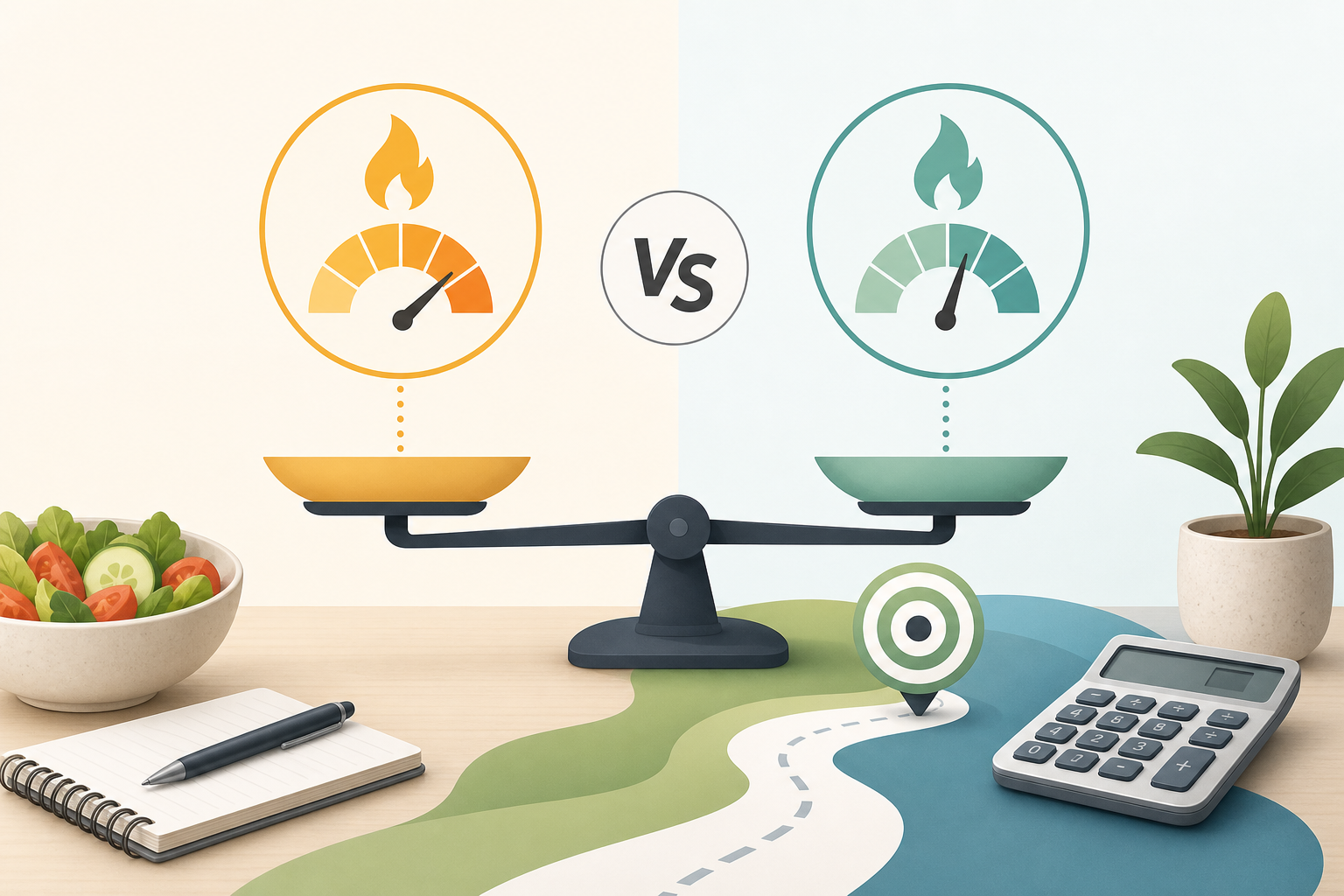
The difference between current maintenance calories vs goalweight maintenance calories is the body weight used in the estimate. Current maintenance calories refer to the estimated intake associated with maintaining your present weight, while goal weight maintenance calories estimate energy needs at a chosen future weight. If the goal weight is lower, the estimated maintenance intake will usually be lower when age, height and activity level remain the same.
Current maintenance calories vs goalweight maintenance calories: the key difference
Maintenance calories are commonly expressed as total daily energy expenditure, or TDEE. This is an estimate of the energy used for resting functions and daily activity at a particular body weight.
A current-weight calculation uses your present weight in the resting energy equation. A goal-weight calculation replaces it with your intended weight while keeping the other entered details unchanged.
| Estimate | Weight entered | What the result represents |
|---|---|---|
| Current maintenance calories | Present body weight | Estimated daily energy needs for maintaining your current weight at the selected activity level |
| Goal weight maintenance calories | Chosen target weight | Estimated daily energy needs for maintaining that target weight at the selected activity level |
Neither figure is a guarantee or a directly measured value. Both depend on the equation, the accuracy of the inputs and how well the selected activity category reflects everyday life.
Why estimated energy needs may change with body weight
The weight maintenance calculator uses the Mifflin-St Jeor equation to estimate basal metabolic rate, or BMR. BMR represents estimated energy expenditure at rest and includes body weight as one of its inputs.
Because weight appears in the equation, entering a different weight changes the estimated BMR. The calculator then multiplies that result by the chosen activity factor to estimate TDEE.
A body at a lower weight will generally receive a lower BMR estimate when age, height and the other equation inputs are unchanged. The estimated total is therefore also likely to be lower, even if the same activity category is selected.
This comparison is useful for planning, but it simplifies real life. Activity factors are broad categories, and actual energy needs can vary with movement patterns, work, training, body composition and changes that occur during weight change. The National Institute of Diabetes and Digestive and Kidney Diseases also treats weight planning as a dynamic process rather than assuming one calorie figure applies indefinitely.
How to compare the two estimates correctly
For a useful comparison, change only the weight entry between calculations. Keep age, height, sex used by the equation and activity selection consistent unless you expect those details to differ at the target weight.
- Calculate estimated maintenance calories using your current body weight.
- Record the estimated BMR and TDEE.
- Run the calculation again using the chosen goal weight.
- Keep the activity level the same for a direct weight-only comparison.
- Compare the results as planning estimates, not exact intake instructions.
If you expect your routine to change, a second comparison may be helpful. For example, you could calculate the target weight once at your current activity selection and again at the activity level you realistically expect to maintain.
Avoid selecting a higher activity category solely to obtain a preferred result. The category should reflect typical daily movement and planned exercise as closely as the available options allow.
A practical goal-weight maintenance example
Consider a person who enters their current weight and receives an estimated maintenance figure of 2,350 calories per day. When the same person enters a lower target weight while leaving all other inputs unchanged, the result might be 2,150 calories per day.
These figures are illustrative rather than universal. In this scenario, the 200-calorie difference comes from the calculator estimating a lower BMR at the target weight and then applying the same activity factor.
The first result estimates maintenance at the person’s current weight. The second does not describe the calorie intake required to reach the goal; it estimates maintenance after that weight has been reached, assuming the entered profile and activity selection apply.
This distinction matters because weight-change planning and weight maintenance answer different questions. A goal-weight maintenance estimate is an anticipated destination figure, not necessarily an appropriate intake throughout the entire period of weight change.
What the weight maintenance calculator can and cannot tell you
What it can estimate
- BMR at the body weight entered, using the Mifflin-St Jeor equation.
- TDEE after applying the selected activity factor.
- The estimated difference between maintenance at current and target weights.
- How changing the weight or activity input affects the calculated result.
What it cannot determine
- Your exact daily energy expenditure.
- The precise intake at which your weight will remain stable.
- How your activity, body composition or routine may change by the time you reach a goal weight.
- The time required to reach a target weight.
- The full range of individual responses that may occur during weight change.
The calculator’s output should therefore be treated as a starting estimate. A calculated value is different from observed maintenance, which is inferred from the relationship between intake and body-weight trends over time.
Even observed maintenance is not perfectly fixed from day to day. Food tracking, body-weight readings and activity can all vary, so short-term changes do not necessarily show that an estimate is wrong.
How to use goal weight maintenance calories in planning
Goal weight maintenance calories can provide a realistic preview of how estimated needs may differ at another body weight. They can also help explain why an intake that appears to create a difference from current maintenance may be closer to maintenance at a lower weight.
Do not assume that the goal-weight result must become a permanent exact calorie target. It is based on the age, height, weight and activity information entered at the time of calculation. If those inputs or your routine change, the estimate should be updated.
Activity deserves particular attention. Selecting the same activity category in both calculations creates a clean comparison, but it does not prove that actual activity expenditure will remain identical. A lighter body weight, a different exercise routine or changes in daily movement can affect the real-world result.
Once a target weight is reached, the estimate can be compared with longer-term weight and intake patterns. If body weight trends upward or downward consistently, actual maintenance may differ from the original calculation.
Frequently asked questions
Are current maintenance calories and goal weight maintenance calories interchangeable?
No. They refer to estimated energy needs at two different body weights. Using a goal-weight estimate as though it were current maintenance can confuse a future planning value with present estimated needs.
Will goal weight maintenance calories always be lower?
They will generally be lower when the entered goal weight is lower and all other calculator inputs stay the same. However, a different activity selection or other changed inputs can alter the comparison.
Does the goal-weight result show how many calories I should eat to lose weight?
No. It estimates maintenance at the entered target weight. It does not calculate a personalised weight-loss intake, predict the rate of change or account fully for changes that may occur along the way.
Should I use my present or planned activity level?
Use the present activity level when estimating current maintenance. For a goal-weight estimate, you may compare both your current activity selection and a realistic planned activity selection. Each result should be labelled clearly so that the assumptions are not confused.
Why does my actual maintenance differ from the calculator result?
The Mifflin-St Jeor equation estimates resting energy expenditure, and activity factors group many different routines into broad categories. Differences in actual movement, tracking accuracy, body composition and individual energy expenditure can make observed maintenance higher or lower than the estimate.
How often should I recalculate maintenance calories?
Recalculation is useful when body weight or usual activity changes meaningfully, or when the details entered previously no longer reflect your routine. The comparison of current maintenance calories vs goalweight maintenance calories is most informative when both calculations use current, consistent inputs.
References
- Mifflin MD et al. Resting energy expenditure equation
- National Institute of Diabetes and Digestive and Kidney Diseases: Body Weight Planner and weight-management resources