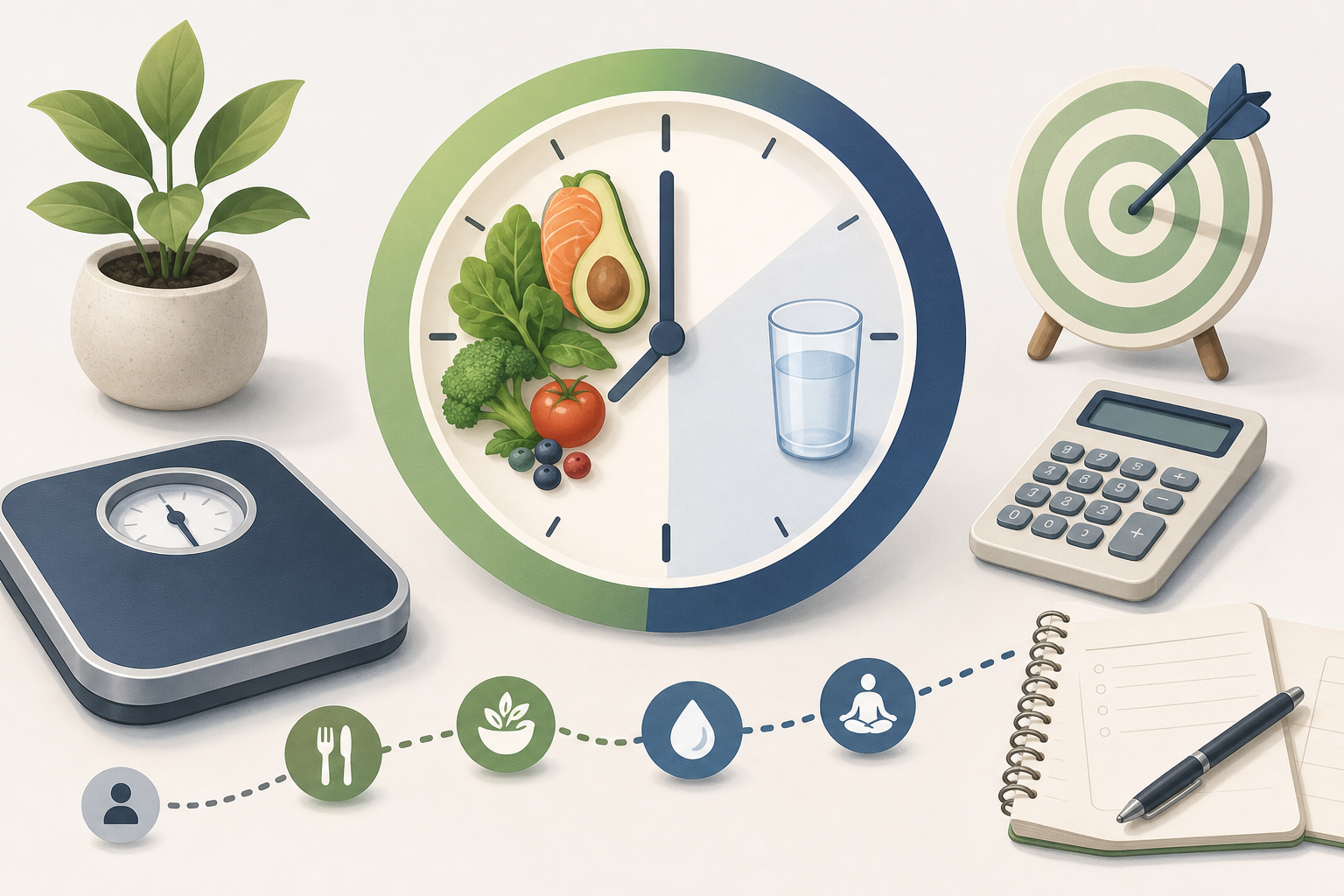
If you are asking what is an intermittent fasting schedule, it is a daily or weekly plan that separates periods for eating from periods without food. Daily schedules such as 12:12, 14:10 and 16:8 describe hours on a clock, not guaranteed weight-loss methods. For example, 16:8 means a 16-hour fasting window followed by an 8-hour eating window within each 24-hour day.
What is an intermittent fasting schedule in practical terms?
An intermittent fasting schedule sets boundaries around when meals and snacks are eaten. In a daily time-restricted schedule, the two numbers should add up to 24 hours. The first number usually represents fasting hours, while the second represents eating hours.
A 14:10 schedule therefore includes 14 fasting hours and a 10-hour eating window. Someone might eat between 9:00 am and 7:00 pm, then fast from 7:00 pm until 9:00 am the following day.
The eating window is not a requirement to eat continuously. It is simply the period in which a person chooses to place meals, snacks and energy-containing drinks. Similarly, definitions of a fasting window can vary, so it is important to be clear about whether the schedule excludes all calories or only meals.
Common daily fasting and eating windows
Many schedules include the hours spent sleeping, which can make the fasting period easier to fit into a normal day. The main difference between common patterns is how early or late the eating window begins and how long it remains open.
| Schedule | Fasting window | Eating window | Example eating times |
|---|---|---|---|
| 12:12 | 12 hours | 12 hours | 7:00 am to 7:00 pm |
| 14:10 | 14 hours | 10 hours | 9:00 am to 7:00 pm |
| 16:8 | 16 hours | 8 hours | 10:00 am to 6:00 pm |
| 18:6 | 18 hours | 6 hours | 12:00 pm to 6:00 pm |
These times are examples rather than rules. A 16:8 fasting schedule could run from 8:00 am to 4:00 pm, 10:00 am to 6:00 pm or another eight-hour period. The corresponding fasting period covers the remaining 16 hours.
Understanding 12:12
A 12:12 schedule divides the day equally. For someone who finishes dinner at 7:00 pm and eats breakfast at 7:00 am, it may resemble an ordinary overnight break between meals.
Understanding 14:10
A 14:10 schedule leaves ten hours for meals. It may involve moving breakfast later, finishing dinner earlier or making smaller adjustments at both ends of the day.
Understanding 16:8 fasting
With 16 8 fasting, all meals are placed within an eight-hour window. This describes meal timing only; it does not specify what foods to eat, how much energy to consume or how many meals to have.
How to build a fasting schedule around the day
A workable fasting schedule needs to fit sleep, work, family meals, exercise and other regular commitments. Selecting a pattern on paper is simple, but following it consistently may be difficult if the eating window conflicts with everyday life.
It can help to plan from a fixed meal. For example, someone who regularly has dinner with family at 7:00 pm might keep dinner within the eating window and calculate the opening time from there.
- For a 12:12 schedule ending at 8:00 pm, the eating window begins at 8:00 am.
- For a 14:10 schedule ending at 8:00 pm, it begins at 10:00 am.
- For a 16:8 schedule ending at 8:00 pm, it begins at 12:00 pm.
Another approach is to start with breakfast and calculate the closing time. An eight-hour eating window beginning at 8:00 am closes at 4:00 pm. Neither an early nor late window is automatically suitable for everyone.
Meal quality and quantity remain separate considerations. A timing plan does not assess whether meals provide enough energy, protein, fibre, fluids or other nutrients for an individual’s needs.
A practical 16:8 schedule example
Consider a person who chooses to eat between 10:00 am and 6:00 pm. The eating window lasts eight hours, so the corresponding fasting window is calculated as follows:
Fasting hours = 24 − eating-window hours
24 − 8 = 16 fasting hours
The person might eat a first meal at 10:00 am, another meal in the afternoon and dinner before 6:00 pm. The eating window closes at 6:00 pm and reopens at 10:00 am the next day.
This example identifies the timing boundaries only. It does not show whether the person will change body weight, whether the meals meet nutritional needs or whether the schedule is appropriate for their circumstances.
What the intermittent fasting calculator can and cannot tell you
An intermittent fasting calculator compares a selected daily eating window with the corresponding fasting window. It performs time arithmetic using the formula:
Fasting hours = 24 − eating-window hours
For example, entering an eight-hour eating window produces a 16-hour fasting window. This can help when comparing 12:12, 14:10 and 16:8 patterns or translating an eating-window length into the matching fasting period.
What it can show
- The number of fasting hours associated with a selected eating window.
- The basic relationship between the two periods in a 24-hour day.
- How changing the eating window changes the fasting window.
- Planning details presented by the tool, such as the selected schedule or times.
What it cannot determine
- Whether intermittent fasting is appropriate for a particular person.
- How many calories someone should consume.
- What foods, meals or portion sizes someone should choose.
- Whether a schedule will lead to weight loss or another health outcome.
- How medical needs, medicines, pregnancy, eating-disorder history or training demands may affect suitability.
The calculator’s result is a planning estimate based on the selected hours. It is not a measurement of metabolism, energy intake, nutritional adequacy or body-fat change.
Why a schedule does not guarantee weight loss
A fasting schedule controls the timing opportunity for eating, but it does not directly control total food intake. Two people can follow the same 16:8 schedule while eating different foods and different amounts within their eight-hour windows.
Body-weight planning also involves factors beyond clock times, including energy intake, activity and individual circumstances. The US National Institute of Diabetes and Digestive and Kidney Diseases provides a Body Weight Planner and weight-management information for broader planning, although such resources do not determine whether intermittent fasting is personally appropriate.
A shorter eating window should not be interpreted as automatically better. If a schedule causes persistent difficulty meeting everyday needs or conflicts with medical or nutritional care, its mathematical simplicity does not make it a suitable plan.
Frequently asked questions
Does 16:8 mean eating for eight continuous hours?
No. It means meals and snacks are placed somewhere within an eight-hour window. A person might have two or three separate meals rather than eat continuously throughout that period.
Does the fasting window have to start at the same time every day?
Not as a matter of arithmetic. However, changing the start and finish times can make the actual fasting duration vary from one day to the next. Anyone tracking a schedule should calculate the interval between the final intake on one day and the opening of the next eating window.
Can sleep count as part of the fasting window?
Yes. Daily schedules commonly include overnight hours. For example, a fast from 7:00 pm until 9:00 am includes time spent sleeping and totals 14 hours.
Are water, tea or coffee allowed during fasting hours?
Definitions differ between fasting approaches. Plain water contains no food energy, while additions such as sugar, milk or cream contribute energy. The calculator does not decide which drinks fit a chosen fasting definition or an individual care plan.
Is 12:12 less effective than 16:8?
The numbers describe different time windows, not a guaranteed ranking of results. A calculator can confirm that 12:12 has a longer eating window than 16:8, but it cannot predict how either schedule will affect an individual.
How should an overnight schedule be recorded?
Record both the closing time and the next day’s opening time. For example, an eating window that closes at 6:00 pm and reopens at 10:00 am creates a 16-hour overnight fasting period.
Putting the schedule into context
In summary, what is an intermittent fasting schedule refers to a plan that assigns eating and fasting windows across the day. Labels such as 12:12, 14:10 and 16:8 are straightforward descriptions of time: the two numbers add up to 24 hours.
An intermittent fasting calculator can make that time comparison easier, but its output should be read as clock-based arithmetic. It cannot assess nutrition, personal suitability or likely weight change.