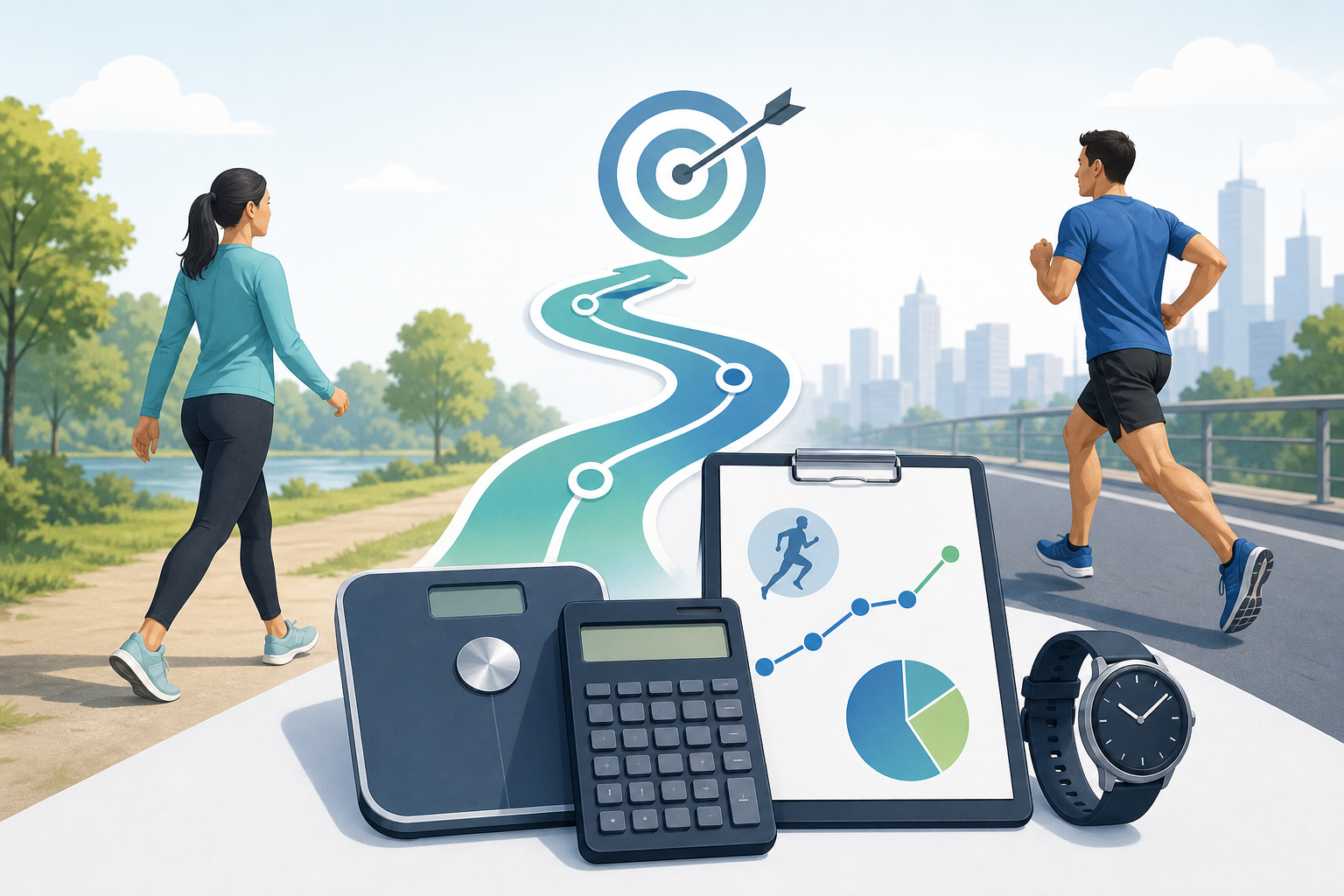
Learning how to calculate walking or running pace starts with two measurements: distance and elapsed time. Divide the total time by the distance covered. The result shows how long it took, on average, to complete one kilometre or one mile.
For example, completing 5 kilometres in 30 minutes gives an average pace of 6:00 minutes per kilometre. The same session has an average speed of 10 kilometres per hour.
What walking pace and running pace mean
Pace expresses time per unit of distance. It is usually written as minutes and seconds per kilometre, such as 7:30 min/km, or minutes and seconds per mile, such as 10:15 min/mile.
A lower pace number represents faster movement because less time is needed to cover the same distance. A pace of 6:00 min/km is faster than 8:00 min/km.
Speed describes the same performance from the opposite direction. Instead of showing time required per kilometre or mile, it shows distance covered per hour. Common units are kilometres per hour (km/h) and miles per hour (mph).
- Pace: elapsed time divided by distance
- Average speed: distance divided by elapsed time
- Typical pace units: min/km or min/mile
- Typical speed units: km/h or mph
How to calculate walking or running pace from distance and time
Use the following formula:
Pace = elapsed time ÷ distance
Before dividing, express the elapsed time in a consistent unit, usually total minutes. Divide that value by the distance in kilometres or miles, depending on the pace unit you want.
- Record the total distance covered.
- Record the elapsed time.
- Convert hours and seconds into minutes if necessary.
- Divide total minutes by distance.
- Convert the decimal part of the result into seconds.
Converting elapsed time into minutes
Multiply hours by 60, then add any remaining minutes and seconds. To express seconds as part of a minute, divide them by 60.
For example, 1 hour, 12 minutes and 30 seconds becomes:
(1 × 60) + 12 + (30 ÷ 60) = 72.5 minutes
Converting decimal pace into minutes and seconds
Suppose the calculation produces 7.25 minutes per kilometre. The whole number is 7 minutes. Multiply the decimal portion by 60 to find the seconds:
0.25 × 60 = 15 seconds
The pace is therefore 7:15 min/km, not 7 minutes and 25 seconds. Treating decimal minutes as ordinary clock seconds is a common calculation error.
Worked pace calculation examples
Example: 5 kilometres in 30 minutes
Divide the elapsed time by the distance:
30 minutes ÷ 5 kilometres = 6 minutes per kilometre
The running pace or walking pace is 6:00 min/km. To calculate average speed, first express 30 minutes as 0.5 hours:
5 km ÷ 0.5 hours = 10 km/h
Example: 3 miles in 48 minutes
Divide 48 minutes by 3 miles:
48 ÷ 3 = 16 minutes per mile
The average pace is 16:00 min/mile. Because 48 minutes equals 0.8 hours, the average speed is:
3 miles ÷ 0.8 hours = 3.75 mph
Example with hours, minutes and seconds
Consider a distance of 10 kilometres completed in 1 hour, 4 minutes and 30 seconds. Convert the time to minutes:
60 + 4 + (30 ÷ 60) = 64.5 minutes
Then divide by 10 kilometres:
64.5 ÷ 10 = 6.45 minutes per kilometre
The decimal portion converts to 27 seconds because 0.45 × 60 = 27. The average pace is therefore 6:27 min/km.
Converting between pace, speed and finish time
Pace and average speed can be converted when they refer to the same distance unit. If pace is stated in minutes per kilometre, divide 60 by the decimal pace to estimate kilometres per hour:
Speed in km/h = 60 ÷ pace in min/km
For a pace of 5:30 min/km, first convert 30 seconds to 0.5 minutes. The decimal pace is 5.5 minutes per kilometre:
60 ÷ 5.5 = approximately 10.91 km/h
The corresponding reverse calculation is:
Pace in min/km = 60 ÷ speed in km/h
You can also estimate a finish time when the intended distance and average pace are known:
Estimated finish time = pace × distance
For example, maintaining 7:00 min/km across 8 kilometres would produce an estimated finish time of 56 minutes. This is a planning estimate; actual pace may change during the session.
Converting min/km and min/mile
One mile equals approximately 1.609 kilometres. To convert a kilometre pace to an equivalent mile pace, multiply the decimal minutes by 1.609. To convert a mile pace to a kilometre pace, divide by 1.609.
For example, 6:00 min/km is approximately 9:39 min/mile. These values describe equivalent average speeds, not separate performances.
What a pace calculator can and cannot tell you
A pace calculator applies the distance-and-time formulas automatically. It can be particularly useful when elapsed time includes hours and seconds or when a decimal result needs to be converted into clock format.
The calculator can provide:
- Average pace per kilometre or mile
- Average speed in kilometres per hour or miles per hour
- Consistent time and distance conversions supported by the tool
- A practical summary for comparing sessions completed over the same type of route
However, the result is an average. It cannot show where speed increased or decreased, how long individual stops lasted, or how terrain and elevation affected different parts of the session.
The result also depends on the accuracy of the inputs. A mapped route, treadmill display, fitness watch or phone may estimate distance differently. Entering elapsed time produces a pace that includes stops, while entering moving time excludes the time that the recording device classified as stationary.
A pace calculator does not determine energy expenditure or the physical intensity experienced by an individual. Research resources such as the 2024 Adult Compendium of Physical Activities classify activities using metabolic-equivalent values, including categories based on walking or running speed, but that is a different calculation from pace.
Choosing the right time measurement
Decide whether elapsed time or moving time fits the purpose of the calculation. Neither is automatically the correct choice; they answer different questions.
- Elapsed time runs from the start to the finish and includes traffic lights, rest breaks and other stops.
- Moving time attempts to include only periods when movement was detected.
Elapsed time is useful when estimating how long a route took in real-world conditions. Moving time may be more useful when reviewing movement pace separately from planned or unplanned stops.
Comparisons are clearest when the same method is used each time. Comparing an elapsed-time pace from one session with a moving-time pace from another can make the difference appear larger than it was.
How to interpret an average pace
An average pace summarises an entire session as one value. It does not mean every kilometre or mile was completed at that exact pace.
Hills, surface conditions, route congestion, weather, stops and deliberate changes in effort can all affect individual segments. Two sessions may have the same average pace even when one was steady and the other included substantial variation.
For planning, keep the distance unit consistent. A value of 8:00 has a very different meaning when expressed as min/km rather than min/mile. Include the unit whenever recording or sharing a result.
In summary, how to calculate walking or running pace comes down to dividing elapsed time by distance and converting any decimal minutes into seconds. The answer is an average estimate based on the distance and time entered, rather than a complete description of how the session unfolded.
Frequently asked questions
Is pace the same as speed?
No. Pace is the time required to cover one unit of distance, while speed is the distance covered in one unit of time. A pace might be written as 7:00 min/km, whereas the equivalent speed is expressed in km/h.
Should I include stops when calculating pace?
Include stops if you want elapsed-time pace for the full session. Exclude them by using moving time if you want an estimate based only on the periods recorded as movement. Label the result clearly so that comparisons use the same method.
Why does a pace of 6.5 minutes equal 6:30 rather than 6:50?
The decimal 0.5 represents half of a minute. Because one minute contains 60 seconds, half a minute is 30 seconds. Therefore, 6.5 decimal minutes equals 6 minutes and 30 seconds.
Can I calculate pace from speed alone?
Yes. Divide 60 by the speed when speed is measured per hour. For example, 60 ÷ 12 km/h gives a pace of 5 minutes per kilometre, or 5:00 min/km.
Why is my calculated pace different from my watch or app?
The device may use a different distance estimate, automatic pause setting, moving-time method or rounding rule. GPS reception and route measurement can also produce slightly different distance values, which changes the calculated average pace.