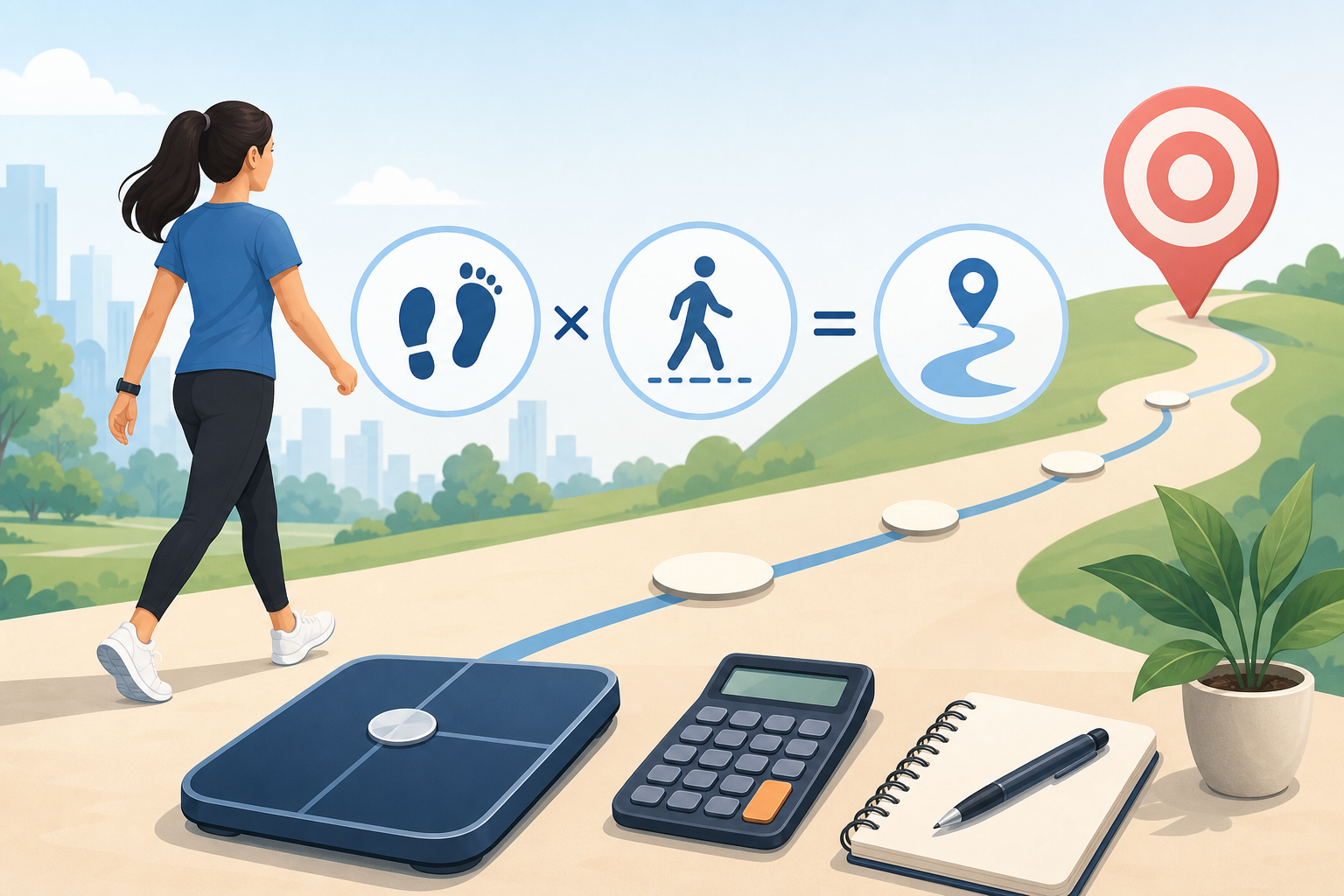
To understand how to convert steps to kilometres, multiply the number of steps by the estimated length of each step, then convert the resulting distance into kilometres. Because step length varies between people and can change with pace or terrain, the result is an estimate unless the distance or step length has been measured directly.
Quick formula for converting steps to kilometres
If step length is measured in centimetres, use this formula:
Distance (km) = number of steps × step length (cm) ÷ 100,000
The division by 100,000 converts centimetres to kilometres, because one kilometre contains 100,000 centimetres.
If step length is measured in metres, the equivalent formula is:
Distance (km) = number of steps × step length (m) ÷ 1,000
For example, if each step is estimated to cover 70 centimetres, 5,000 steps would represent:
5,000 × 70 ÷ 100,000 = 3.5 km
How to convert steps to kilometres step by step
- Find the step count. Use a phone, watch, pedometer or manually recorded total.
- Estimate or measure step length. This is the distance from one footfall to the next footfall.
- Multiply the steps by the step length. Keep the unit consistent, such as centimetres.
- Convert the total distance to kilometres. Divide centimetres by 100,000 or metres by 1,000.
- Round sensibly. A result such as 6.923 km may be better reported as about 6.9 km because the step length itself is usually an estimate.
This calculation assumes that the selected step length applies to every step. In everyday walking, step length may vary throughout the day, so extra decimal places do not necessarily make the answer more accurate.
Estimating or measuring your step length
A conversion is only as useful as its step-length estimate. Height-based methods are convenient because taller people often have longer steps, but height does not determine step length exactly. Walking speed, mobility, footwear, surface and individual movement patterns can all affect it.
Using a height-based estimate
A height-based calculator applies a step-length estimate derived from the height entered. This produces a practical planning value when personal step-length data are unavailable.
The result should not be treated as a measured distance. Two people of the same height may cover different distances with the same number of steps.
Measuring step length over several steps
A personal measurement can be calculated by walking a known or measured distance at a normal pace:
- Choose a level, unobstructed walking area.
- Mark the starting position.
- Walk at your usual pace for 10 to 20 steps.
- Measure the total distance travelled.
- Divide that distance by the number of steps.
For example, if 20 steps cover 14 metres, estimated step length is:
14 m ÷ 20 = 0.70 m per step
Measuring several steps is generally more representative than measuring a single footfall. Repeating the test and averaging the results can also reduce the effect of an unusually short or long step.
Step length is not the same as stride length
A step is the movement from one footfall to the next. A full stride usually runs from one footfall to the next footfall of the same foot and therefore contains two steps.
This distinction matters when entering a value into a conversion formula. Using a full stride length as though it were one step length could approximately double the estimated distance.
Worked examples, including 10000 steps in km
Example 1: 10,000 steps with a 70 cm step length
For a hypothetical step length of 70 centimetres:
10,000 × 70 ÷ 100,000 = 7 km
In this example, 10000 steps in km is 7 kilometres. It is not a universal conversion: the same step count produces a different result when step length changes.
Example 2: How step length changes the answer
Consider three hypothetical people who each record 10,000 steps:
- At 60 cm per step: 10,000 × 60 ÷ 100,000 = 6 km
- At 70 cm per step: 10,000 × 70 ÷ 100,000 = 7 km
- At 80 cm per step: 10,000 × 80 ÷ 100,000 = 8 km
These examples show why there is no single exact distance for every 10,000-step total. The correct estimate depends on the step length used.
Example 3: Converting a daily total
Suppose a step tracker records 7,500 steps and measured step length is 0.68 metres:
7,500 × 0.68 = 5,100 metres
Convert metres to kilometres:
5,100 ÷ 1,000 = 5.1 km
The estimated distance is therefore 5.1 kilometres.
Understanding steps per kilometre
Steps per kilometre expresses the conversion in the opposite direction. Instead of asking how far a step total represents, it estimates how many steps are needed to cover one kilometre.
When step length is in metres, use:
Steps per kilometre = 1,000 ÷ step length (m)
For a step length of 0.70 metres:
1,000 ÷ 0.70 = about 1,429 steps per kilometre
A shorter step length produces more steps per kilometre, while a longer step length produces fewer. This can help with route planning, but it remains an estimate if step length has not been measured under similar walking conditions.
What the steps to kilometres calculator can tell you
The steps to kilometres calculator converts a step count into an estimated distance using a height-based step length. It handles the multiplication and unit conversion automatically.
The calculator can provide:
- An estimated distance in kilometres for the entered step count
- A consistent height-based estimate when personal step length is unknown
- A convenient planning value for comparing different step totals
- Supporting conversion details, depending on the options shown in the tool
It cannot determine:
- The exact distance travelled without direct distance measurement
- Whether every step had the same length
- How hills, turns, crowds or uneven ground affected individual steps
- Whether a phone or wearable detected every step correctly
- The energy used or health effect of those steps from distance alone
A GPS reading and a step-based estimate may differ because they measure or estimate distance in different ways. GPS performance can also be affected by the route and surrounding environment, while the step calculation depends strongly on step length.
Factors that can change the estimated distance
Step length is not fixed throughout every walk or every day. Common sources of variation include:
- Pace: Slow, comfortable and brisk walking may involve different step lengths.
- Terrain: Hills, stairs and uneven surfaces can shorten or otherwise alter steps.
- Route layout: Frequent turns or movement in confined spaces may produce shorter steps.
- Footwear and carried loads: These may change a person’s usual walking pattern.
- Device placement: A phone in a bag may detect steps differently from a wrist or waist device.
- Individual movement: People of the same height do not necessarily walk with the same step length.
For a general daily estimate, a height-based conversion may be sufficient. For a particular route, directly measured route distance or a step length measured under similar conditions may be more informative.
Frequently asked questions
Is there a fixed number of steps in one kilometre?
No. The number depends mainly on step length. For example, a person using 0.70 metres per step would take about 1,429 steps per kilometre, while a different step length would produce a different figure.
How many kilometres are 10,000 steps?
There is no single exact answer. With a hypothetical 70-centimetre step length, 10,000 steps equal 7 kilometres. Shorter steps would produce a lower distance, and longer steps would produce a higher distance.
Should I use height or measured step length?
Use measured step length when a representative personal measurement is available. A height-based estimate is useful when it is not practical to measure step length, but it should be understood as an approximation.
Why does my calculator result differ from my watch or phone?
The tools may use different methods. One may apply an estimated step length, while another may use GPS, movement sensors, stored personal data or a combination of inputs. Differences do not necessarily mean that either number is exact.
Can running steps be converted with the same step length?
The mathematical formula is the same, but walking step length should not automatically be used for running. Step length often changes with movement pattern and pace, so a running-specific measurement or estimate is more appropriate.
In summary, how to convert steps to kilometres comes down to two operations: multiply the step count by step length, then convert the resulting centimetres or metres into kilometres. The arithmetic is exact for the values entered, but the real-world distance remains an estimate whenever step length is estimated.