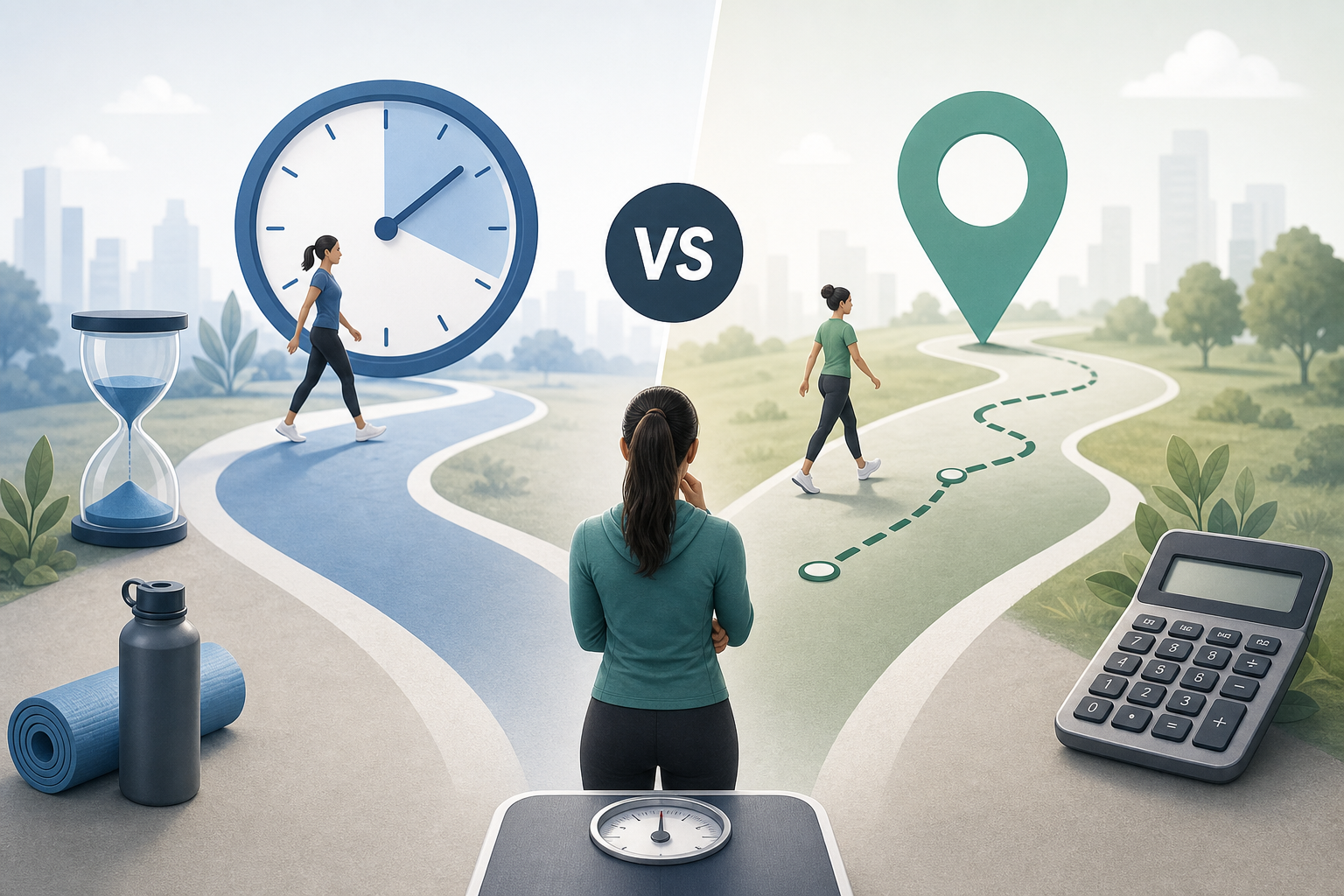
When considering walking time vs walking distance which is better to track, the most useful measure depends on your goal. Time is usually simpler for building a routine and recording walks across different routes, while distance is more helpful for route planning, pace comparisons and distance-based events. Neither measure is universally better, and many walkers benefit from tracking both.
- Walking time vs walking distance which is better to track for everyday use?
- Choose the measure that matches your walking goal
- For establishing a regular walking routine
- For route planning or a distance-based event
- For monitoring movement across the day
- Why the same walking time can produce different distances
- How to combine time, distance and steps
- What a walking distance calculator can and cannot tell you
- A practical example: choosing metrics for different walks
- Frequently asked questions
- Is walking for 30 minutes better than walking a set distance?
- Should I track moving time or total elapsed time?
- How accurate is walking distance from steps?
- Why does my watch show a different distance from a step calculator?
- Can I compare my walking distance with another person’s step count?
- What is the simplest tracking approach?
Time and distance describe different parts of the same activity. A 30-minute walk shows how long you were active, but not how far you travelled. A 3-kilometre walk shows how much ground you covered, but not whether it took 25 minutes or 50 minutes.
Walking time vs walking distance which is better to track for everyday use?
Walking time is often the more practical starting point. It does not require a measured route, reliable GPS signal or conversion from steps. You can set aside a period for walking and record it with a watch, phone or clock.
Walking distance becomes more useful when the amount of ground covered matters. It can help you compare routes, prepare for a distance-based walk or understand what your step count may represent in kilometres or miles.
| Measure | Most useful for | Main limitation |
|---|---|---|
| Time | Routine building, scheduled activity and varied routes | Does not show how far you travelled |
| Distance | Route planning, pace calculations and event preparation | May be estimated rather than measured |
| Steps | Monitoring movement accumulated throughout the day | Step counts do not directly show time, distance or effort |
| Time and distance together | Understanding pace and comparing similar walks | Requires both values to be recorded consistently |
The quality of the measurement also matters. A directly timed walk may be more dependable than an inaccurate GPS distance, while a measured route may be more useful than an incomplete time record that includes long stops.
Choose the measure that matches your walking goal
For establishing a regular walking routine
Track minutes when your main aim is to make space for walking in your day. A time-based plan adapts easily to different locations: you can walk around your neighbourhood, through a park or on a treadmill without needing identical routes.
Time can also accommodate day-to-day changes. Covering less distance in the same period does not mean the walk had no value; hills, crowds, surfaces and planned rest breaks can all affect how far you travel.
For route planning or a distance-based event
Track distance when you need to know whether you can cover a particular route. Distance records can help you compare the length of different walks and organise turnaround points on an out-and-back route.
If you are preparing for an event measured in kilometres or miles, recording distance is directly relevant. Adding time allows you to see your average pace, but pace should be compared carefully when routes and conditions differ.
For monitoring movement across the day
Steps may be easier to collect than either dedicated walking time or route distance because phones and wearable devices can count movement throughout the day. However, a step total may combine purposeful walks with short movements at home, work or elsewhere.
If you want to estimate walking distance from steps, step count must be paired with an assumed step length. This gives an approximation rather than a direct measurement.
Why the same walking time can produce different distances
Distance depends on both walking duration and speed. Two people can walk for the same number of minutes but cover different distances because they move at different paces. The same person may also cover different distances on different days.
Terrain is one reason. An uphill, uneven or crowded route may reduce distance covered during a fixed period. Footwear, weather, turns, crossings and rest stops may also influence the result.
Time alone does not capture these differences, but distance alone does not explain them either. Recording a brief route note—such as “hilly,” “treadmill” or “included stops”—can make comparisons more meaningful.
Walking activities can also vary in intensity according to pace and context. The 2024 Adult Compendium of Physical Activities provides standardised activity classifications for research and estimation, but an individual’s experience of a walk can still differ from a general classification.
How to combine time, distance and steps
You do not need to select one permanent measure. A simple approach is to choose one primary measure for consistency and use the others as supporting information.
- Use time as the main measure if your schedule is the limiting factor. Add distance when it is available.
- Use distance as the main measure if you are following routes or preparing for a distance-based activity. Add time to calculate average pace.
- Use steps as the main measure if you want a broad record of movement across the day. Convert steps to distance only when an estimate is useful.
- Use route notes when hills, surfaces, stops or weather make one walk difficult to compare with another.
Average pace can be calculated from time and distance. For example, if a 4-kilometre walk takes 48 minutes, the average pace is 12 minutes per kilometre. This is an overall value, so it may include slower sections or stops unless those are removed from the recorded time.
Consistency is usually more useful than switching between unrelated measures. If you compare weekly walking records, try to use the same device, distance source and definition of walking time.
What a walking distance calculator can and cannot tell you
A walking distance calculator estimates distance from a step count and a height-based estimate of step length. Its basic method is:
- Estimated step length = height × the factor used by the calculator
- Estimated distance = number of steps × estimated step length
The tool may request options such as unit system and sex because its step-length method uses sex-specific factors. After entering the requested values, the result can help translate steps to distance in kilometres or miles.
The calculator can provide a reasonable planning estimate when you have a step count but no measured route. It can also illustrate why the same number of steps may correspond to different distances for people with different estimated step lengths. For example, 10,000 steps may represent several kilometres or miles rather than one fixed distance.
It cannot measure your individual step length, confirm the accuracy of your step counter or reconstruct your exact route. Actual step length can change with pace, terrain, footwear, fatigue and gait. Running steps and very short indoor movements may also differ from the walking pattern assumed by the estimate.
GPS and mapped routes answer a different question. They attempt to measure where you travelled, while a step-based calculator estimates distance from movement counts. If accurate route distance matters, a measured course or carefully mapped route may be more appropriate than a step conversion.
A practical example: choosing metrics for different walks
Consider someone who walks for 30 minutes on three different days. The first walk is on a level path, the second includes hills, and the third is indoors with frequent turns.
If the goal is to maintain a scheduled walking routine, recording 30 minutes for each session may be sufficient. The time record shows that the planned period was completed even though the distances may differ.
If the person is preparing to complete a 5-kilometre route, distance becomes more important. They might record both time and distance on the level and hilly routes while recognising that pace comparisons are affected by terrain.
For the indoor walk, GPS distance may be inconsistent because of the small area and repeated turns. A step count could be converted to an approximate distance, but the person should label it as an estimate rather than treating it as a measured route.
This example shows why the most useful metric can change with the situation. Time supports scheduling, distance supports route-specific planning, and steps help describe movement when direct distance data are unavailable.
Frequently asked questions
Is walking for 30 minutes better than walking a set distance?
It depends on what you want to monitor. Thirty minutes is straightforward for scheduling and routine tracking. A set distance is more relevant when completing or preparing for a particular route.
Should I track moving time or total elapsed time?
Use the measure that matches your purpose and label it consistently. Moving time excludes detected stops, while elapsed time includes the entire period from start to finish. Elapsed time may be more useful for planning how long a route takes in real conditions.
How accurate is walking distance from steps?
It is an estimate unless your personal step length has been measured and your device has counted every step correctly. Height-based step length provides a practical conversion, but pace, terrain and gait can cause actual distance to differ.
Why does my watch show a different distance from a step calculator?
A watch may use GPS, motion sensors, a stored stride length or a combination of methods. A calculator applies a height-based step-length estimate. Because the two methods use different inputs and assumptions, their results do not have to match.
Can I compare my walking distance with another person’s step count?
Only cautiously. People can take different numbers of steps over the same distance because their step lengths differ. Device placement and step-detection methods may also affect the recorded totals.
What is the simplest tracking approach?
Choose the measure most closely connected to your goal and record it in the same way each time. In deciding walking time vs walking distance which is better to track, use time for schedule-based consistency, distance for route-based progress, and both when pace or travel time is relevant.