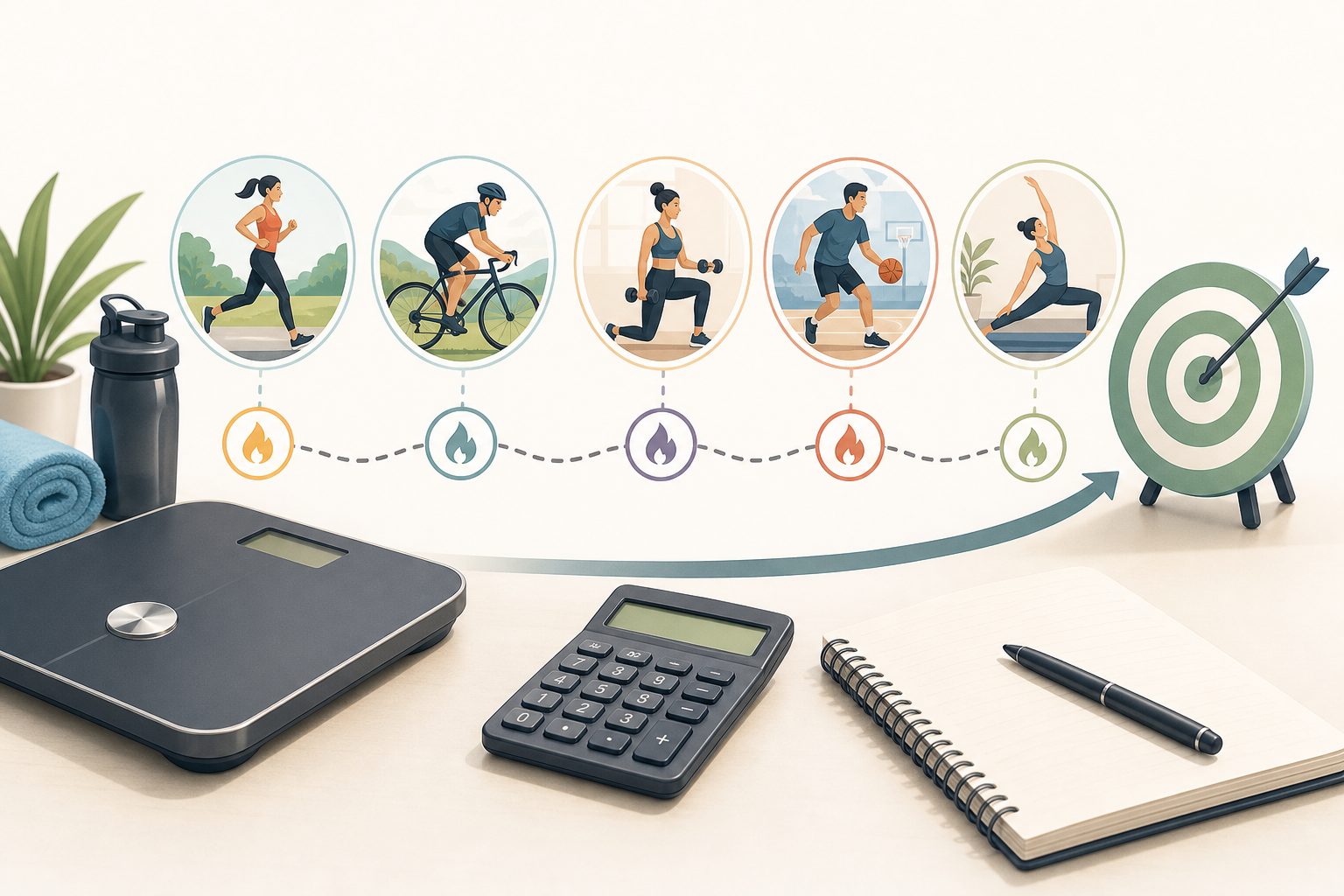
Learning how to estimate calories burned across multiple exercise sessions means calculating each distinct activity separately and then adding the estimates. The key is to include every minute only once. If a fitness tracker reports an entire workout while an exercise calories calculator estimates individual parts of the same workout, adding both results would double-count overlapping time.
How to estimate calories burned across multiple exercise sessions
Start by making a simple timeline of your exercise. Record each session’s activity, duration and estimated intensity. Sessions completed at different times can usually be calculated separately and added together, provided their recorded minutes do not overlap.
Exercise energy expenditure is commonly approximated with metabolic equivalent of task, or MET, values. A MET represents activity intensity relative to rest. Activity-specific MET values are available in resources such as the 2024 Adult Compendium of Physical Activities.
The standard calculation used by the related calculator is:
Estimated kcal = MET × 3.5 × body weight (kg) ÷ 200 × minutes
To combine multiple sessions:
- List each separate activity or non-overlapping exercise segment.
- Choose an appropriate MET value for each activity and intensity.
- Use the same body weight for sessions completed over a short period, unless there is a meaningful change in the planning value.
- Calculate each session separately using its own duration and MET value.
- Add the session estimates to obtain a combined total.
The result is an estimate, not a direct measurement of energy expenditure. Actual energy use can vary because pace, technique, terrain, resistance, fitness and other individual factors may differ from the assumptions represented by a MET value.
Avoid double-counting overlapping exercise time
Double-counting occurs when the same exercise minutes appear in more than one estimate. This commonly happens when combining a whole-workout result with results for activities performed inside that workout.
For example, imagine a 45-minute gym visit consisting of 10 minutes of warming up, 25 minutes of resistance exercise and 10 minutes of cooling down. You could estimate those three segments separately and add them. Alternatively, you could use one MET value intended to represent the full mixed session.
You should not add the full 45-minute estimate to the three segment estimates. Both methods cover the same period.
Common sources of overlap
- A fitness watch records an entire workout while a calculator is used for individual activities within it.
- A walk is counted separately even though it was already included in a general cardio-session estimate.
- Warm-up and cool-down minutes are included in both the main session duration and separate calculations.
- A circuit is recorded once as circuit training and again as its individual strength and cardio exercises.
- Active recovery between intervals is counted as a separate session without being removed from the interval workout’s total duration.
A timeline is the simplest check. If two records cover any of the same clock time, choose one method for those minutes or divide the period into non-overlapping segments.
Practical example with three exercise sessions
Consider a person weighing 75 kg who completes three separate activities in one day. The MET values below are illustrative planning inputs rather than measured personal intensities.
| Session | Duration | MET input | Estimated energy |
|---|---|---|---|
| Morning activity | 20 minutes | 3.5 MET | About 92 kcal |
| Afternoon activity | 30 minutes | 6 MET | About 236 kcal |
| Evening activity | 10 minutes | 2.5 MET | About 33 kcal |
| Combined estimate | 60 minutes | Varies | About 361 kcal |
For the 30-minute session, the calculation is:
6 × 3.5 × 75 ÷ 200 × 30 = about 236 kcal
The same formula is applied to the other two sessions. Because the activities took place at separate times, their estimates can be added: 92 + 236 + 33 = approximately 361 kcal.
Do not average the three MET values without accounting for duration. A long session should contribute more to the combined calculation than a short session. Calculating each segment separately avoids this problem.
What the exercise calories calculator can and cannot tell you
The exercise calories calculator applies an activity-specific MET value to body weight and duration. It can provide a consistent way to compare sessions, estimate separate activities and build a non-overlapping total.
It can help answer questions such as:
- How does the estimate change when session duration increases?
- How do two activities with different MET values compare?
- What is the approximate combined expenditure from several separate sessions?
- How much does each activity contribute to the estimated total?
A MET calculator cannot measure an individual’s actual energy expenditure. It may not capture changes in pace, resistance, hills, weather, movement efficiency or intensity within a session. Selecting an activity label that is broadly similar to the exercise does not guarantee that its listed MET value matches the person’s effort.
The formula also produces an estimate associated with the full activity period. It should not automatically be combined with another device’s “active calories” figure because devices and calculators may use different definitions or may subtract resting energy differently.
How to make a combined estimate more consistent
Use one source and method where practical
Results are easier to interpret when all sessions use the same formula and a consistent set of MET values. Mixing a watch estimate, gym-machine display and MET calculation can introduce differences caused by the methods rather than the activities themselves.
Separate activities when intensity changes meaningfully
If a session includes clearly different activities, calculate each part separately. For example, walking for 15 minutes and cycling for 25 minutes should generally be entered as two segments rather than as 40 minutes under one activity.
Small, brief changes in pace do not necessarily require a separate entry. Excessive splitting can suggest more precision than the inputs support.
Record duration carefully
Decide whether duration means total elapsed time or active exercise time, then use that definition consistently. If a 60-minute gym visit includes 15 minutes of changing, waiting or extended rest that is not represented by the selected activity, entering all 60 minutes may overstate the activity duration.
Keep gross and net estimates separate
The stated MET formula estimates energy during the activity period and includes the energy associated with being alive during those minutes. Some records instead report activity energy above rest, sometimes called a net estimate.
Do not add gross estimates and net estimates as though they use the same definition. Before combining results from different tools, check whether each result represents total energy during exercise or only energy above a resting baseline.
Frequently asked questions
Can I add calories burned from morning and evening workouts?
Yes. If the workouts occurred at separate times, calculate each one using its activity, duration and MET value, then add the estimates. The total remains an approximation rather than a measured value.
Should warm-up and cool-down periods be included?
They can be included, but each minute should appear only once. You may calculate them separately with suitable activity inputs or include them within a whole-session estimate, but not both.
What if one workout contains several exercises?
Divide it into non-overlapping segments when the activities or intensities differ meaningfully. Calculate each segment and add the results. For rapidly changing circuits, a representative whole-session category may be more practical, provided individual components are not also added.
Can I combine calculator results with smartwatch calories?
Use caution. The smartwatch and calculator may cover the same minutes or use different definitions of exercise energy. For a combined daily estimate, use one result for each period rather than adding two estimates for the same workout.
Should I include normal daily movement?
Only if the purpose is to estimate that movement separately and it is not already represented elsewhere. Adding exercise estimates to a daily energy estimate that already includes physical activity can double-count some energy use.
Is one combined entry as accurate as several separate entries?
It depends on the session. One entry may be reasonable when the activity and intensity remain similar. Separate entries are generally more informative when duration or intensity differs substantially between activities, although all MET-based results remain estimates.
Using how to estimate calories burned across multiple exercise sessions in practice
The most reliable bookkeeping approach is to create a chronological activity list, calculate each unique period once and add only non-overlapping results. Use duration-weighted calculations rather than a simple average of MET values, and avoid mixing gross exercise estimates with figures that report only energy above rest.
Understanding how to estimate calories burned across multiple exercise sessions is mainly about consistent inputs and careful time accounting. The final number is useful for comparing activities or planning, but it should be treated as an estimate rather than a laboratory measurement or an exact amount of calories burned during exercise.