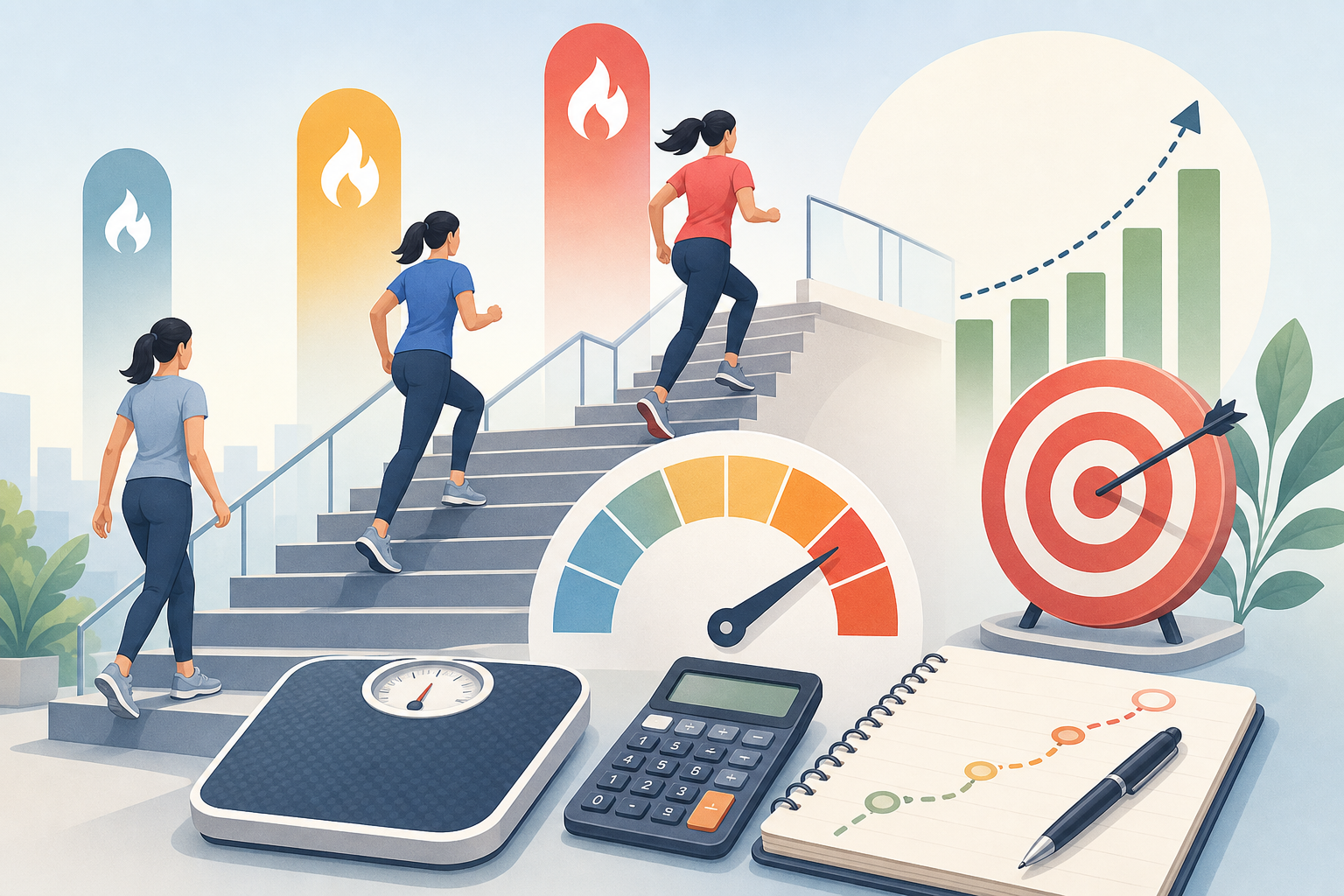
Yes—does stair climbing speed change calories burned has a clear answer: climbing faster generally raises exercise intensity and estimated calories burned per minute. However, total stair calorie burn also depends on how long you keep climbing, your body weight, the height gained and how much support or rest you use. A shorter, faster session can therefore burn fewer total calories than a longer session at a moderate pace.
Does stair climbing speed change calories burned per minute?
Faster stair climbing usually requires more work in less time. Your muscles must repeatedly lift your body against gravity at a higher rate, so the estimated energy cost per minute tends to increase.
Stair-climbing intensity is commonly represented by a metabolic equivalent, or MET, value. Higher-intensity activities receive higher MET values in resources such as the 2024 Adult Compendium of Physical Activities.
A standard MET-based calorie equation is:
Estimated kcal = MET × 3.5 × body weight in kilograms ÷ 200 × minutes
Because MET appears directly in this equation, selecting a higher effort level increases the calorie estimate when body weight and duration stay the same. The relationship between your exact stair speed and actual energy use is not perfectly predictable, however. Step height, technique, fitness, pauses and use of handrails can all affect the result.
Calories per minute and total calories are different
Speed mainly changes the rate of energy expenditure. Duration determines how long that rate continues. Both need to be considered when comparing the calories burned climbing stairs.
- A faster pace will generally produce a higher estimate per minute.
- A longer session provides more minutes over which calories are used.
- A short, hard effort does not automatically exceed a longer, easier session in total calories.
- Frequent pauses can reduce the average intensity of the full session.
For example, suppose a person climbs vigorously for 10 minutes while another climbs at a lower intensity for 25 minutes. The first person may have the higher calorie rate, but the second may still have the higher total because of the additional time.
This is why comparing sessions only by pace can be misleading. For planning purposes, consider both estimated calories per minute and the complete active duration.
A practical speed-and-duration example
Consider an 80 kg person. At an intensity of 8.8 MET, 20 minutes of stair climbing produces the following estimate:
8.8 × 3.5 × 80 ÷ 200 × 20 = about 246 kcal
At that same estimated intensity, 10 minutes would be about 123 kcal. Doubling the active duration from 10 to 20 minutes doubles the estimate because the other inputs remain unchanged.
The following comparison uses a hypothetical 6 MET session to show why duration still matters. It is a mathematical illustration, not a claim that a particular stair speed always equals 6 MET.
| Body weight | Illustrative intensity | Duration | Estimated energy use |
|---|---|---|---|
| 80 kg | 8.8 MET | 10 minutes | About 123 kcal |
| 80 kg | 8.8 MET | 20 minutes | About 246 kcal |
| 80 kg | 6 MET | 30 minutes | About 252 kcal |
In this illustration, the 8.8 MET session has the higher calorie rate, but 30 minutes at the lower hypothetical intensity produces a slightly higher total than 20 minutes at 8.8 MET. It shows why “faster” and “more total calories” do not always mean the same thing.
What the stair climbing calories calculator can tell you
A stair climbing calories calculator estimates energy use from body weight, selected effort and duration. It applies a standard MET equation, making it useful for comparing sessions under consistent assumptions.
For example, it can help you explore how the estimate changes when you:
- keep duration constant but select a different effort level;
- keep effort constant but increase or decrease active minutes;
- compare estimated results at different body weights;
- plan sessions using the same calculation method each time.
The result is an estimate rather than a measured value. The calculator does not directly measure oxygen consumption, vertical distance, heart rate response or individual movement efficiency.
It also may not fully account for step height, stair slope, machine resistance, pauses, handrail use or whether part of the recorded time was spent standing still. Two people entering the same weight, effort and duration can have different actual energy expenditure.
For the most consistent comparison, enter active climbing time and choose the effort description that best reflects the session. If you include long breaks as active minutes, the result may overstate the session’s average expenditure.
Other factors that influence stair calorie burn
Body weight
Stair climbing is weight-bearing, so moving a greater body mass upward generally requires more energy. In the MET formula, a higher body weight produces a higher calorie estimate when intensity and time remain unchanged.
Vertical work and step height
The height gained matters because climbing requires lifting the body against gravity. Taller steps or a greater total vertical rise may require more work than a session with shorter steps, even when the number of steps is similar.
Handrail use
Using a handrail for balance may have little effect, but leaning heavily on it can change how much body weight the legs support. A basic calculator cannot determine how much assistance the rail provided.
Pauses and pace changes
Many stair sessions are not continuous. Waiting at landings, slowing because of congestion or alternating hard and easy intervals changes the average intensity. Selecting one effort level simplifies those variations into a single estimate.
Stairs versus a stair machine
Building stairs and step machines do not always create identical movement demands. Machine speed, step depth, resistance settings and rail use can affect effort, so estimates from apparently similar sessions may differ.
How to compare climbing speeds more meaningfully
Speed can be described in several ways, including steps per minute, flights per minute, vertical metres gained or a general effort category. These measures are related, but they are not interchangeable.
For a practical comparison, record the same type of information across sessions:
- Note your active climbing duration rather than only the total time spent near the stairs.
- Use the same staircase or machine when possible.
- Record the machine setting, floors climbed or another repeatable pace measure.
- Note whether you used the handrails or took extended breaks.
- Use the same calculator effort category for sessions that felt and performed similarly.
These steps will not turn an estimate into a laboratory measurement, but they can make comparisons more consistent. Small differences between calculated results should not be treated as exact changes in actual calorie use.
Overall, the answer to does stair climbing speed change calories burned is yes: a faster pace generally raises calories per minute. Total calories still depend on duration and the conditions of the session, so pace should be interpreted alongside active time, body weight and vertical work.
Frequently asked questions
Does running up stairs always burn more calories than walking up them?
Running generally represents a higher intensity and may raise calories per minute. It does not always produce a higher session total because running may be sustained for less time or involve longer recovery periods.
Will taking two steps at a time increase calories burned?
Taking two steps at a time changes stride mechanics and the amount of vertical movement per step. Whether it meaningfully increases total expenditure depends on pace, duration, step height and how the movement affects fatigue. A basic calculator usually cannot account for this technique separately.
Should rest breaks be included in calculator duration?
Use active climbing time unless the calculator specifically requests total session time. Including long stationary breaks while applying an active stair-climbing MET value may produce an estimate that is too high for the full session.
Why does my wearable show a different result?
Wearables may use heart rate, motion sensors and proprietary equations, while a stair climbing calories calculator usually uses body weight, duration and a selected MET value. Both are estimates, and differences do not necessarily mean that one result is precisely correct.
Does climbing the same number of stairs faster always increase total calories?
Not necessarily. Faster climbing increases intensity, but completing the same vertical work in less time shortens the duration. The calorie rate may rise while the difference in total energy expenditure remains smaller than expected.