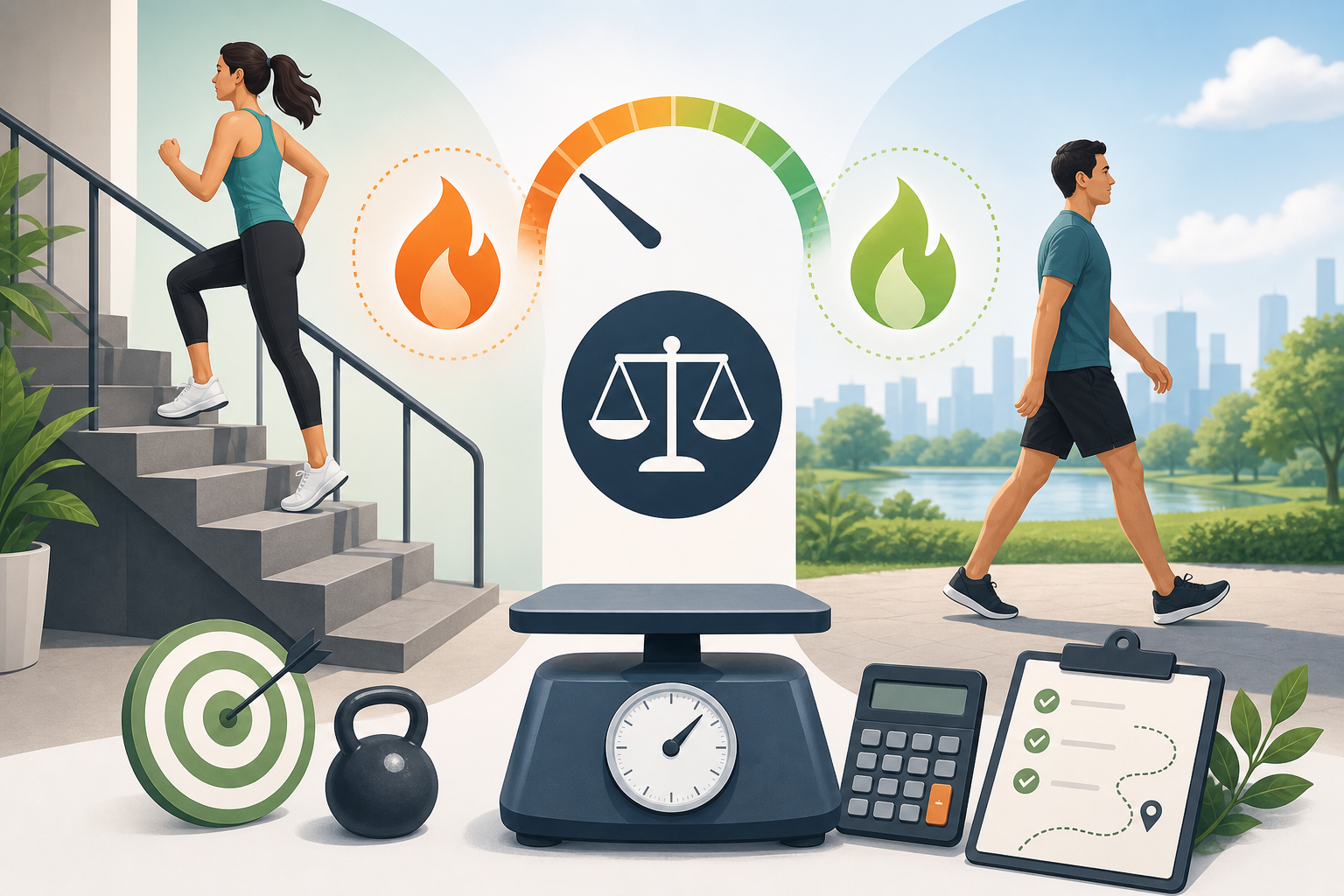
For most comparable sessions, stair climbing uses energy faster than level walking because it involves repeatedly raising the body against gravity. However, the answer to stair climbing vs walking which uses more energy depends on pace, duration, body weight, step height, pauses and terrain. A long, brisk walk may use more total energy than a short or interrupted stair session.
Stair climbing vs walking which uses more energy: the short answer
Minute for minute, continuous stair climbing generally has a higher energy cost than comfortable level walking. Each upward step combines forward movement with vertical work, while level walking involves much less change in elevation.
Total energy use is a separate question. It depends on both intensity and time. Walking may use more energy overall if it is performed for substantially longer, at a brisk pace or on an incline.
Descending stairs also differs from climbing them. Although going down remains a weight-bearing activity, it does not require the same upward work against gravity. A session containing both ascent and descent should not be treated as continuous upward climbing.
Why climbing stairs usually has a higher energy cost
Stair climbing repeatedly lifts body mass from one step to the next. The faster the ascent and the greater the vertical rise, the more work must be completed over a given period.
The 2024 Adult Compendium of Physical Activities assigns metabolic equivalent, or MET, values to activities based on their estimated intensity. Stair climbing can have a higher MET value than many forms of level walking, although the exact comparison depends on how each activity is performed.
Several practical factors can change stair calorie burn:
- Pace: Faster climbing generally raises the rate of energy use.
- Vertical rise: Taller steps or more floors increase the upward work completed.
- Body weight: Moving a greater mass usually requires more energy under otherwise similar conditions.
- Handrail use: Supporting or pulling part of the body with the arms may change the effort required from the legs.
- Pauses: Waiting on landings lowers the average intensity of the complete session.
- Step pattern: Taking one step at a time may differ from skipping steps.
- Equipment settings: Stair machines vary in speed, resistance and how they report activity.
Walking is also highly variable. A slow walk on a smooth surface is not equivalent to brisk walking, hill walking or carrying a load. This is why the activity description used for an estimate matters.
How to compare stairs and walking fairly
A useful comparison should specify whether the goal is to compare energy per minute or total energy for the entire session. These measures can produce different answers.
| Comparison | What it shows | Important limitation |
|---|---|---|
| Same duration | Which activity has the higher estimated energy-use rate | Pace and effort must still be comparable and clearly defined |
| Same distance | Energy used over an equal horizontal distance | Stairs add vertical distance, so this is not a like-for-like workload |
| Same number of steps | Energy used for a similar step count | Step height and walking stride length differ |
| Complete session | Total estimated energy used from start to finish | Rest periods, descent and session length can dominate the result |
For example, comparing 20 minutes of uninterrupted upward stair climbing with 20 minutes of comfortable level walking focuses on the energy-use rate. Comparing 10 minutes on stairs with a 60-minute walk instead answers which complete session uses more energy.
Fitness trackers and exercise machines may use different activity assumptions. Two displayed estimates can therefore differ even when they describe the same person and duration. These figures are planning estimates rather than direct measurements of an individual’s metabolism.
A practical stair-climbing calculation
A common MET-based method estimates activity energy expenditure using this formula:
Estimated kcal = MET × 3.5 × body weight (kg) ÷ 200 × minutes
Consider a person weighing 80 kg who climbs stairs for 20 minutes at an assumed intensity of 8.8 MET:
8.8 × 3.5 × 80 ÷ 200 × 20 = approximately 246 kcal
This does not mean every 80 kg person will use exactly 246 kcal. The result depends on the selected MET value and assumes that the stated intensity continues across the full 20 minutes. Handrail use, pauses, individual movement efficiency and the actual staircase may all affect the result.
A level walk may have a lower estimated rate per minute, but duration can change the outcome. If the walk lasts much longer than the stair session, its total estimated energy expenditure may be greater even though its minute-by-minute rate is lower.
What the stair climbing calories calculator can and cannot tell you
The stair climbing calories calculator estimates energy use from body weight, effort and duration. It applies a MET-based equation rather than directly measuring oxygen consumption or heat production.
What it can estimate
- Approximate calories burned climbing stairs for the entered duration.
- How the estimate changes when body weight, time or selected effort changes.
- The likely difference between two planned stair sessions when the same method is used.
- A consistent planning figure for recording similar workouts.
What it cannot determine precisely
- Your individually measured energy expenditure.
- The exact effect of step height, climbing technique or handrail support.
- How much of the entered time was spent climbing rather than pausing or descending.
- The accuracy of a stair machine’s pace or resistance settings.
- How much body weight will change as a result of the activity.
To use the tool, choose the requested unit system, enter the required body weight and planning details, select the appropriate effort level, and calculate the result. Review the selected inputs before interpreting the estimate.
The calculator is most useful for comparisons made with consistent assumptions. For example, changing only the duration helps show how the estimate scales with time, while changing several inputs at once makes it harder to identify what caused the difference.
Choosing between stair climbing and walking
Energy expenditure is only one practical consideration. Stairs provide a higher-intensity option in a short period, but walking may be easier to continue for longer or fit into transport and daily routines.
Stair climbing also requires repeated step-ups and controlled landings. Walking demands vary with speed and surface, but level walking generally involves less vertical movement. The activity that produces the larger total estimate will depend on how long and how intensely each is performed.
A mixed session can combine the two. Someone might walk between buildings and use stairs for several floors, for example. In that situation, estimate each part separately rather than assigning a stair-climbing intensity to the entire outing.
Consistency in definitions is important when tracking results. Record whether stair time includes descent and rests, and describe walking as level, brisk or inclined where possible. This makes future comparisons more meaningful.
Frequently asked questions
Does climbing one flight of stairs use more energy than walking the same horizontal distance?
It will often have a higher energy cost because climbing includes vertical work. However, flight length, step height, walking pace and the way distance is defined affect the comparison.
Can walking use more total energy than stair climbing?
Yes. A longer or more vigorous walk can use more total energy than a shorter stair session. The higher rate associated with climbing does not automatically produce the higher session total.
Should descent time be included as stair climbing?
Include it in the total session time only if the chosen estimate represents a combination of ascent and descent. Do not classify the entire period as continuous upward climbing if a meaningful part was spent descending or resting.
Why does a stair machine show a different result from a calculator?
The machine may use its own activity model, user inputs and equipment settings. A calculator may instead apply a standard MET equation. Neither display should be treated as an individually measured value unless energy expenditure was assessed with appropriate measurement equipment.
Does holding the handrail affect calories burned?
It can affect the workload, particularly if the rail supports part of the body or is used to pull upward. Most simple calculators cannot quantify this difference accurately.
Are calorie estimates suitable for comparing workouts?
They can support broad comparisons when inputs and assumptions remain consistent. Small differences should not be overinterpreted because MET values and session details are estimates.
Putting the comparison in context
The practical answer to stair climbing vs walking which uses more energy is that upward stair climbing usually has the higher estimated energy cost per minute when compared with level walking under similar conditions. It does not follow that every stair session uses more total energy than every walk.
For a meaningful comparison, consider duration, pace, vertical rise, body weight, pauses and whether stair descent is included. A stair climbing calories calculator can organise these inputs and provide a useful estimate, but it cannot reproduce an individually measured result.